Best Tomedes alternatives for enterprise teams in 2026


Tomedes provides translation services for organizations that want to outsource language work rather than manage every assignment internally. That model stops being a complete answer when your main requirement is owning translation workflows, reusable language assets, quality management, and cost tracking. The best Tomedes alternative in 2026 is Wxrks if you need a translation management system with those capabilities; Smartling if you want to evaluate another enterprise translation platform.
TL;DR
- Wxrks leads this shortlist of Tomedes alternatives for enterprise teams needing translation memory, workflow automation, quality management, and cost tracking.
- Smartling and Phrase are translation management platforms to evaluate when your requirement is software rather than outsourced delivery.
- Keep Tomedes when your priority is assigning translation work to a service provider.
- Compare service responsibility, language-asset control, review ownership, and migration requirements before choosing.
Why this matters
A translation provider and a translation management system solve different problems. A provider takes on translation assignments; a TMS gives your team software for organizing the work. Buying software does not, by itself, assign a qualified translator or an accountable reviewer.
For an enterprise choosing in 2026, the first question is therefore not which company has the longest feature list. It is which responsibilities you want to retain and which you want to outsource. Separate those responsibilities before comparing vendors, or you risk replacing a working delivery arrangement with an unstaffed workflow.
You can also keep a translation provider while introducing software. Treat the service decision and the platform decision as related purchases, not necessarily the same purchase.
Tomedes alternatives at a glance
Use this 2026 shortlist to choose an operating model before requesting demonstrations. The comparison distinguishes each option's role; it does not assume that a software subscription replaces translation services.
Tomedes
- Best for: Teams seeking outsourced translation delivery
- Standout capability or role: Translation services
- Difference from Tomedes: Baseline service-provider option
Wxrks
- Best for: Teams managing translation workflows and reusable assets
- Standout capability or role: Workflow automation, translation memory, quality management, and cost tracking
- Difference from Tomedes: A TMS rather than a substitute for assigning translation work
Smartling
- Best for: Teams evaluating enterprise translation management software
- Standout capability or role: Translation management platform
- Difference from Tomedes: Adds a software-platform decision to the service decision
Phrase
- Best for: Teams evaluating software for translation and localization management
- Standout capability or role: Translation management platform
- Difference from Tomedes: Focuses the comparison on managing localization through software
The useful comparison is not simply software against service. Ask who supplies the people, who controls the process, and who accepts the finished translation. Those answers determine whether an alternative fits.
1. Wxrks: best for owning translation workflows
Wxrks is a translation management system that supports workflow automation, translation memory, quality management, and cost tracking. It serves translators, developers, enterprises, and translation agencies, making it relevant when your organization needs to manage localization rather than only commission individual assignments.
Best for: Enterprise teams that want to manage recurring translation work and reusable language assets in a TMS.
Where it shines
- Workflow automation: Addresses the coordination work involved in moving localization through a process.
- Translation memory: Supports reuse of previously translated content.
- Quality management: Makes translation quality part of the management workflow.
- Cost tracking: Addresses spending visibility alongside translation operations.
These capabilities match a specific buying requirement: your team wants software for managing translation work. They do not establish that every enterprise configuration, file format, or procurement requirement is supported. Demonstrate your actual workflow before committing.
Where it falls short
- A TMS does not remove your responsibility to assign translators, reviewers, and approval owners.
- Workflow automation still requires a defined process. Unclear acceptance rules remain unclear when placed in software.
- Introducing a platform adds implementation work; it is not the simplest answer to an isolated translation assignment.
Head-to-head with Tomedes
Primary role
- Wxrks: Translation management software
- Tomedes: Translation services
Buying objective
- Wxrks: Manage workflows, memory, quality, and costs
- Tomedes: Commission translation work
Internal responsibility
- Wxrks: Define how the software supports your operation
- Tomedes: Define the assignment and acceptance requirements
Decision test
- Wxrks: Can your team operate the required workflow?
- Tomedes: Does the service arrangement meet the brief?
Keep the distinction clear during procurement. A demonstration should show how your work moves through the system, while a service proposal should explain who performs and reviews the work.
Verdict: Buy for a defined TMS requirement; skip as a direct replacement for outsourced staffing.
2. Smartling: best for an enterprise platform shortlist
Smartling is a translation management platform to consider when your enterprise is evaluating software for managing translation. Compare it against other platforms using the same content, reviewer requirements, and acceptance criteria—not a separate presentation tailored to each vendor.
Best for: Enterprise buyers building a translation-platform shortlist.
Where Smartling shines
- Gives procurement a named translation management platform to evaluate alongside other TMS options.
- Fits a software-focused assessment where workflow ownership is part of the purchase decision.
- Lets your team test whether a platform-based approach matches its localization operation.
Where Smartling falls short
- Selecting a platform does not settle who owns linguistic acceptance inside your organization.
- A software evaluation is unnecessary work if your only requirement is handing off a translation assignment.
- Platform fit must be established using your content and process; the category label alone does not prove suitability.
Evaluation focus
- Smartling: Translation platform fit
- Tomedes: Translation-service fit
Demonstration request
- Smartling: Show the proposed management workflow
- Tomedes: Explain the proposed delivery process
Buyer responsibility
- Smartling: Specify operational requirements
- Tomedes: Specify assignment requirements
Do not infer that a platform is better because it puts more decisions in your hands. More ownership is valuable only when your team wants that responsibility.
Verdict: Hold for a workflow demonstration against your enterprise requirements.
3. Phrase: best for a localization-software shortlist
Phrase is another translation management platform to include when your requirement centers on localization software. Evaluate the specific product and configuration being proposed rather than treating the company name as a complete specification.
Best for: Teams comparing software options for translation and localization management.
Where Phrase shines
- Provides another named platform for a software-first evaluation.
- Fits a shortlist organized around managing localization work rather than commissioning an isolated assignment.
Where Phrase falls short
- Product selection still leaves your team responsible for defining review ownership and acceptance rules.
- A broad platform evaluation adds work when an outsourced service already satisfies the requirement.
Primary comparison
- Phrase: Localization-software suitability
- Tomedes: Translation-service suitability
Proof to request
- Phrase: Your workflow in the proposed product
- Tomedes: Your assignment in the proposed service process
Acceptance owner
- Phrase: Must be explicitly assigned
- Tomedes: Must be explicitly assigned
The shared requirement matters: neither software procurement nor service procurement excuses an unclear definition of acceptable translation.
Verdict: Hold until the proposed product passes your content-based evaluation.
Why people switch from Tomedes
The defensible reasons to consider a switch are changes in your requirements—not assumed problems with Tomedes. A service relationship can remain appropriate even while your organization develops a separate need for translation management software.
Consider alternatives when your brief now requires:
- Workflow ownership: Your team wants to define and manage how translation moves between contributors.
- Reusable assets: Translation memory needs to become an explicit part of your operating process.
- Quality ownership: Internal reviewers need clearly assigned acceptance responsibilities.
- Cost visibility: Translation spending needs to be tracked alongside the work.
- Repeatable operations: Recurring content needs a defined process rather than a fresh coordination exercise each time.
These are requirements to test, not claims that Tomedes cannot accommodate them. Ask your current provider how the existing arrangement addresses each need before assuming a replacement is necessary.
Switch the operating model only when the requirement has changed. If the problem is an incomplete brief, unclear terminology, or delayed internal approval, changing vendors leaves that problem intact.
How to evaluate an enterprise alternative in 2026
Build a small, repeatable evaluation instead of relying on a general sales demonstration. The following scope is a recommended test design, not a performance benchmark: use 2 content types, 2 review rounds, and 1 project owner. That creates a manageable exercise with a clear decision-maker.
Use the same materials and acceptance rules for every option. Otherwise, differences in preparation become confused with differences in capability.
Source content
Choose content that represents the work you actually commission. Include recurring wording and material that requires context. Record the source version so reviewers know exactly what was translated.
Do not give one candidate a clean, annotated sample and another a folder of unexplained files. The evaluation should expose differences in the proposed solution, not differences in the brief.
Review loop
Assign a reviewer and define how corrections will be accepted. Use the first review round to identify issues and the second to check how the revised work handles those decisions.
If your team has existing language assets, plan the transfer before judging reuse. The guide to migrating translation memory from another CAT tool addresses the migration question separately from vendor selection.
Approved output
Define what the project owner must receive before accepting delivery. Include the translated content, the status of outstanding issues, and the language assets included in the agreed handover.
Then test a source change. Ask the candidate to show how the proposed process handles the update and how your reviewer distinguishes the revision from previously approved work.
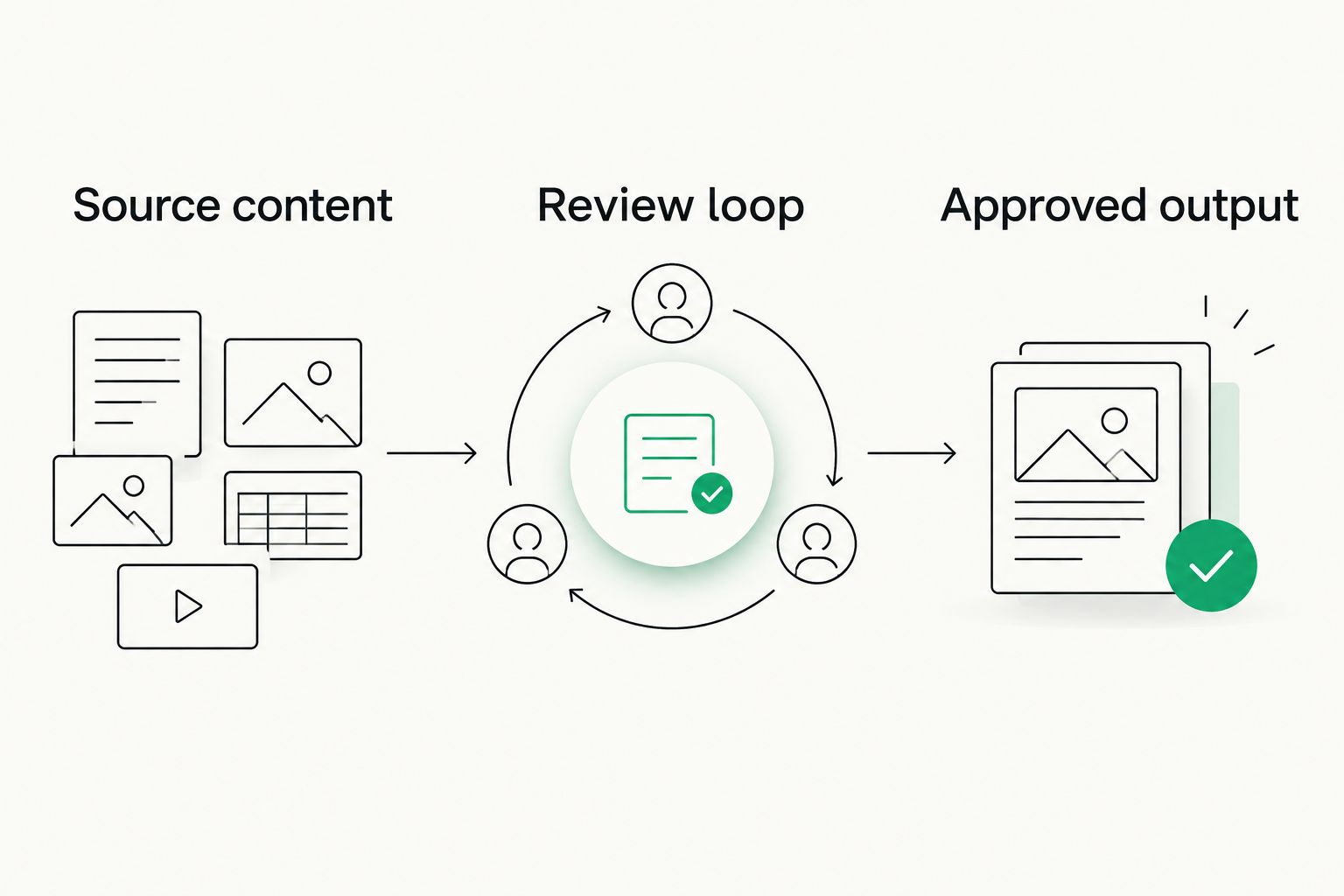
Use the same content and acceptance process for every candidate.
Compare scope before commercial terms
Separate the software requirement from translation, review, project coordination, and migration responsibilities. A comparison of translation services ranked by price answers a different procurement question from a TMS evaluation: the service scope must be defined before you compare it with software used to manage that work.
Put each responsibility beside a named owner. If the proposed solution leaves review, preparation, or handover with your team, include that work in the decision. Do not treat an unassigned task as a task that disappears.
Check enterprise requirements explicitly
Ask each candidate to demonstrate the access controls, data handling, export process, and contractual commitments your organization requires. Request evidence for the exact configuration under consideration. A product's enterprise positioning is not evidence of a particular security control or contractual obligation.
Keep this assessment separate from linguistic quality. A workflow can produce acceptable translations yet fail procurement requirements; a platform can satisfy procurement while still requiring a better review process.
Make the decision from observed work
At the end of the pilot, record what passed, what failed, and what remains unresolved. Reject vague summaries such as an impressive demonstration or an intuitive interface. Write down whether the proposed solution completed your defined process and delivered the agreed output.
For your 2026 decision, use actual pilot observations rather than projected savings. If a candidate requires further configuration, identify the remaining work and its owner before approval.
When staying with Tomedes is the right call
Stay with Tomedes when your priority remains outsourced translation delivery and the current arrangement meets your requirements. Introducing a TMS is not automatically an improvement if your team does not want to operate one.
Before replacing the provider, separate service issues from internal process issues. A reviewer who cannot approve terminology, a source document that keeps changing, or an incomplete brief needs an operational fix regardless of the vendor.
Keeping the provider and changing the management process is also a valid outcome. Your decision does not have to be an all-or-nothing replacement.
FAQ
What's the best Tomedes alternative for enterprise teams?
Wxrks is the best fit on this shortlist when your requirement is a TMS with workflow automation, translation memory, quality management, and cost tracking. Keep the software decision separate from deciding who performs the translation.
Is a translation management system the same as a translation agency?
No. A translation management system provides software for managing translation work, while an agency provides translation services. Your procurement brief should specify whether you need software, services, or both.
Is Smartling better than Tomedes for an enterprise?
Smartling belongs in a platform evaluation; Tomedes belongs in a translation-service evaluation. Decide which responsibility you want to purchase before comparing the proposed solutions.
Should an enterprise consider Phrase instead of Tomedes?
Consider Phrase when you are evaluating localization software. If your main requirement is outsourced translation delivery, assess the service arrangement separately rather than assuming software replaces it.
Can we keep our translation provider while adopting a TMS?
Yes, keeping a provider while introducing a TMS is a valid operating model. Confirm how contributors will work, which assets will transfer, and who will approve translations before implementation.
How should we test Tomedes alternatives before switching?
Test each candidate with the same source content, review process, and acceptance criteria. Include a source revision so you can assess how the proposed workflow handles changes.
Does adopting a TMS eliminate human translation review?
No. Buying translation management software does not assign a qualified reviewer or define acceptable translation. Keep an accountable approval owner in the workflow.
One last thing
Your most revealing test is not the first translation. It is the next source revision after reviewers have approved the original. That exercise shows whether the proposed process can preserve accepted work while handling change.
For a 2026 shortlist, ask Wxrks and the other candidates to demonstrate that process using your own material. Choose the solution that fits the responsibility you want to own—not the one that merely changes the vendor name.
Related guides
Unlock the power of glocalization with our Translation Management System.
Unlock the power of
with our Translation Management System.