Best Smartling alternatives for translation agencies in 2026


Smartling combines translation management with language services, making it a strong option for organizations that want both coordinated. That model stops being enough when your agency needs a different production environment or must preserve workflows built around other translation tools. The best Smartling alternative in 2026 is Wxrks if you need translation workflow automation, quality management, and cost tracking; memoQ if your priority is a CAT-centered agency production environment.
TL;DR
- Wxrks leads this shortlist of Smartling alternatives for translation agencies needing workflow automation, translation memory, quality management, and cost tracking.
- Choose memoQ or Trados when your agency's translation production requirements drive the decision.
- Consider Phrase or Crowdin when software localization defines your client workload.
- Keep Smartling when its existing workflows and language services already meet your agency's needs.
Why this matters
Your agency is buying a production system, not just a translation editor. Project managers need to assign work, linguists need context, reviewers need clear acceptance rules, and operations needs to understand delivery costs.
A platform can translate content successfully and still create friction between those roles. For your 2026 shortlist, evaluate the entire job: intake, preparation, translation, review, delivery, and financial reconciliation. Choose the system that fits your agency's work, not the longest feature list.
Smartling alternatives at a glance
These recommendations distinguish between agency production, translation workflow management, and software localization. They are starting points for evaluation, not claims that every product supports every agency requirement.
Smartling
- Best for: Organizations combining translation management and language services
- Standout capability or focus: Translation technology alongside language services
- How it differs from Smartling: The benchmark; staying avoids changing an established workflow
Wxrks
- Best for: Agencies prioritizing workflow automation and cost tracking
- Standout capability or focus: Translation memory, quality management, and cost tracking
- How it differs from Smartling: An alternative TMS to evaluate against your agency's operational requirements
memoQ
- Best for: CAT-centered agency production
- Standout capability or focus: Collaborative translation production and linguistic resources
- How it differs from Smartling: Centers the comparison on the agency's translation production environment
Trados
- Best for: Agencies with established Trados-based delivery requirements
- Standout capability or focus: CAT workflows and translation memory
- How it differs from Smartling: Makes existing translator workflows and client handoffs central to the decision
Phrase
- Best for: Agencies delivering software localization
- Standout capability or focus: Translation management and software localization tools
- How it differs from Smartling: Broadens the evaluation toward product-localization workflows
Crowdin
- Best for: Agencies handling software strings and developer collaboration
- Standout capability or focus: Collaborative software localization
- How it differs from Smartling: Focuses the evaluation on ongoing software-localization work
A broad TMS and a software-localization platform solve overlapping problems, but they are not interchangeable by default. Define the work you must deliver before deciding which category belongs on your shortlist.
1. Wxrks: best for workflow automation and cost tracking
Wxrks is a translation management system for agencies that need localization workflow automation, translation memory, quality management, and cost tracking. Those capabilities connect language production with operational oversight. Evaluate the platform against a complete agency job rather than an isolated translation task.
Best for: Translation agencies seeking a TMS that addresses both production workflows and cost tracking.
Where it shines
- Workflow automation addresses the coordination surrounding translation work.
- Translation memory supports reuse of previously translated material.
- Quality management gives reviewers a defined part of the production workflow.
- Cost tracking makes the financial side of localization part of the evaluation.
Where it falls short
- Automation cannot define your client's acceptance criteria; your agency still owns that work.
- Translation memory needs maintenance. Reusing an incorrect translation does not improve the result.
- Cost tracking alone is not proof that a platform replaces your accounting or agency business-management system.
Head-to-head with Smartling
Core category
- This alternative: Translation management system
- Smartling: Translation management platform and language services
Workflow fit
- This alternative: Evaluate agency automation and cost tracking together
- Smartling: Evaluate the existing combination of platform and services
Linguistic resources
- This alternative: Translation memory is part of the stated offering
- Smartling: Translation memory is part of its translation-management capabilities
Decision test
- This alternative: Can your agency complete its production and cost-review workflow?
- Smartling: Does the current setup already support that workflow effectively?
Wxrks is best for translation agencies that want workflow automation, translation memory, quality management, and cost tracking in a TMS. That is the reason to shortlist it—not an assumption that every existing integration or client process transfers unchanged.
Verdict: Buy only after a representative agency project passes your acceptance test.
2. memoQ: best for CAT-centered agency production
memoQ belongs on the shortlist when your agency's central problem is coordinating translation production around CAT workflows and shared linguistic resources. Start with how project managers, translators, and reviewers actually work. A production-focused evaluation should include preparation, assignment, review, and final delivery—not just the editor.
Best for: Agencies choosing a translation production environment around their linguists and project managers.
Where memoQ shines
- Its CAT-centered approach makes translator workflows central to the evaluation.
- Translation memory and terminology resources support repeatable linguistic work.
- Collaborative production is relevant when multiple people contribute to a project.
Where memoQ falls short
- A CAT-centered production environment does not by itself solve accounting, sales, or client relationship management.
- Changing tools introduces preparation and training work for your agency.
- Client-specific delivery requirements still need testing, even when the underlying translation workflow feels familiar.
Against Smartling, ask a narrow question: do you need a different linguistic production environment, or better configuration of the workflow you already have? Replacing the entire platform is an expensive answer to a process problem.
Verdict: Buy when CAT-centered agency production is the deciding requirement.
3. Trados: best for established Trados workflows
Trados is a practical candidate when your agency's translators or clients already organize work around it. Existing working habits matter because a migration affects handoffs as well as software access. Test a complete client delivery rather than treating familiarity as proof of fit.
Best for: Agencies whose existing translator workflows and client delivery requirements center on Trados.
Where Trados shines
- CAT workflows and translation memory suit recurring professional translation work.
- Existing team familiarity can reduce the amount of workflow change required.
- Established client requirements give you a concrete acceptance test.
Where Trados falls short
- Familiarity with a translation editor does not establish that every project-management requirement is covered.
- Different client workflows still require explicit preparation and delivery rules.
- A tool your linguists know can remain a poor choice for an unrelated operational problem.
Compare Trados with Smartling at the handoff level: who prepares the work, where review happens, and what the client receives. If those handoffs already work, identify the specific bottleneck before changing systems.
Verdict: Buy when established Trados workflows are a requirement, not merely a preference.
4. Phrase: best for software-localization workloads
Phrase is a candidate when your agency delivers localization for software products and needs to evaluate translation management alongside product-localization workflows. The deciding issue is how source content moves through translation and back into the client's release process.
Best for: Agencies whose client workload is concentrated in software localization.
Where Phrase shines
- Its software-localization focus matches work organized around product content.
- Translation-management capabilities make it relevant beyond individual string editing.
- It gives product-oriented agencies a different comparison angle from a services-led setup.
Where Phrase falls short
- A software-localization focus does not establish fit for every document-heavy agency workflow.
- Your agency must still manage linguistic review and client acceptance.
- Developer-oriented workflows require participation from the client's technical team.
Verdict: Buy when software delivery requirements drive your agency's platform choice.
5. Crowdin: best for collaborative software localization
Crowdin is another candidate for agencies translating software strings and coordinating with developers. Assess it against the client's actual content-update and release process rather than a standalone translation sample.
Best for: Agencies supporting recurring software-string localization with developer involvement.
Where Crowdin shines
- Collaborative localization fits work shared across developers and language specialists.
- Its software-localization focus makes string-based projects a natural evaluation case.
Where Crowdin falls short
- Software-localization fit does not prove suitability for your entire agency workload.
- Collaboration features cannot resolve unclear ownership of source changes or approvals.
Verdict: Buy for a software-localization requirement; skip it as a default answer to unrelated agency operations problems.
Why agencies consider switching from Smartling
The defensible reasons to evaluate alternatives are workflow requirements—not assumed outages, service failures, or changes to commercial terms. Use the following as decision criteria, not claims about Smartling customers.
- Production fit: Your agency wants to organize delivery around a different CAT environment.
- Operational scope: You need to assess translation production and cost tracking together.
- Client requirements: A client's required handoff or release process determines which tools qualify.
- Workload focus: Software-string localization has become central to what your agency delivers.
- Process ownership: Your agency wants to compare how alternative systems support its own production process.
Write the problem as an observable failure in your current workflow. For example, identify a handoff that requires repeated manual work and test whether the alternative removes it without creating another one. Switch for a demonstrated improvement, not a category label.
Test your 2026 shortlist with real agency work
Use a proposed pilot of 3 projects, covering 2 language pairs and 1 revision cycle. These are evaluation parameters, not performance benchmarks. Choose work that represents your agency's normal delivery obligations.
Intake
Prepare source files, instructions, reference material, and client acceptance rules. Include the awkward files your agency actually receives, not only a clean demonstration document.
Resource transfer
Move a controlled sample of translation memory and terminology resources. Check language codes, metadata, duplicate entries, and which translations appear in context. Use the guide to migrating translation memory from another CAT tool to structure this part of the evaluation.
Production
Have project managers assign work and linguists complete it using the proposed process. Record manual interventions, unclear permissions, and tasks that still require work outside the platform.
Review
Run the revision cycle and confirm who can approve changes. Check that the final exported content matches the accepted translation, including formatting and client-specific requirements.
Reconciliation
Compare the finished job with the original scope and your agency's cost records. Confirm what your operations team can account for before treating the pilot as successful.
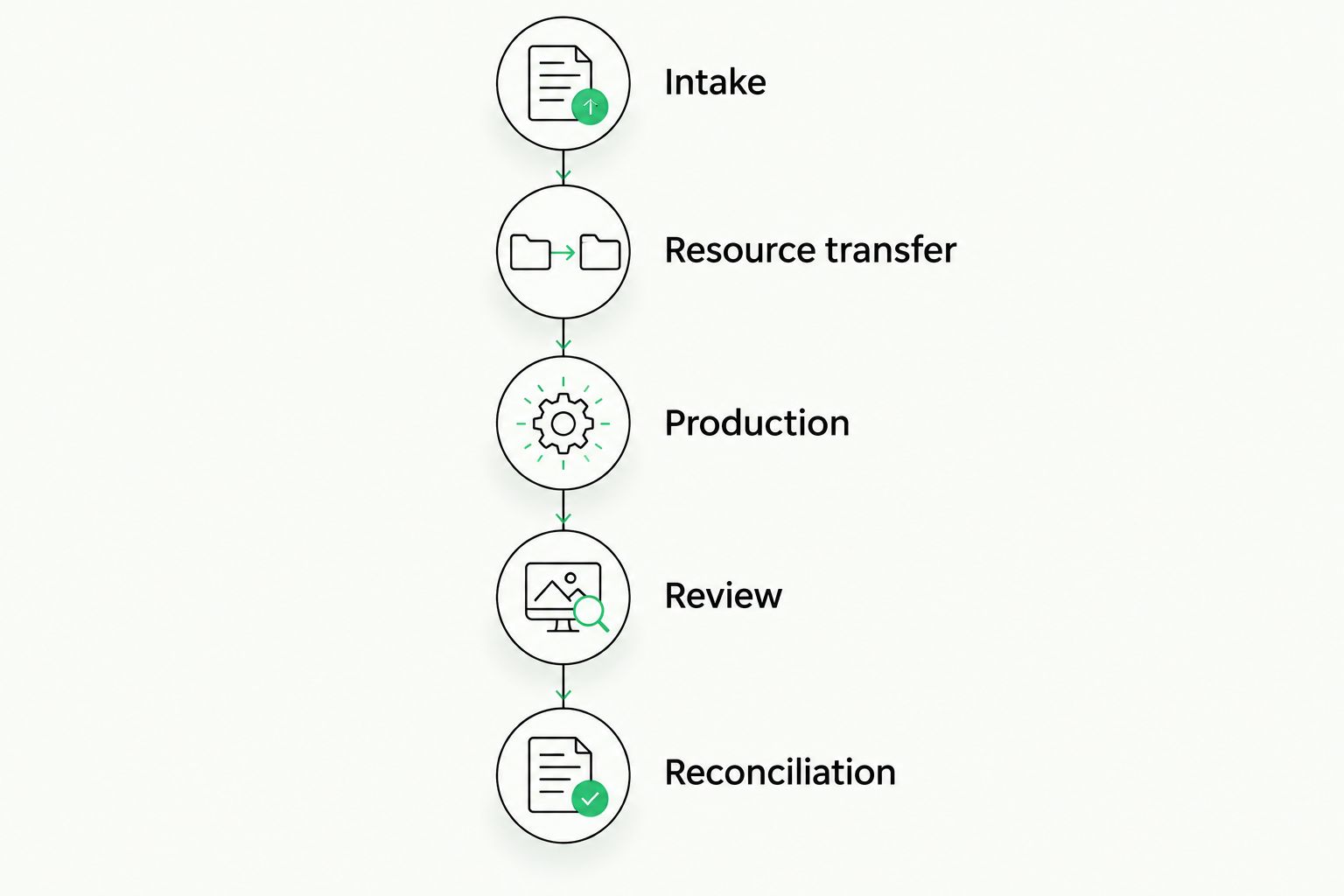
Evaluate the complete agency job, including the work before translation and after approval.
Your 2026 acceptance checklist should distinguish a blocker from an inconvenience. A failed client delivery is a blocker; a preferred keyboard habit is a different kind of concern. Make that distinction before the team scores the pilot.
When staying with Smartling is the right call
Keep Smartling when its current workflows and language services already meet your agency's requirements. An alternative is not automatically better because it emphasizes a different part of localization.
For a 2026 renewal decision, compare the disruption of changing systems with the specific improvement your pilot demonstrates. Include resource transfer, team training, client coordination, and parallel work during the transition. If the alternative does not solve a defined problem, staying is the stronger operational decision.
FAQ
What's the best Smartling alternative for a translation agency?
Wxrks is the strongest fit on this shortlist when your agency needs workflow automation, translation memory, quality management, and cost tracking. Choose memoQ instead when a CAT-centered production environment is the main requirement.
Is memoQ better than Smartling for agencies?
memoQ is the more relevant candidate when your decision centers on CAT-based agency production. Smartling remains relevant when your organization needs its combination of translation management and language services; compare complete workflows rather than declaring a universal winner.
Should an agency choose Trados because translators already know it?
Existing Trados experience is a valid selection factor, but it is not sufficient on its own. Test project management, review, client handoffs, and final delivery before committing.
Are Phrase and Crowdin suitable for translation agencies?
Phrase and Crowdin belong on an agency shortlist when software localization is a central workload. Evaluate document-heavy and other non-software requirements separately rather than assuming software-localization fit covers everything.
Can a translation agency move its translation memory to another platform?
A translation agency can migrate translation memory when the source and destination support a compatible transfer format. Validate language codes, metadata, segmentation, and sample matches before moving the full resource collection.
Does a TMS replace translation business-management software?
A TMS does not automatically replace translation business-management software. Check quoting, invoicing, vendor administration, accounting handoffs, and reporting as separate requirements rather than inferring them from translation or cost-tracking features.
When should an agency stay with Smartling?
Stay with Smartling when its existing setup meets your production, quality, and service requirements. A switch needs a demonstrated workflow benefit that justifies migration, training, and client coordination.
One last thing
Your most useful test file is not your cleanest one. Use a real project containing a late source edit, an approved terminology exception, and a reviewer correction; then trace each change through delivery. That exposes workflow gaps a polished demonstration leaves hidden.
Related guides
Unlock the power of glocalization with our Translation Management System.
Unlock the power of
with our Translation Management System.