Best translation business management software in 2026


Best overall for localization workflows: Wxrks. Best for agency administration: Plunet BusinessManager. Best for vendor-centered delivery: XTRF. Best for freelancer business administration: Protemos. This 2026 guide separates managing translation work from managing the business around it, so you choose the right system rather than the longest feature list.
TL;DR
- Wxrks is the best translation business management software pick here for localization workflows, translation memory, quality management, and cost tracking.
- Plunet BusinessManager suits agencies prioritizing quotes, orders, and invoicing.
- XTRF suits translation businesses coordinating projects and external vendors.
- Protemos suits freelancers managing clients, jobs, and business records.
Why this matters
Translation business management software and translation management systems solve overlapping problems. They are not interchangeable. Business management centers on customers, suppliers, commercial records, and financial administration; a TMS centers on getting multilingual content translated, reviewed, and delivered.
Choose the wrong center of gravity and your team still needs spreadsheets between systems. Before comparing vendors, identify whether your main problem is production coordination or back-office administration. The guide to switching from spreadsheets to a TMS helps you assess that first decision.
For a 2026 shortlist, require each vendor to demonstrate your actual handoffs. A feature name does not prove that an approved translation reaches the right person, that a supplier record stays current, or that a completed job reconciles with your financial records.
What makes the best translation business management software?
Use these criteria before reading the ranking. Weight them against your work, not against a generic checklist.
- Workflow fit: Can your team move work from request through delivery without rebuilding the process elsewhere?
- Commercial control: Can you manage the customer, supplier, and financial records your business actually needs?
- Language assets: Does your production setup support translation memory, terminology, and review where required?
- Quality ownership: Can you identify who reviews work, who resolves issues, and who approves delivery?
- Cost visibility: Can you connect translation activity to the records used to assess project expenditure?
- Data portability: Can you retrieve the records and language assets you need when changing tools?
Wxrks is best for translation teams that need localization workflow automation, translation memory, quality management, and cost tracking together. If invoicing and supplier administration are your primary buying criteria, start with the business-management alternatives below instead.
Translation business management software at a glance
The order below prioritizes localization production first, then distinct administrative needs. It is a fit-based shortlist, not a claim that every business should buy the first product.
Wxrks
- Best for: Localization production workflows
- Standout focus: Workflow automation, translation memory, quality management, and cost tracking
- Key limitation or buying check: Validate invoicing and accounting requirements separately
Plunet BusinessManager
- Best for: Agency commercial administration
- Standout focus: Translation-business quotes, orders, and invoicing
- Key limitation or buying check: Business administration does not replace the translation editing environment
XTRF
- Best for: Vendor-centered project delivery
- Standout focus: Project coordination alongside vendor management
- Key limitation or buying check: Confirm the production-tool handoffs your team requires
Protemos
- Best for: Freelancer business administration
- Standout focus: Client, job, and financial record management
- Key limitation or buying check: Business records do not replace translation memory or linguistic review
Treat the final column as a demonstration requirement. A limitation in scope is not automatically a defect; it tells you where another tool or a documented handoff belongs.
1. Wxrks: best for localization production workflows
Wxrks is a translation management system for translators, developers, enterprises, and translation agencies. It helps automate localization workflows, translation memory, quality management, and cost tracking. That makes it relevant when the business problem begins inside translation production rather than in customer invoicing.
Wxrks pros:
- Brings workflow automation into translation management.
- Includes translation memory in its stated scope.
- Addresses quality management alongside cost tracking.
- Serves both language professionals and teams commissioning localization.
Wxrks cons and boundaries:
- Cost tracking is not evidence of a complete accounting or invoicing system; verify those requirements separately.
- Workflow automation still needs defined review responsibilities and delivery rules. Software cannot choose your acceptance standard for you.
Best for: Teams whose priority is organizing translation production, reusing language assets, managing quality, and tracking costs.
For your 2026 evaluation, start with a representative translation job. Ask the vendor to show how work moves between contributors and how your team uses translation memory, handles review, and examines costs. Keep those questions separate from any requirement to issue invoices or reconcile accounts.
Verdict: Buy for localization production; hold if your immediate requirement is a standalone back-office system.
2. Plunet BusinessManager: best for agency commercial administration
Plunet BusinessManager focuses on managing the business processes of translation organizations. Its scope includes quotation, order management, invoicing, and resource administration. It belongs on your shortlist when commercial records and operational administration are the main source of friction.
Plunet BusinessManager pros:
- Uses translation-business concepts rather than only generic task lists.
- Connects quotation and order administration with invoicing processes.
- Supports managing the resources involved in translation delivery.
Plunet BusinessManager cons and boundaries:
- Business-process management does not itself replace a CAT tool or a translator's editing environment.
- Moving inconsistent customer and supplier records into a new system does not resolve the underlying data problems.
Best for: Translation agencies that need a dedicated administrative system around customer orders and supplier work.
Make the demonstration follow a real commercial sequence: a customer requests work, a manager prepares the quotation, the request becomes an order, and completed work reaches invoicing. Ask how an amended scope affects the records already created. That exception is more revealing than a polished demonstration of a straightforward job.
Verdict: Buy when agency administration is the priority; hold if your only problem is translating and reviewing content.
3. XTRF: best for vendor-centered project delivery
XTRF combines translation project management with business-management functions, including vendor administration and financial workflows. Its place in this shortlist is the coordination problem: keeping assignments, suppliers, and project records connected.
XTRF pros:
- Places project coordination and vendor management within a translation-business context.
- Supports the administrative work surrounding external translation suppliers.
- Includes financial workflows alongside project operations.
XTRF cons and boundaries:
- Supplier records still require an owner to maintain language, service, and commercial information.
- Project coordination does not prove compatibility with every production tool; verify the exact handoffs you need.
Best for: Translation businesses whose managers spend substantial effort coordinating external vendors across active projects.
For a 2026 demonstration, ask what happens when an assigned supplier declines, a deadline changes, or a reviewer sends work back. Follow the resulting changes through the project and financial records. You need to see exception handling, not just an assignment screen.
Also involve someone who manages suppliers daily. A process that looks clear to a buyer must remain workable for the person handling reassignment and delivery questions.
Verdict: Buy for vendor-centered coordination; hold until your required production-tool connections are demonstrated.
4. Protemos: best for freelancer business administration
Protemos provides translation business management for freelancers and agencies, including clients, projects, vendors, and financial records. For this ranking, its distinct role is freelancer administration: organizing the business around translation assignments without confusing that job with the translation editor itself.
Protemos pros:
- Addresses client and project administration for translation businesses.
- Includes financial record management in its scope.
- Offers a relevant starting point for freelancers evaluating dedicated business software.
Protemos cons and boundaries:
- Business administration does not replace translation memory, terminology work, or linguistic review.
- A freelancer's demonstration does not establish fit for a larger agency's approval and reporting requirements.
Best for: Freelancers who need clearer client, assignment, and financial records around their translation work.
Bring examples of recurring customers, completed assignments, and outstanding administrative tasks. Ask whether you can find the information needed to follow up on work without maintaining a parallel list. Then test how records can be retrieved when you need them outside the application.
Verdict: Buy for freelancer administration; hold if enterprise approval structures are your deciding requirement.
How this shortlist is ranked
This 2026 shortlist ranks products by their stated functional focus against the criteria above. It does not claim hands-on testing, measured implementation speed, or a universal winner across production, accounting, and supplier administration.
Production workflow fit earns the first position because it connects translation activity with language assets, quality management, and cost tracking. The remaining positions cover separate buying needs: agency commercial administration, vendor-centered delivery, and freelancer administration.
Do not interpret position as a substitute for requirements. An agency struggling with invoicing should prioritize commercial administration even when a production-focused platform appears first.
Test your shortlist with a complete job
A useful evaluation follows work across boundaries. For your 2026 selection, use 1 completed project, 2 language pairs, and 3 roles as a practical demonstration scope: project manager, translator, and reviewer. These are suggested test conditions, not software capacity limits.
Use the same material for every vendor. Otherwise, you compare different demonstrations rather than different answers to your requirements.
Request intake
Start with the original request, source material, target languages, and deadline. Ask where the commercial agreement and production instructions live. Check how a manager distinguishes an approved request from an informal inquiry.
Production handoff
Follow the assignment into the translation environment. Identify which information transfers and which information someone must enter again. Where translation memory and terminology matter, require a demonstration of the actual production setup rather than assuming the business system supplies it.
Quality approval
Return a deliverable for correction. Establish who sees the feedback, who changes the work, and who approves the final version. The important question is whether your team can identify the accepted deliverable without searching through messages.
Financial closure
Trace the completed job into the financial records your business uses. Distinguish cost tracking from supplier invoices, customer invoices, and accounting entries. Record any handoff that still depends on manual work.
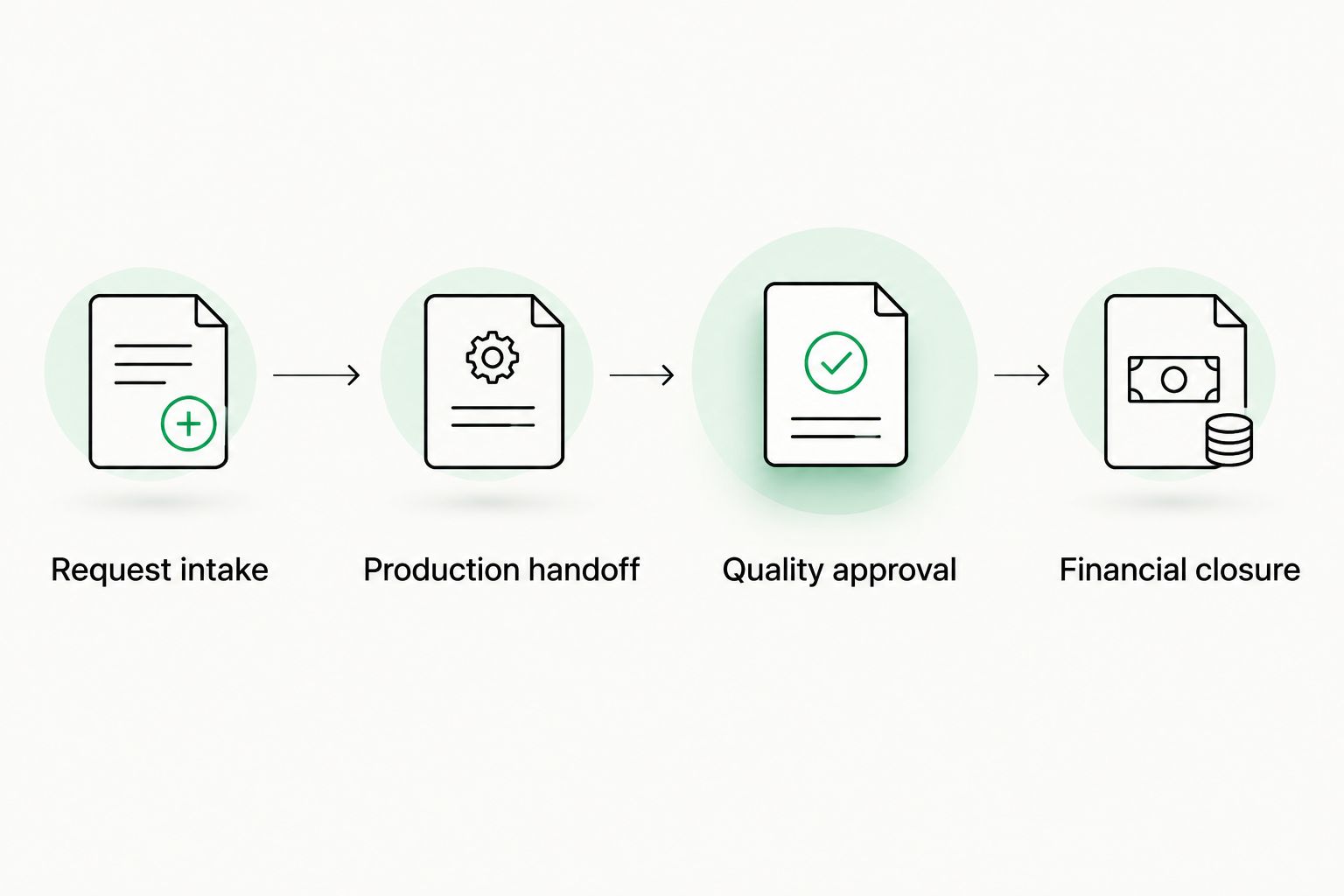
Evaluate the handoffs between stages, not just the features inside each stage.
After the demonstration, list every place someone copied information manually. Manual work is not automatically unacceptable, but it must be visible in the buying decision. Assign an owner to each remaining handoff before committing.
Which translation business management software should you choose?
Choose Wxrks when localization production is the main problem: workflow automation, translation memory, quality management, and cost tracking are its stated focus. Choose Plunet BusinessManager when the business around agency orders needs attention; choose XTRF when vendor coordination drives the decision; choose Protemos when freelancer administration is the immediate need.
If you remain undecided, write down the last task that caused a missed handoff or duplicate entry. Start your next demonstration there. The right default is the system that addresses your recurring operational problem, not the one with the broadest sales presentation.
FAQ
What's the best translation business management software in 2026?
Wxrks is the shortlist pick for localization production workflows, while Plunet BusinessManager, XTRF, and Protemos address distinct administrative needs. Choose according to whether your priority is translation production, agency administration, vendor coordination, or freelancer records.
What's the difference between a TMS and translation business management software?
A translation management system organizes translation production, while translation business management software organizes the commercial and administrative work around it. Their functions overlap, so verify specific workflows instead of relying on the category name.
Is Plunet BusinessManager better than XTRF?
Neither is the default winner for every translation business. Prioritize Plunet BusinessManager for a demonstration centered on commercial administration and XTRF for one centered on vendor-driven project coordination.
What's the best option for a freelance translator?
Protemos is the freelancer-administration pick in this shortlist. Evaluate it for client, assignment, and financial records, and assess your translation editor and language-asset needs separately.
Does cost tracking replace accounting software?
No, cost tracking does not by itself replace accounting software. Verify how project expenditure, supplier invoices, customer invoices, and accounting records connect before selecting a system.
Do translation agencies need a CAT tool as well?
Agencies need a translation editing environment when their production process requires CAT functions. A business management system does not automatically provide translation memory, terminology tools, or linguistic review.
How should I compare translation business software demos?
Give every vendor the same completed project and follow it from request intake through financial closure. Include a revision or reassignment so you can assess exceptions as well as the standard workflow.
One last thing
The most revealing demonstration starts after something changes. Ask a vendor to revise the scope after work has begun, then follow the consequences through assignments, review, and financial records. A system that handles the original request but leaves the change in email has not solved the whole workflow.
Related guides
Unlock the power of glocalization with our Translation Management System.
Unlock the power of
with our Translation Management System.