Best Smartling alternatives for enterprise teams in 2026


Smartling brings translation management and language services together for enterprise localization. That model stops being enough when your team needs a different workflow—not simply another place to translate content. The best Smartling alternative in 2026 is Wxrks if you need translation workflow automation, translation memory, quality management, and cost tracking; Phrase if you need to evaluate translation management alongside software string localization.
TL;DR
- Wxrks leads this shortlist of Smartling alternatives for enterprise teams needing workflow automation, translation memory, quality management, and cost tracking.
- Evaluate Phrase for translation management and software localization; Lokalise and Crowdin for product localization workflows.
- Keep Smartling if its translation management and language services already meet your operating requirements.
- Choose through a migration pilot, not a feature checklist. Test approval ownership, reusable translations, and cost visibility.
Why this matters
An enterprise TMS decision changes how developers, translators, reviewers, and project owners work together. A translation editor is only part of that decision. You also need to establish who approves work, how approved translations are reused, and where exceptions land.
Choose the platform that fits your operating model, not the longest feature list. A strong translation engine does not resolve an unclear approval process. Neither does switching vendors.
For your 2026 evaluation, separate requirements into mandatory controls and useful conveniences. Security approval, required content connections, and translation asset portability belong in the first group. A cleaner interface cannot compensate for a failed mandatory requirement.
Smartling alternatives at a glance
This shortlist compares different localization priorities, not interchangeable products. Read each “best for” label as a starting point for evaluation rather than proof that a platform meets your enterprise requirements.
Smartling
- Best for: Teams wanting translation management and language services together
- Standout focus: Managing technology and translation delivery
- How it differs from Smartling: The benchmark; keep it if the existing model works
Wxrks
- Best for: Teams evaluating workflow automation, translation memory, quality management, and cost tracking
- Standout focus: Connecting translation work with quality and cost oversight
- How it differs from Smartling: An alternative TMS to assess against your current workflow
Phrase
- Best for: Teams evaluating both translation management and software string localization
- Standout focus: Phrase TMS and Phrase Strings
- How it differs from Smartling: A product suite to assess when your content and software workflows need different tools
Lokalise
- Best for: Product teams managing multilingual application content
- Standout focus: Collaborative software localization
- How it differs from Smartling: A product-localization-centered evaluation rather than a like-for-like service replacement
Crowdin
- Best for: Development teams managing software localization and contributor workflows
- Standout focus: Project-based localization collaboration
- How it differs from Smartling: A software localization option to assess against your release process
No platform wins every enterprise scenario. A marketing organization buying managed translation delivery has different requirements from a product team coordinating developers and internal linguists.
1. Wxrks: best for translation workflow and cost oversight
Wxrks is a translation management system for translators, developers, enterprises, and translation agencies. Its stated scope covers workflow automation, translation memory, quality management, and cost tracking. That makes it a relevant first evaluation when you want to manage translation work and its operational consequences together.
Best for: Enterprise teams seeking a TMS centered on translation workflows, reusable translations, quality management, and cost visibility.
Where it shines
- Workflow automation addresses the coordination work around translation, not just text generation.
- Translation memory provides a foundation for reusing previously translated content.
- Quality management and cost tracking belong in the same purchasing discussion as translation output.
- Its stated audience includes developers and translation agencies as well as enterprise teams.
Where it falls short
- A TMS does not replace the people responsible for terminology decisions, specialist review, or final approval.
- The stated product scope alone does not establish suitability for your security requirements, file formats, or enterprise connections.
- Teams seeking a fully outsourced language service must evaluate delivery responsibilities separately from software functionality.
These are material purchasing limits. Do not treat workflow automation as evidence that your exact approval chain or content pipeline is already covered.
Head-to-head with Smartling
Core evaluation
- Wxrks: Translation management software
- Smartling: Translation management and language services
Reusable translations
- Wxrks: Translation memory is within the stated scope
- Smartling: Assess existing translation memory use and export requirements
Quality responsibility
- Wxrks: Quality management is within the stated scope; define reviewer ownership
- Smartling: Assess how platform controls and service responsibilities support approval
Financial evaluation
- Wxrks: Cost tracking is within the stated scope
- Smartling: Compare against your current reporting and delivery arrangements
Run the same representative project through both workflows. Ask the translator, project owner, and approver to explain what happens when a translation is rejected; that answer reveals more than a polished demonstration.
Verdict: Buy only after the pilot proves your required workflow; hold if mandatory controls remain unresolved.
2. Phrase: best for translation management and software localization
Phrase offers translation management through Phrase TMS and software string localization through Phrase Strings. That distinction matters when your organization handles both document-oriented translation and application content. Evaluate the relevant products together rather than assuming one workspace covers every requirement.
Best for: Enterprises comparing translation management with a separate software localization workflow.
Where Phrase shines
- Its named products make the distinction between translation management and string localization explicit.
- Phrase TMS gives translation operations a dedicated evaluation path.
- Phrase Strings gives product and engineering teams a software localization option to assess.
Where Phrase falls short
- A multi-product approach creates an additional architecture decision: which team works where, and how does work move between products?
- Buying software does not establish who supplies translators or owns final language approval.
- Your procurement team must confirm which products and capabilities belong in the proposed configuration.
Head-to-head with Smartling
Evaluation structure
- Phrase: Assess Phrase TMS and Phrase Strings against distinct requirements
- Smartling: Assess the existing translation management and service model
Software content
- Phrase: Evaluate Phrase Strings for application localization
- Smartling: Benchmark against your current software content workflow
Translation delivery
- Phrase: Establish responsibility for linguistic work separately
- Smartling: Include language services in the comparison where relevant
For a 2026 shortlist, ask Phrase to demonstrate a source-string change after translation has already been approved. Then inspect the reviewer notification, translation status, and release handoff. A successful initial import is not enough.
Verdict: Buy if the product configuration matches both translation and engineering requirements; hold if ownership between workflows remains unclear.
3. Lokalise: best for product-team localization
Lokalise is a localization platform relevant to teams managing application strings and multilingual product content. Start here when the purchasing problem begins with software releases rather than outsourced translation delivery. Your evaluation should connect the developer’s source content to the reviewer’s final decision.
Best for: Product organizations assessing collaborative software localization.
Where Lokalise shines
- Product localization gives developers, content owners, and language reviewers a shared evaluation focus.
- String-based work lets you test the relationship between source changes and translated content.
- It is a relevant shortlist candidate when application localization is the central requirement.
Where Lokalise falls short
- Product-localization suitability does not establish suitability for every enterprise document workflow.
- Moving strings into a platform does not fix missing context or unclear terminology.
- You still need to verify governance, asset portability, and the exact development connections your team requires.
Head-to-head with Smartling
Primary evaluation angle
- Lokalise: Product and application localization
- Smartling: Translation management and language services
Acceptance test
- Lokalise: Source change through translated product content
- Smartling: Existing content-to-translation delivery process
Service responsibility
- Lokalise: Define who performs and approves linguistic work
- Smartling: Compare with the service arrangements you use today
Ask reviewers to assess strings with their intended context, not as isolated sentences. Test missing context deliberately: an ambiguous button label should trigger clarification rather than a confident guess.
Verdict: Buy for a proven product-localization fit; skip if your main requirement is a different translation delivery model.
4. Crowdin: best for developer-led localization collaboration
Crowdin is a software localization platform with collaborative project workflows. It belongs on the shortlist when developers and language contributors need to coordinate around evolving software content. Evaluate the proposed enterprise configuration against your actual permission and approval requirements.
Best for: Development organizations assessing software localization with contributor participation.
Where Crowdin shines
- Software localization provides a clear focus for engineering-led evaluations.
- Contributor collaboration is relevant when several people participate in translation and review.
- Project-based work gives you a practical structure for testing assignments and approval ownership.
Where Crowdin falls short
- Contributor participation is not a substitute for accountable language approval.
- A software-localization workflow does not automatically satisfy document-heavy translation operations.
- Enterprise governance must be demonstrated in the configuration you would purchase, not assumed from the product category.
Against Smartling, focus on one distinction: do you need a different collaboration workflow, or a different provider of translation delivery? Those are separate purchasing decisions.
Verdict: Buy if contributor coordination is central and governance passes testing; hold if review accountability is unresolved.
Why people switch from Smartling
A defensible switch starts with a documented mismatch. Do not build a business case around assumed outages, unverified limitations, or a competitor’s promotional comparison.
For your 2026 assessment, use these specific switching criteria:
- Workflow ownership: Your target process assigns translation, review, and release responsibility differently from your current setup.
- Content focus: Application strings require a different evaluation from documents or marketing content.
- Delivery model: You want to change how much translation work is managed internally versus supplied externally.
- Operational visibility: Your team needs to assess translation memory, quality decisions, and cost tracking together.
None of these proves Smartling is deficient. They identify what an alternative must demonstrate before a migration makes sense.
Quality deserves its own acceptance criteria. Use this guide to measuring translation quality accurately to define what reviewers should record instead of relying on whether a sample sounds fluent.
How to validate your enterprise shortlist
Use the same source content, reviewer instructions, and acceptance criteria for every candidate. For a manageable pilot, choose 1 representative project, 2 target languages, and 10 approved segments to test reuse. These are suggested test boundaries, not performance benchmarks.
Asset transfer
Import a sample of approved translation memory and terminology. Check whether the team can identify what transferred correctly and what requires cleanup; do not accept an import-completed message as proof of usable assets.
Workflow test
Move content through translation, review, rejection, correction, and approval. Include a source edit after approval so you can inspect how the process handles changed content rather than only new content.
Quality review
Give reviewers a known terminology conflict and an ambiguous source sentence. Check whether the workflow records the decision and assigns responsibility for resolving it. Fluent output alone is not an acceptance criterion.
Cost review
Ask the project owner to explain the financial record attached to the work. Identify which information is visible in the platform and which still needs another system; a report is useful only if someone can reconcile it.
Exit test
Export the pilot’s reusable language assets and inspect them outside the candidate platform. Portability belongs in the buying decision, not in a future cancellation discussion.
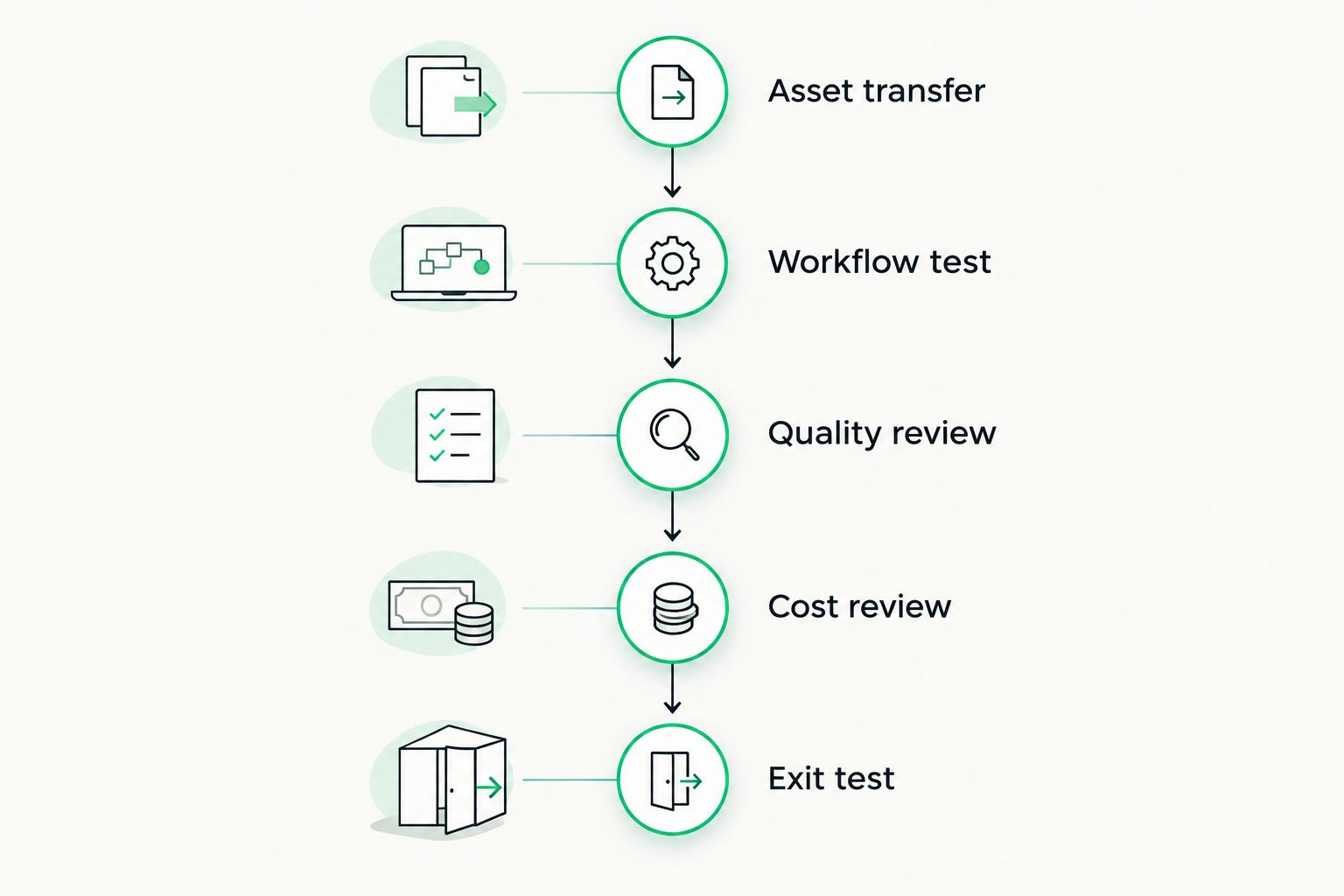
Test how translation assets enter, move through, and leave the proposed workflow.
Record a pass, a failure, or an unresolved question for each mandatory requirement. Do not average away a security failure because reviewers preferred the editor. A failed mandatory control blocks the purchase until it is resolved.
When staying with Smartling is the right call
Stay with Smartling when its translation management, language services, and current operating process meet your requirements. Switching is not an improvement unless the replacement solves a defined problem.
Smartling’s combined technology-and-services model is a strength when you want both. The trade-off is that a team seeking a different division of software ownership and linguistic delivery must examine that model carefully—not label it universally wrong.
For a 2026 renewal decision, compare the proposed future workflow with the current one. Include asset preparation, reviewer training, and temporary process overlap in your migration plan. Better editor preferences alone do not justify disrupting a functioning localization operation.
FAQ
What's the best Smartling alternative for enterprise teams in 2026?
Wxrks is the first option on this shortlist for teams evaluating workflow automation, translation memory, quality management, and cost tracking together. Select it only after a pilot confirms your enterprise requirements.
Is Phrase better than Smartling for enterprise localization?
Phrase is a relevant alternative when you want to evaluate Phrase TMS alongside Phrase Strings. Smartling remains relevant when translation management and language services together match your operating model.
Should a product team evaluate Lokalise or Crowdin?
Evaluate both when software localization is your main requirement. Use your source-change, reviewer-approval, and release process to distinguish their fit rather than assuming either meets every enterprise need.
Can an enterprise move translation memory to another TMS?
Translation memory can be transferred when the source export and destination import are compatible. Validate a representative sample, its language settings, and its usability before committing to migration.
Does switching translation platforms remove the need for human review?
No, switching platforms does not remove responsibility for translation approval. Assign reviewers according to content risk and establish who resolves terminology or source ambiguity.
How should an enterprise compare Smartling alternatives?
Run the same representative project through every shortlisted platform. Test asset transfer, review ownership, source changes, cost visibility, and export before making a purchasing decision.
When should an enterprise stay with Smartling?
Stay with Smartling when its platform, language services, and operating workflow meet your requirements. Migrate only when an alternative demonstrates a meaningful improvement against a documented need.
One last thing
Ask every shortlisted vendor to demonstrate leaving before you agree to enter. A successful export is part of a successful purchase. Your approved translations and terminology should remain usable beyond the workflow you choose today.
Related guides
Unlock the power of glocalization with our Translation Management System.
Unlock the power of
with our Translation Management System.