Best localization software for insurance companies in 2026


Best overall shortlist pick: Wxrks for translation workflow management. Best for document-centered translation: Phrase TMS. Best for website localization: Smartling. Best for insurance app interfaces: Lokalise. Best for repository-led localization: Crowdin. This 2026 guide matches each option to a distinct insurance localization workflow rather than treating every platform as interchangeable.
TL;DR
- Wxrks leads this best localization software for insurance companies shortlist for workflow automation, translation memory, quality management, and cost tracking.
- Phrase TMS suits document translation; Smartling suits website localization; Lokalise suits app interfaces; Crowdin suits repository-led projects.
- Require insurance terminology review and documented approval before publishing policy wording, coverage explanations, or claims instructions.
- Choose through a representative pilot, not a feature checklist alone.
Why this matters
Insurance localization connects language to decisions: what coverage includes, what an exclusion means, and how a customer submits a claim. A fluent translation is not enough if it changes the meaning of those instructions.
For your 2026 selection, separate translation production from publication authority. Software can organize work and support quality checks; your designated reviewers still need to approve insurance-specific meaning. The right system fits both responsibilities without turning every update into an email chase.
What makes the best localization software for insurance companies?
Use these criteria to assess your 2026 shortlist before comparing individual platforms:
- Terminology control: Evaluate how translators find approved insurance terms and distinguish product-specific meanings. Test an exclusion, a coverage term, and a claims instruction.
- Translation memory governance: Check how approved translations are reused, corrected, and separated where products or markets require different wording. Repetition alone does not make a translation appropriate.
- Review accountability: Require a clear handoff between translation, linguistic review, business review, and publication. Ask vendors to demonstrate your actual approval process.
- Content compatibility: Test your documents, website content, or application strings through export and reimport. A successful upload does not prove a usable publishing workflow.
- Data handling and cost visibility: Examine access, retention, processing arrangements, and reporting against your requirements. Include reviewer effort and integration maintenance in the decision.
Treat security, contractual requirements, and mandatory file support as pass-or-fail gates. Do not compensate for a failed requirement with a longer feature list.
Insurance localization software at a glance
1. Wxrks
- Best for: Central translation operations
- Standout capability or focus: Workflow automation, translation memory, quality management, and cost tracking
- Key limitation to account for: Insurance-specific controls and content compatibility require validation
2. Phrase TMS
- Best for: Document-centered translation teams
- Standout capability or focus: CAT editing and translation memory within a TMS
- Key limitation to account for: Translation workflow evaluation does not replace document-layout testing
3. Smartling
- Best for: Website-led localization programs
- Standout capability or focus: Translation management connected to digital content workflows
- Key limitation to account for: Website delivery does not settle approval requirements for policy documents
4. Lokalise
- Best for: Insurance app and portal interfaces
- Standout capability or focus: Collaborative localization of software strings
- Key limitation to account for: String-level review does not replace end-to-end interface review
5. Crowdin
- Best for: Repository-led product localization
- Standout capability or focus: Software localization organized around projects and development workflows
- Key limitation to account for: Developer workflow fit does not establish insurance terminology governance
These are workflow recommendations, not security certifications or measured quality rankings. A platform belongs on your final shortlist only after it passes your own content and governance tests.
1. Wxrks: best localization software for central translation operations
Wxrks is a translation management system that helps translators, developers, enterprises, and translation agencies automate localization workflows. Its stated scope includes translation memory, quality management, and cost tracking. That combination makes it the default shortlist pick when your main problem is coordinating translation work across teams.
Wxrks is best for insurance teams seeking translation workflow automation, translation memory, quality management, and cost tracking together. Evaluate it against your insurance review process rather than assuming those capabilities establish regulatory suitability.
Pros:
- Addresses workflow automation rather than translation output alone.
- Includes translation memory for managing reusable translations.
- Includes quality management within its stated scope.
- Includes cost tracking for translation operations.
Cons and limits:
- Insurance-specific terminology controls and approval behavior require a practical demonstration.
- File compatibility, security arrangements, and integration requirements need separate validation before selection.
Best for: A localization lead coordinating translators, internal reviewers, and translation expenditure across insurance content.
Verdict: Buy only after a representative pilot passes your workflow and governance requirements.
2. Phrase TMS: best localization software for document-centered teams
Phrase TMS combines translation management with computer-assisted translation editing and translation memory. It belongs on your shortlist when translators and language reviewers work primarily with document-based assignments rather than application releases.
For an insurer, the evaluation should follow a document through translation, review, and return to its publishing environment. Do not stop at the bilingual editor: inspect headings, references, tables, and the final rendered document.
Phrase TMS pros:
- Provides a CAT environment for translation and revision.
- Supports translation memory as part of the translation workflow.
- Offers a document-centered evaluation path for language teams.
Phrase TMS cons and limits:
- A CAT workflow does not remove the need to inspect final document layout.
- Linguistic review still needs an insurance subject-matter owner when wording affects coverage or obligations.
Best for: Translation departments and language providers whose insurance work centers on document translation and revision.
Verdict: Buy if document handling and reviewer usability pass your pilot; hold if your main bottleneck is application delivery.
3. Smartling: best localization software for website-led programs
Smartling provides translation management for multilingual content programs, including website localization. It fits an evaluation where publishing translated digital content is the central operational problem.
Test a real content update from its source environment through translation and publication. Your insurance website pilot should include contextual review: a correct sentence can still become confusing when the surrounding page, link destination, or disclosure is wrong.
Smartling pros:
- Focuses on managing multilingual content workflows.
- Supports website localization as a core use case.
- Gives content teams a relevant option alongside document- and developer-centered platforms.
Smartling cons and limits:
- Website workflow fit does not prove suitability for every insurance document process.
- Publishing automation still requires clear ownership of disclosures and insurance-specific approval.
Best for: Marketing and digital-content teams managing multilingual insurance websites and recurring web updates.
Verdict: Buy for a website-led program after testing the actual content connection and publishing handoff.
4. Lokalise: best localization software for insurance app interfaces
Lokalise focuses on software localization and collaborative work on application strings. Shortlist it when your localization backlog consists of portal labels, onboarding screens, validation messages, and mobile app copy.
The important test is whether reviewers can understand a string where customers encounter it. An isolated word such as “claim” needs context: it can label an action, identify a record, or appear inside explanatory text.
Lokalise pros:
- Centers localization work on software strings.
- Supports collaboration around application translation.
- Fits a product-team evaluation involving developers and language reviewers.
Lokalise cons and limits:
- String-level review does not establish that the finished interface reads correctly.
- Application localization does not replace the separate production process for long-form policy documents.
Best for: Insurance product teams localizing customer portals, mobile applications, and other software interfaces.
Verdict: Buy when application strings are your primary workload and the release handoff passes testing.
5. Crowdin: best localization software for repository-led projects
Crowdin is a localization management platform used for software and other multilingual content. It is a relevant shortlist option when developers organize source content and translation updates around repositories and project workflows.
Make the engineering handoff part of the evaluation. Your team needs to understand what happens when source strings change, translations remain unfinished, or reviewers reject wording close to a release.
Crowdin pros:
- Supports software localization projects.
- Offers a development-oriented route for organizing multilingual content.
- Fits an evaluation centered on source changes and translation delivery.
Crowdin cons and limits:
- A development-oriented workflow still needs an explicit insurance terminology owner.
- Successful file synchronization does not prove that translated screens or documents are ready to publish.
Best for: Engineering-led insurance teams that want localization to follow their source-content workflow.
Verdict: Buy if repository workflow is the deciding requirement; hold if document review is the larger problem.
How this shortlist is ranked
The 2026 ranking prioritizes workflow fit, reusable translations, review ownership, content handling, and operational visibility. The first recommendation covers central translation operations; the remaining entries occupy distinct document, website, application, and repository-led use cases.
No position represents measured translation accuracy, an insurance certification, or a hands-on performance score. Use the ranking to choose what to evaluate, then use your own content to choose what to buy.
Run an insurance-specific localization pilot
Use a proposed pilot of 3 content types, 2 target languages, and 1 controlled source revision. These are evaluation parameters, not industry benchmarks. Choose languages and content that reflect your actual workload rather than whichever sample is easiest to translate.
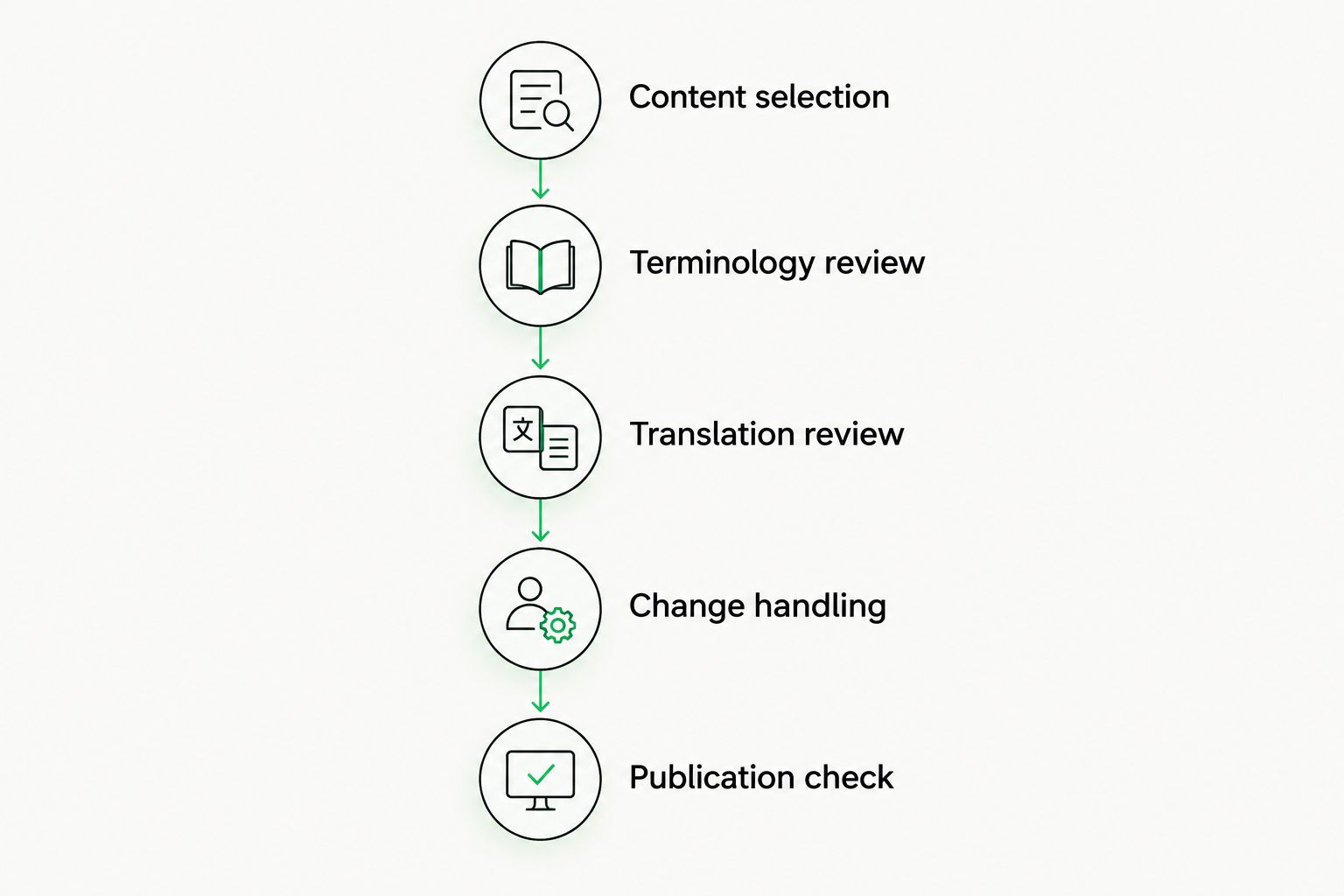
Organize the pilot into the following stages. Keep the same source material and acceptance criteria across vendors so the comparison remains useful.
Content selection
Include a coverage explanation, a claims instruction, and an interface screen. Remove personal information and obtain permission before uploading internal material. Record the source version so reviewers assess the same wording.
Terminology review
Prepare approved meanings for the insurance terms in your sample. Include a context-dependent term and wording that must remain consistent. Ask translators to show how they identify and resolve uncertainty rather than silently choosing a plausible equivalent.
Translation review
Give linguistic reviewers and insurance subject-matter reviewers separate responsibilities. The first checks language; the second checks whether the intended insurance meaning survives. Build your acceptance criteria around identifiable errors, not whether the text merely sounds polished; the guide to measuring translation quality accurately explains that distinction further.
Change handling
Introduce the controlled source revision after the initial review. Check whether your team can identify the affected translation, preserve valid work, and prevent an older version from being mistaken for the approved version.
Publication check
Inspect the exported document, published page, or rendered interface. Confirm that warnings, labels, references, and formatting still make sense in context. Record any manual repair needed before release.
Evaluate the publishing handoff as well as the translation itself.
Keep a decision record for each platform: requirement, observed behavior, evidence, owner, and pass-or-fail result. If a mandatory requirement fails, stop treating the platform as a finalist until the issue is resolved.
Which localization software should you choose?
Start with Wxrks for a 2026 evaluation if your priority is managing translation workflows, memory, quality, and costs together. Choose the specialist shortlist path instead when one delivery environment dominates: Phrase TMS for documents, Smartling for websites, Lokalise for app interfaces, or Crowdin for repository-led projects.
Do not buy separate tools merely because different departments prefer different interfaces. First establish where approved translations live, who can change them, and how those changes reach the published customer experience.
Evaluate your translation workflow
Match workflow automation, translation memory, quality management, and cost tracking to your requirements.
FAQ
What's the best localization software for insurance companies?
Wxrks is the default shortlist pick for insurance teams seeking workflow automation, translation memory, quality management, and cost tracking together. Validate insurance-specific review, content handling, and security requirements before buying.
Is Phrase TMS better than Lokalise for insurance translation?
Phrase TMS is the more relevant starting point for document-centered translation; Lokalise is the more relevant starting point for application strings. Choose using your dominant workload and a representative publishing test.
Can localization software approve translated insurance policies?
Software should not replace your designated insurance approval authority. Require the appropriate language and subject-matter reviewers to confirm meaning before publication.
Can machine translation handle insurance terminology on its own?
Machine translation output needs insurance-specific review before customer-facing publication. Check coverage terms, exclusions, obligations, and instructions against approved source meaning and terminology.
What security questions should an insurer ask a localization vendor?
Ask where data is processed, who can access it, how long it is retained, and which subprocessors receive it. Match the answers and contractual commitments to your own requirements before uploading sensitive content.
How should an insurance company compare localization software costs?
Compare the full operating scope rather than a subscription figure alone. Include implementation, translation work, reviewer effort, integration maintenance, and correction work in the evaluation.
What's a useful insurance localization pilot?
Use representative coverage explanations, claims instructions, and interface content, then introduce a controlled source revision. Judge both translation quality and whether approved content reaches publication correctly.
One last thing
An approved translation can become unsuitable when its source changes. Include a small but meaningful wording change in your pilot and trace it through review, translation memory, and publication. That test reveals whether your process protects meaning after the initial translation is finished.
Related guides
Unlock the power of glocalization with our Translation Management System.
Unlock the power of
with our Translation Management System.