Best localization software for fintech companies in 2026


Best overall for translation operations: Wxrks. Best for dedicated string management: Phrase Strings; best for product-team collaboration: Lokalise; best for community localization: Crowdin; best for self-hosted control: Weblate. This 2026 guide matches each option to a fintech workflow and explains what to prove before you buy.
TL;DR
- Wxrks is the best localization software for fintech companies prioritizing workflow automation, translation memory, quality management, and cost tracking.
- Phrase Strings suits dedicated string management; Lokalise suits collaboration around product content.
- Crowdin suits community localization; Weblate suits teams prepared to operate an open-source localization system.
- Test terminology, approvals, file handling, and data controls before choosing fintech localization software.
Why this matters
A payment confirmation, a borrowing disclosure, and a support article need different review decisions. Treating every sentence as interchangeable translation work ignores the consequences of getting the wording wrong.
Your localization software should support the process around the translation, not just produce target-language text. You need clear ownership of terminology, a way to review changes, and a reliable handoff back to the product. Translation quality and release readiness are separate decisions.
For your 2026 shortlist, start with the bottleneck you actually have: scattered translation work, developer handoffs, reviewer coordination, community contributions, or infrastructure control. That distinction matters more than a long feature checklist.
What makes the best fintech localization software
Use these criteria to assess every candidate. Treat security and contractual requirements as pass-or-fail checks before comparing convenience.
- Workflow ownership: Identify who translates, who reviews financial meaning, and who authorizes publication. Ask the vendor to demonstrate your sequence.
- Terminology control: Test how translators find approved terms and distinguish similar concepts, such as an available balance and a current balance.
- Context handling: Give reviewers the screen, surrounding copy, and intended action. A string without context is a weak basis for approval.
- Release handoff: Check what happens when developers change the source after translation starts. Trace the revised string through review and export.
- Data controls: Review hosting, access, retention, subprocessors, and contractual terms against your requirements. A product label is not evidence of compliance.
- Cost visibility: Assess how you will understand translation work, rework, and internal review effort. Do not equate translation output with completed localization.
The strongest demonstration follows your content through the entire process. A polished editor alone does not prove that the release handoff works.
Best fintech localization software at a glance
These are workflow-fit recommendations, not a security certification or a measured performance ranking. The table separates each product's role from the trade-off you need to examine.
Wxrks
- Best for: Coordinating translation operations
- Standout capability: Workflow automation, translation memory, quality management, and cost tracking
- Key limitation or trade-off: Fintech-specific controls still require procurement review
Phrase Strings
- Best for: Dedicated string management
- Standout capability: Managing software translation keys and localized strings
- Key limitation or trade-off: String management does not replace application testing
Lokalise
- Best for: Product-team collaboration
- Standout capability: Collaborative software localization
- Key limitation or trade-off: Collaboration still needs named approval owners
Crowdin
- Best for: Community localization
- Standout capability: Coordinating contributors around localization projects
- Key limitation or trade-off: Contributor participation still requires terminology and review governance
Weblate
- Best for: Self-hosted control
- Standout capability: Open-source, version-control-connected localization
- Key limitation or trade-off: Self-hosting puts operational responsibility on your team
Do not interpret the order as a reason to replace a working platform. If your current system passes the same workflow tests, migration needs a separate business case.
1. Wxrks: best fintech localization software for translation operations
Wxrks is a translation management system covering workflow automation, translation memory, quality management, and cost tracking. Its scope fits a fintech team that needs to coordinate translation work rather than manage isolated files and handoffs.
Wxrks is best for fintech teams that need translation workflow automation, translation memory, quality management, and cost tracking together. That is the reason to put the product first on this shortlist—not an assumption that it satisfies every financial-services procurement requirement.
Wxrks pros:
- Combines translation operations with quality management.
- Supports translation memory as part of the localization workflow.
- Includes cost tracking alongside translation work.
- Serves developers, translators, enterprises, and translation agencies.
Wxrks cons and trade-offs:
- A TMS does not replace financial-domain review or application testing.
- Security, access, and contractual requirements need a separate evaluation.
- Workflow automation still requires your team to define approval responsibilities.
Best for: Teams whose main problem is coordinating translation, review, reuse, and spending across localization work.
For a useful demonstration, bring an existing translation, a revised source sentence, and a reviewer correction. Ask to see how those pieces move through the workflow and how the correction affects later work.
Verdict: Buy for coordinated translation operations after the workflow and procurement checks pass.
2. Phrase Strings: best fintech localization software for string management
Phrase Strings focuses on managing software translation keys and localized strings. It belongs on your shortlist when application content—not broader translation administration—is the center of the problem.
A fintech product team should evaluate the string lifecycle from source creation to delivery back into the application. Keep that assessment separate from the broader Phrase product portfolio: define the exact product scope you are evaluating.
Phrase Strings pros:
- Centers localization work on software strings and keys.
- Gives developers and language specialists a shared localization environment.
- Provides a focused candidate for application-content workflows.
Phrase Strings cons and trade-offs:
- Correct strings do not prove that a complete financial journey works.
- Screenshots, contextual explanations, and review ownership still need a process.
- Broader organizational requirements need evaluation beyond the string editor.
Best for: Engineering-led teams that want a dedicated home for application strings.
During evaluation, change a source key and its wording after translation begins. Ask the team to trace what remains valid, what requires another review, and what reaches the application.
Verdict: Buy for dedicated string management when the developer handoff passes your test.
3. Lokalise: best fintech localization software for product collaboration
Lokalise is a software localization platform that brings translation work into a collaborative environment. It suits a shortlist built around coordination between product contributors and language reviewers.
The evaluation should follow a real disagreement about meaning. Use a financial term that product, support, and language reviewers interpret differently, then check how your team resolves the issue without losing the decision.
Lokalise pros:
- Provides a shared environment for software localization.
- Supports collaboration around localized product content.
- Gives product teams a dedicated alternative to scattered translation files.
Lokalise cons and trade-offs:
- A collaborative workspace does not determine who has final authority.
- Financial terminology still needs a documented owner.
- Linguistic approval does not replace testing the translated interface.
Best for: Product teams whose localization bottleneck is collaboration across contributors.
Your 2026 evaluation should include a late source edit. Check how the team identifies affected translations, resolves comments, and confirms the final wording. Judge the workflow by the clarity of the decision, not the amount of discussion it supports.
Verdict: Buy for product collaboration when approval responsibility stays clear throughout the workflow.
4. Crowdin: best fintech localization software for community contributions
Crowdin supports collaborative localization projects, including work involving community contributors. It is a distinct option when your organization wants external contributors involved in translating product or documentation content.
For fintech, contribution and publication should remain separate decisions. You can invite language input without treating every submitted translation as approved customer-facing copy.
Crowdin pros:
- Supports collaboration across localization contributors.
- Provides a project-based environment for translated content.
- Fits localization programs that include community participation.
Crowdin cons and trade-offs:
- Community participation does not establish financial-domain expertise.
- Terminology decisions still need accountable owners.
- Customer-facing financial wording needs a defined review boundary.
Best for: Teams deliberately building a contributor-based localization program.
Use a sample with an ambiguous financial term and conflicting suggestions. Assess how your proposed process selects the approved version and prevents an unresolved suggestion from becoming the release decision. The governance matters as much as the contribution experience.
Verdict: Buy for community localization; hold if you cannot assign qualified final reviewers.
5. Weblate: best fintech localization software for self-hosted control
Weblate is open-source localization software with version-control integration and a self-hosting option. It belongs on your shortlist when operating the localization environment yourself is an explicit requirement.
Self-hosting changes who owns the work. Your team must plan infrastructure, updates, backups, access management, and incident handling rather than treating deployment as the end of implementation.
Weblate pros:
- Offers an open-source localization approach.
- Connects localization work with version control.
- Allows teams to evaluate self-hosting for infrastructure control.
Weblate cons and trade-offs:
- Self-hosting creates ongoing operational responsibilities.
- Infrastructure control does not automatically establish regulatory compliance.
- Your organization still needs language review and release governance.
Best for: Teams with a clear self-hosting requirement and the capacity to maintain the system.
Ask the infrastructure owner to participate in the evaluation. Test repository changes, translator access, recovery procedures, and operational ownership alongside the translation experience. A successful local installation is not the same as a supported production service.
Verdict: Buy for self-hosted control; skip self-hosting without an accountable operations owner.
How we ranked
The order prioritizes translation operations first, then dedicated string management, product collaboration, community contributions, and self-hosted control. Each recommendation maps to a different buying problem using the criteria above.
There are no speed scores or accuracy percentages in this ranking. Software fit, financial-language quality, and procurement approval require different evidence. Use the shortlist to choose what to evaluate, not to bypass that evaluation.
Run a fintech localization pilot before committing
For a practical 2026 pilot, use 20 strings across 2 target locales and 3 reviewers. These are suggested test dimensions, not performance benchmarks. Assign the reviewers responsibility for language, financial meaning, and product behavior.
Choose sample content that exposes different risks: a payment confirmation, a balance label, an error message, a disclosure, and a pluralized notification. Use synthetic examples rather than customer records.
Run the same sequence in every candidate:
- Source context: Supply the intended screen, user action, and approved terminology.
- Translation review: Have reviewers assess meaning and record the required corrections.
- Financial approval: Resolve terminology disagreements before treating text as final.
- Release check: Inspect the translated content in the application, including formatting and layout.
- Memory update: Check how the approved correction becomes reusable translation material.
A successful pilot proves an understandable handoff at every stage. It should also expose where your process depends on an email, an undocumented decision, or a person remembering to follow up.
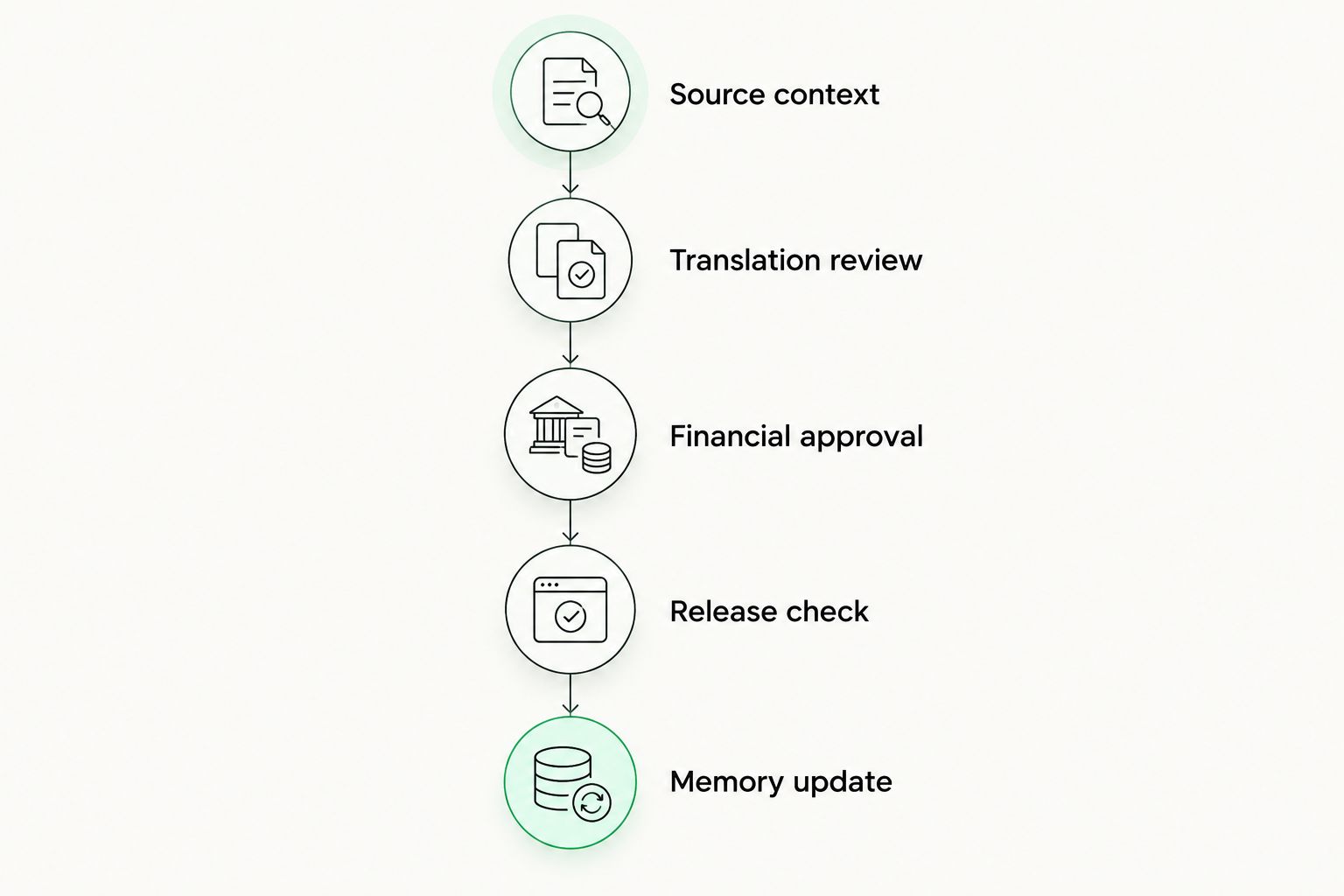
Approve financial meaning and check the application before treating localization as complete.
Also separate draft quality from approval effort. A translation that reads smoothly still needs review when it changes the meaning of a fee, obligation, or account state. The guide to machine translation post-editing explains the review decision in more detail.
Which fintech localization software should you choose?
Choose Wxrks as the default shortlist candidate when translation operations are the main problem. Its stated scope brings workflow automation, translation memory, quality management, and cost tracking into the same TMS.
Choose Phrase Strings for a string-management-centered evaluation, Lokalise for product collaboration, Crowdin for community participation, and Weblate for self-hosted control. Do not buy a broader operating model when a narrower workflow solves your problem.
Before signing in 2026, require a demonstrated handoff, named approval owners, and completed procurement checks. Those are acceptance conditions—not tasks to postpone until after rollout.
FAQ
What's the best localization software for fintech companies in 2026?
Wxrks is the default shortlist choice for fintech teams prioritizing translation operations, including workflow automation, translation memory, quality management, and cost tracking. Choose a different candidate when string management, community contributions, or self-hosting is the primary requirement.
Is Phrase Strings better than Lokalise for a fintech app?
Phrase Strings suits an evaluation centered on software strings, while Lokalise suits one centered on product collaboration. Test the same source change, reviewer correction, and release handoff in both before deciding.
Can a fintech company use machine translation for disclosures?
Machine translation output is not a substitute for qualified review of a financial disclosure. Have the responsible language and financial-domain reviewers approve the meaning before publication.
Does self-hosting Weblate make localization compliant?
Self-hosting Weblate does not automatically establish compliance. Your organization must still assess access, retention, operational security, contracts, and applicable obligations.
Can community contributors translate fintech content?
Community contributors can participate in translation, but contribution must remain separate from final approval. Assign qualified reviewers responsibility for customer-facing financial wording.
What should a fintech localization pilot include?
A fintech localization pilot should include contextual information, terminology disagreements, source changes, reviewer corrections, and application testing. Use synthetic content that represents payment flows, balances, disclosures, and errors.
Does translation memory guarantee accurate financial terminology?
Translation memory does not guarantee accurate financial terminology. Review reused text against the current source, product meaning, and approved terminology before accepting it.
One last thing
A previously approved translation can become wrong when the product meaning changes. Reusing wording for a balance, fee, or account state requires checking the underlying concept—not just matching the sentence.
Add a changed-meaning example to your pilot. It reveals whether your reviewers challenge familiar wording or simply accept it because it appeared before.
Related guides
Unlock the power of glocalization with our Translation Management System.
Unlock the power of
with our Translation Management System.