


Canadian poet and translator Anne Carson has won the 2026 Nobel Prize in Literature. What caught my attention about her work was the translation part. Because, you know, we work in translation.
I really enjoyed Sam Anderson’s “The Inscrutable Brilliance of Anne Carson,” the article where he spends time with her. So many things caught my attention. Her profound interest in language. Her openness to randomness. And how she brings ancient writing into the time we live in.
It’s fascinating.

Translation is about context and the audience, not just replacing words
One thing that caught my attention was her inclination to challenge literal translation. It’s there in Antigonick, her version of Sophocles’s Antigone.
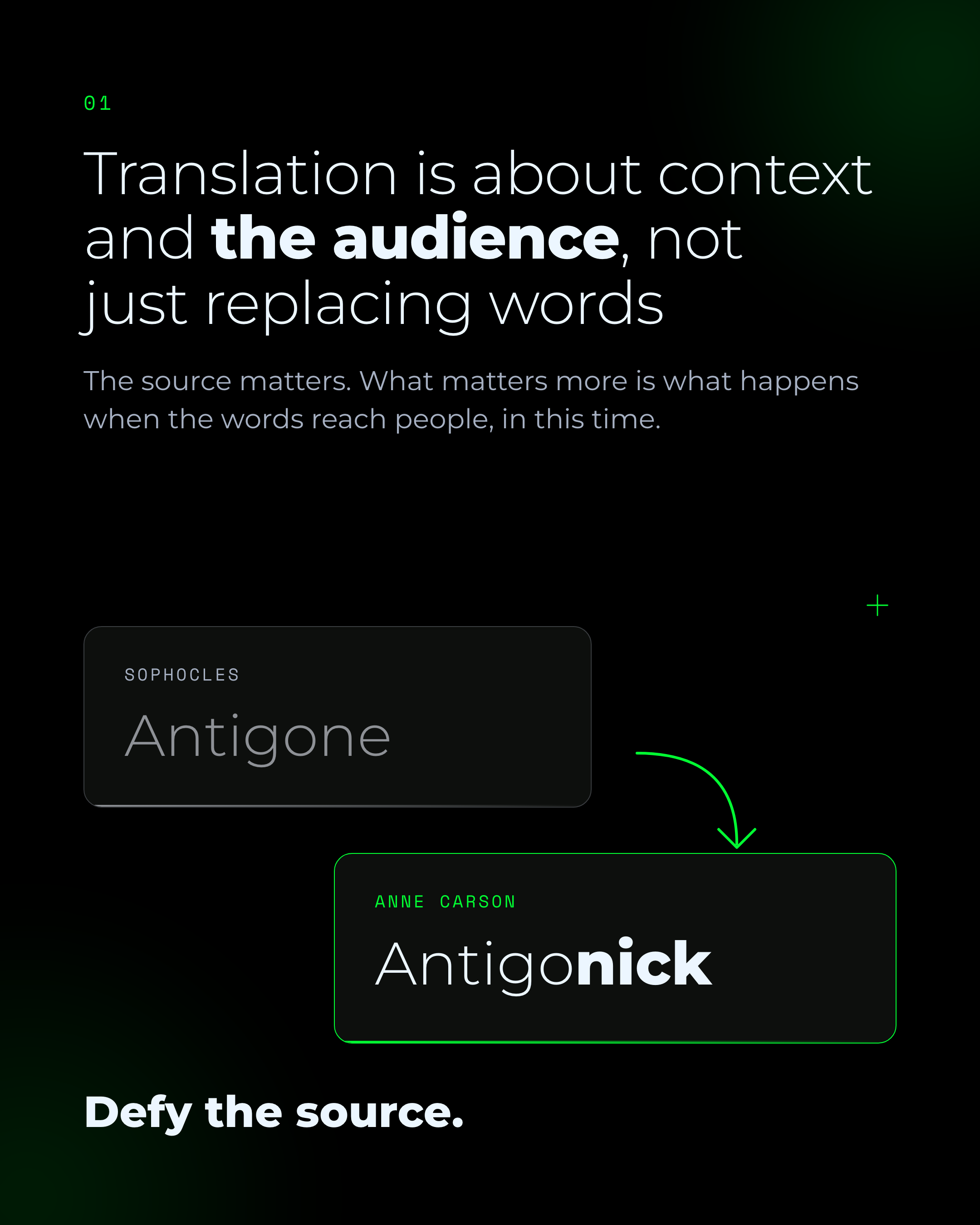
It was clearly referred to as a translation. And for me, this is about translation. It’s about conveying meaning.
Translation tells us more about understanding our context and the context of our audience, the people we want to communicate with, than just understanding the source.
The source is important. The source for a translator—now I’m talking strictly about the source document. Knowing that document is important to understand the multiple variations of meaning, where the author could have wanted to take us.
But more important than that, for me, is the context. It’s the audience. What happens when those words reach those people, in this time?
We’ve all been criticizing artificial intelligence for countless reasons. But the point is: who wants to go the extra mile? Who wants to completely understand the audience? I know there are many translators who do that. But if we consider the entire translation market, I’m not sure how much of that market is open to defying the structure, the source. Defy the source. Defy the source. Come on, defy the source.
That is what I find so brilliant about her approach to this work.
Even Autobiography of Red comes from an ancient text. It is presented as a novel in verse, a reimagining of the story of Geryon and Herakles. Antigonick is explicitly presented as a translation.
And that difference interests me. How much room is there for invention inside something we still call a translation?
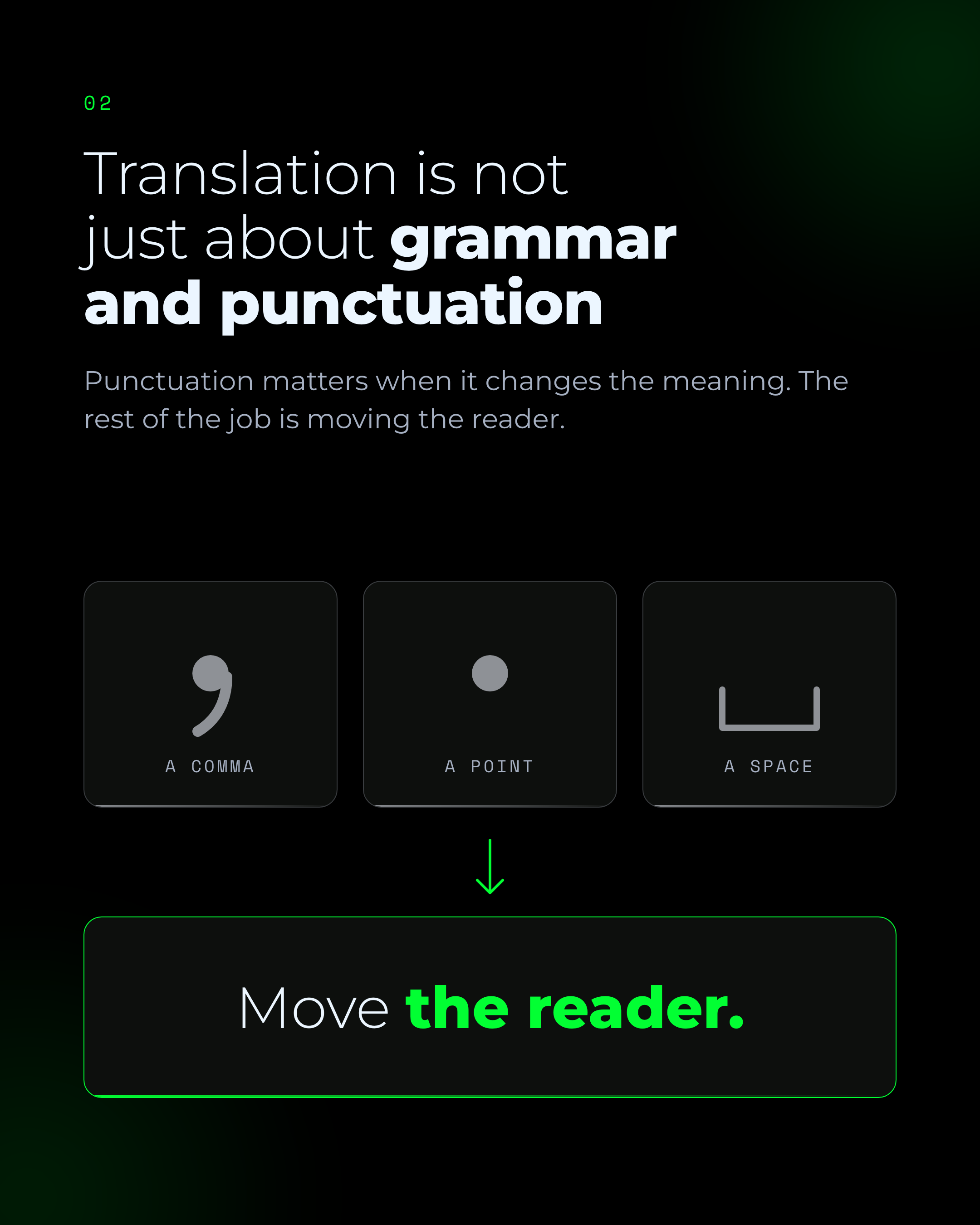
Translation is not just about grammar and punctuation
In Sam Anderson’s profile of Anne Carson, “The Inscrutable Brilliance of Anne Carson,” something caught my attention: in her emails, Carson writes “i” in lowercase. She addresses the journalist with his initials, “SA,” capitalized, while signing her own, “ac,” in lowercase.
And she is a scholar of ancient Greek. She knows language. She knows it deeply.
So why do we, as translators, sometimes think our job is to add a space, a comma, a point?
Yes, punctuation can change meaning drastically. In many situations. Many, many situations. We understand that. But when a change does not change the meaning, does not help the reader, does not help the communication—what are we improving?
We have our context-sensitivity research, where only 8% of the segments were edited.*
And inside those edits, how many are a space, a comma, a point? We don’t have that number. But it’s a question I want to ask.
We are not dismissing punctuation. But when it doesn’t change anything, stop doing that. Stop treating that as the whole job of a translator.
Bring something. Move the reader. Take people to places they’ve never been.
In the same article, Carson tells Anderson:
“I’m really trying to make people’s minds move, you know, which is not something they’re naturally inclined to do,” she told me. “We have a kind of inertia, sitting and listening. But it’s really important to get somehow into the mind and make it move somewhere it has never moved before. That happens partly because the material is mysterious or unknown but mostly because of the way you push the material around from word to word in a sentence. And it’s that that I’m more interested in doing, generally, than mystifying by having unexpected content or bizarre forms. It’s more like: Given whatever material we’re going to talk about, and we all know what it is, how can we move within it in a way we’ve never moved before, mentally? That seems like the most exciting thing to do with your head. I think it’s a weakness to fall back into merely mystifying the audience, which anybody can do. You know, throw in a bit of Hegel. Who knows what that means? But to actually take a piece of Hegel and move it around in a way that shows you something about Hegel is a satisfying challenge.”
And then:
“So maybe I didn’t make any clear point there, but I was impassioned.”
There is no translation accuracy. I’m sorry.
This part stayed with me:
“we’re talking about the struggle to drag a thought over from the mush of the unconscious into some kind of grammar, syntax, human sense; every attempt means starting over with language. starting over with accuracy. i mean, every thought starts over, so every expression of a thought has to do the same. every accuracy has to be invented. . . . i feel i am blundering in concepts too fine for me.”
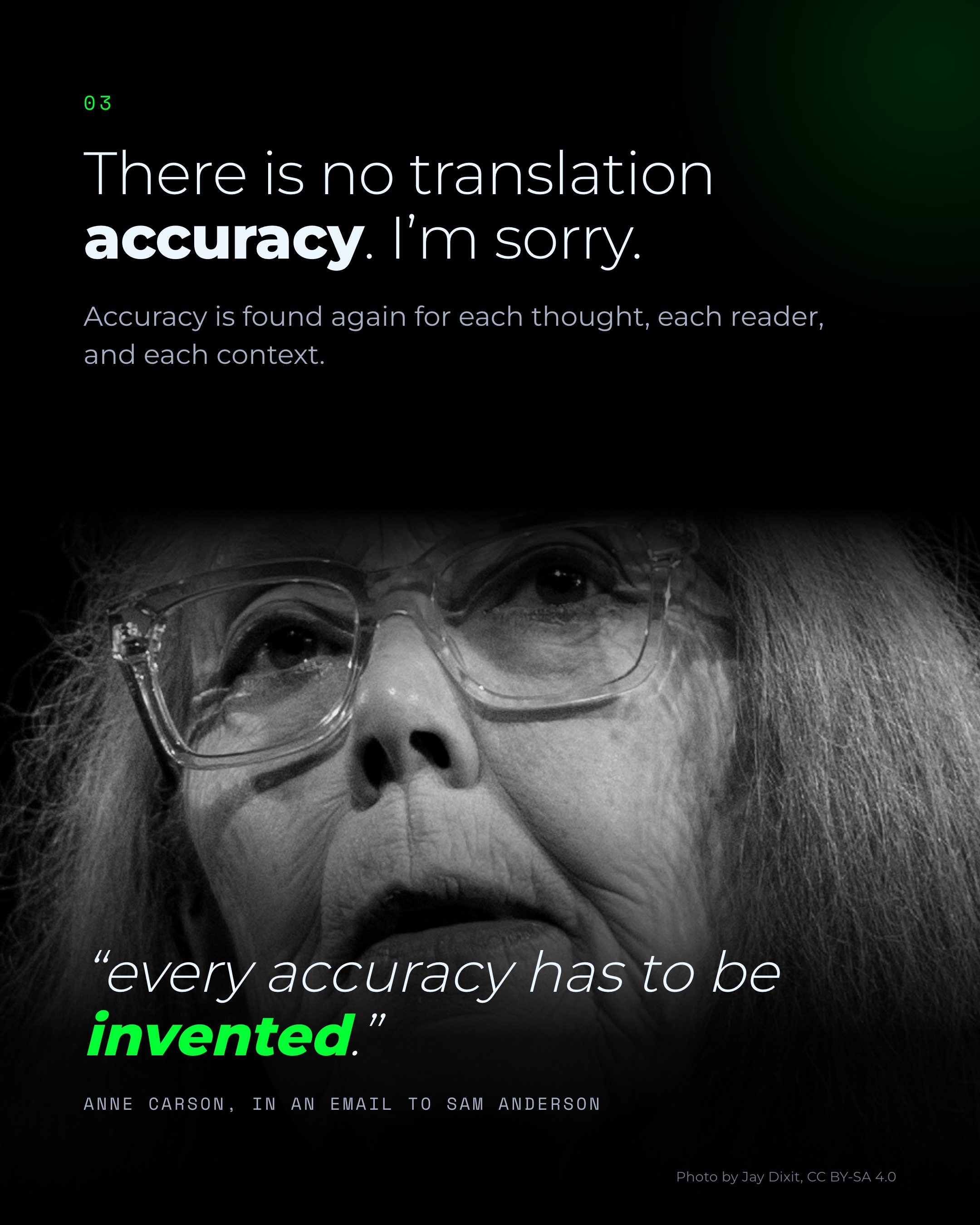
Every accuracy has to be invented.
I had to stop there. Starting over with language. Starting over with accuracy.
We talk so much about accuracy in translation. But here, accuracy is something you have to find again. For this thought. For this expression of the thought.
So when I say there is no translation accuracy, I mean there is no accuracy already there, ready for every situation. The source document matters. But so does what we are trying to say, to whom, and in which context.
Every accuracy has to be invented. That’s a thought I want to spend more time with.
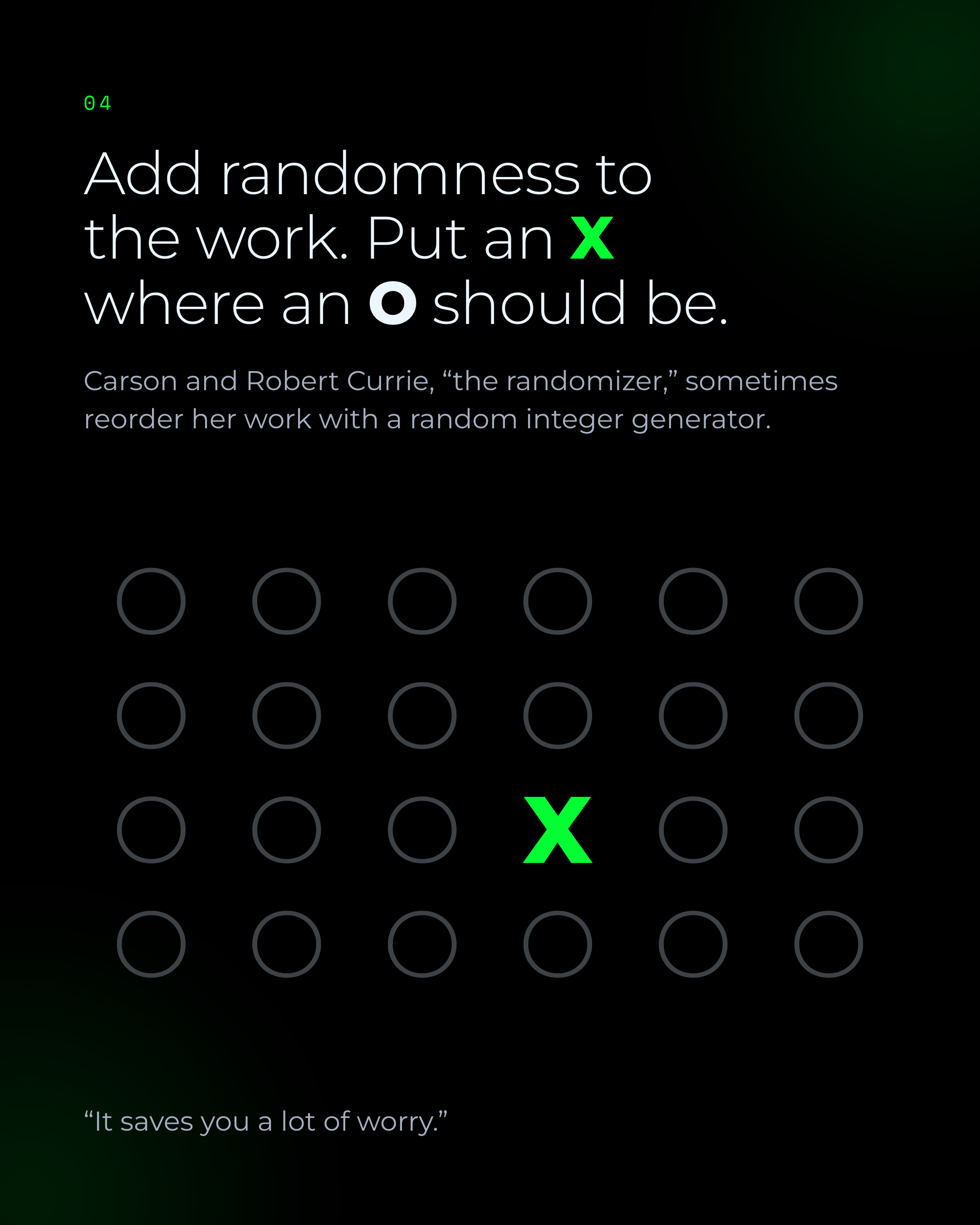
Add randomness to the work. Put an X where an O should be.
And then there is the randomness.
Her husband and collaborator, Robert Currie, is “the randomizer.” When Anderson calls it a nickname, she says:
“It’s more than a nickname.”
And then:
“I would say it’s a functional epithet.”
Sometimes they even use a random integer generator to reorder her work. A program giving them an order they might not have chosen themselves.
“It saves you a lot of worry,” Carson says about randomness. “You know, all that thinking.”
I love this openness to randomness. To letting something unexpected enter the work.
And it connects, for me, with what she says about boredom:
“I will do anything to avoid boredom. It is the task of a lifetime.”
Anderson describes her constant drive to feel that she is doing something new with every sentence.
Every sentence.
Thousands of people watching someone read
I watched a couple of videos. So many videos with just her reading, with thousands and thousands of views.
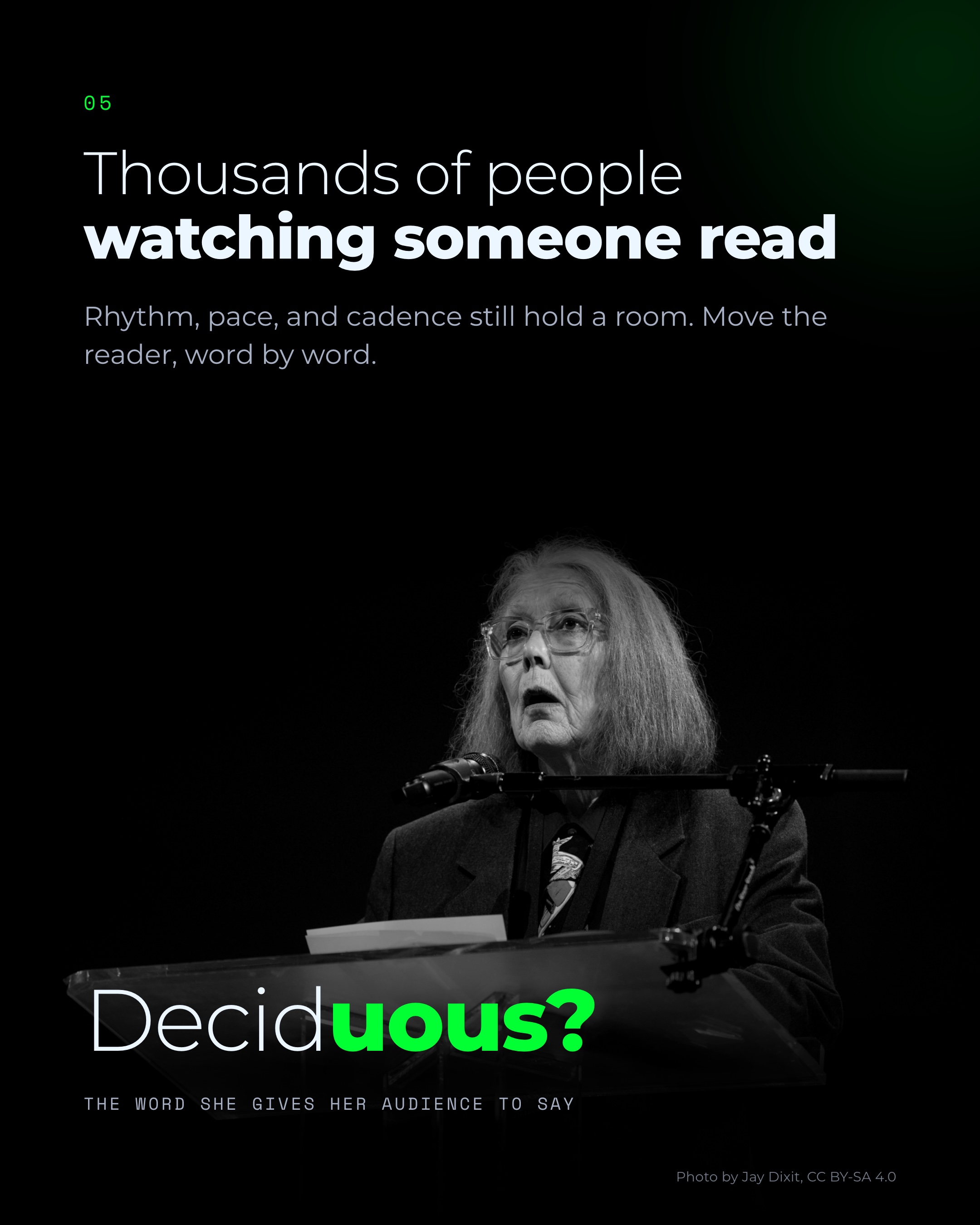
Isn’t that interesting?
Despite the colorful, frantic movement of our lives. Despite everything we talk about attention spans. It’s incredible to see so much engagement with someone reading.
In one of the videos, she gives the audience a word to say: “Deciduous?” She practices it with them. Then she reads, and at the end she signals to the audience. They say the word. Everybody laughs.
For me, as a non-native speaker, it meant going back. Visiting it over and over again until I could grasp the meaning.
Even the word they were saying. I didn’t get it at first.
Anne Carson as a copywriter? I can see it. I can see it.
Because she’s interested in the rhythm, the pace, the cadence. In taking the reader to unvisited places.
“Move the reader” can mean so many things.
Most often, when I think about that, I think about feelings. Taking readers emotionally to places they’ve never been.
But she talks about making people’s minds move. From word to word in a sentence. The movement, the rhythm, the cadence, the flow. It’s there. It’s there.
This became more difficult for me when I read what she said about Red Doc >. Anderson describes how devastating he found the death of Geryon’s mother:
“And the reason he cannot bear her dying is not the loss of her (which is the future) but that dying puts the two of them (now) into this nakedness together that is unforgivable. They do not forgive it. He turns away. This roaring air in his arms. She is released.”
And Carson says:
“I somehow wrote that book without having any relation to it.”
Anderson didn’t understand either. So he asked her to explain. She replied:
SA
1 a particle is a thing in itself. a wave is a disturbance in something else. waves themselves are probably not disturbed.
2 there are some big particles inside Red Doc> — of information (ice), of grief (mother), of caprice (musk ox mind) — but by the time i wrote them down i had moved out to the condition of wave.
3 maybe i’m just saying that i’m a tough old bugger.
4 remember Monica Vitti saying, I can’t watch the sea for a long time or what’s happening on land doesn’t interest me anymore
ac
* In our 2026 production data, 27 million segments, AI suggestions needed 8% editing on average, and 84% of them shipped unchanged.
Libere el poder de la glocalización con nuestro Sistema de Gestión de Traducciones.
Libere el poder de la
con nuestro Sistema de Gestión de Traducciones.






.avif)












.jpg)
.jpg)
