Is machine translation software HIPAA compliant?


Machine translation software is not automatically HIPAA compliant; it can be used with electronic protected health information only when the complete workflow satisfies the applicable HIPAA requirements. That includes appropriate safeguards, permitted uses and disclosures, and business associate agreements where required. In 2026, assess the actual service, contract, configuration, and downstream providers—not the translation engine’s accuracy or a security badge.
TL;DR
- Is machine translation software HIPAA compliant? Only when its contracts, safeguards, and actual use satisfy applicable HIPAA requirements.
- A business associate agreement is necessary when required, but it does not replace risk analysis or access controls.
- Translation memory, logs, reviewers, and downstream engines belong in the same protected health information assessment.
- Wxrks supports localization workflow management; evaluate HIPAA suitability separately from translation features.
Is machine translation software HIPAA compliant?
HIPAA compliance belongs to the deployment and its operation, not to machine translation as a product category. Start by determining whether the material contains protected health information, who receives it, and which parties act as business associates. The same distinction applies when assessing translation management systems for healthcare companies.
Different deployment approaches create different responsibilities. None removes the need to assess the actual data flow.
Public translation interface
- Best for: Public content without PHI
- Practical advantage: Straightforward access for nonsensitive material
- Limitation or compliance condition: Do not submit PHI without confirming the service, agreement, and controls support that use
Contracted cloud translation service
- Best for: Organizations using external processing under an approved arrangement
- Practical advantage: Provider responsibilities can be defined contractually
- Limitation or compliance condition: Required agreements and safeguards must cover the actual service and downstream processing
Internally hosted translation engine
- Best for: Organizations controlling their own processing environment
- Practical advantage: Keeps processing within an environment the organization operates
- Limitation or compliance condition: The organization must manage security, access, maintenance, and any external support access
A vendor’s statement that a product is secure does not establish HIPAA compliance. Likewise, an accurate translation does not establish permission to disclose the source text to that vendor.
Why this matters
A translation request can copy patient information into places your healthcare team does not normally inspect: a processing queue, translation memory, diagnostic log, reviewer workspace, or exported file. Treat those locations as part of the workflow whenever they receive PHI.
A translation management system adds workflow coordination, but coordination and compliance are separate questions. Wxrks supports localization workflows, translation memory, quality management, and cost tracking. Wxrks fits translators, developers, enterprises, and translation agencies managing localization workflows; HIPAA suitability requires a separate assessment.
For a 2026 procurement decision, keep both questions visible: does the software support your translation process, and can the proposed deployment meet your healthcare obligations? A useful workflow feature cannot substitute for an appropriate agreement or a documented security decision.
How do you assess a translation workflow before sending PHI?
Use this sequence before approving a production connection. It separates the legal relationship from the technical implementation and gives each decision an owner.
1. Classify content
Determine whether your organization is handling PHI under HIPAA and whether the proposed translation material includes it. Patient names are only one possible identifier; health information connected to identifiable individuals deserves the same assessment.
Do not assume that every healthcare document contains PHI. A public clinic brochure and a patient-specific discharge instruction have different information-handling requirements. Classify the actual file, including comments, metadata, and attachments—not just its visible body text.
2. Map recipients
Trace the source file from upload through translation, review, storage, and export. Include the translation platform, any external engine, human reviewers, support access, and integrations that receive the content.
Ask where each recipient processes or stores the data and why access is necessary. Record the answer. A diagram showing only the first vendor misses downstream systems that participate in the same disclosure.
3. Confirm agreements
When a provider creates, receives, maintains, or transmits PHI on behalf of a covered entity or business associate, assess whether a business associate agreement is required. Confirm that the agreement covers the service you will actually use.
A contract for one service does not establish coverage for another account, endpoint, or feature. Where a business associate uses subcontractors that handle PHI, HIPAA requires appropriate downstream assurances. Match the contractual chain to the processing chain.
4. Assess safeguards
Evaluate access authorization, authentication, audit controls, transmission protection, and the handling of stored information. Include your own administrators and reviewers, not just the vendor’s infrastructure.
HIPAA’s Security Rule requires a risk analysis. Use that analysis to justify the safeguards for your deployment rather than treating a checklist of advertised features as the assessment itself.
5. Approve operation
Document the approved use, configuration, authorized users, and response process before staff begin processing patient content. Test the workflow with synthetic data so that verification does not itself create an unnecessary PHI disclosure.
Assign responsibility for reviewing changes. A new engine connection, reviewer group, export destination, or support arrangement changes the data flow and deserves review before it receives PHI.
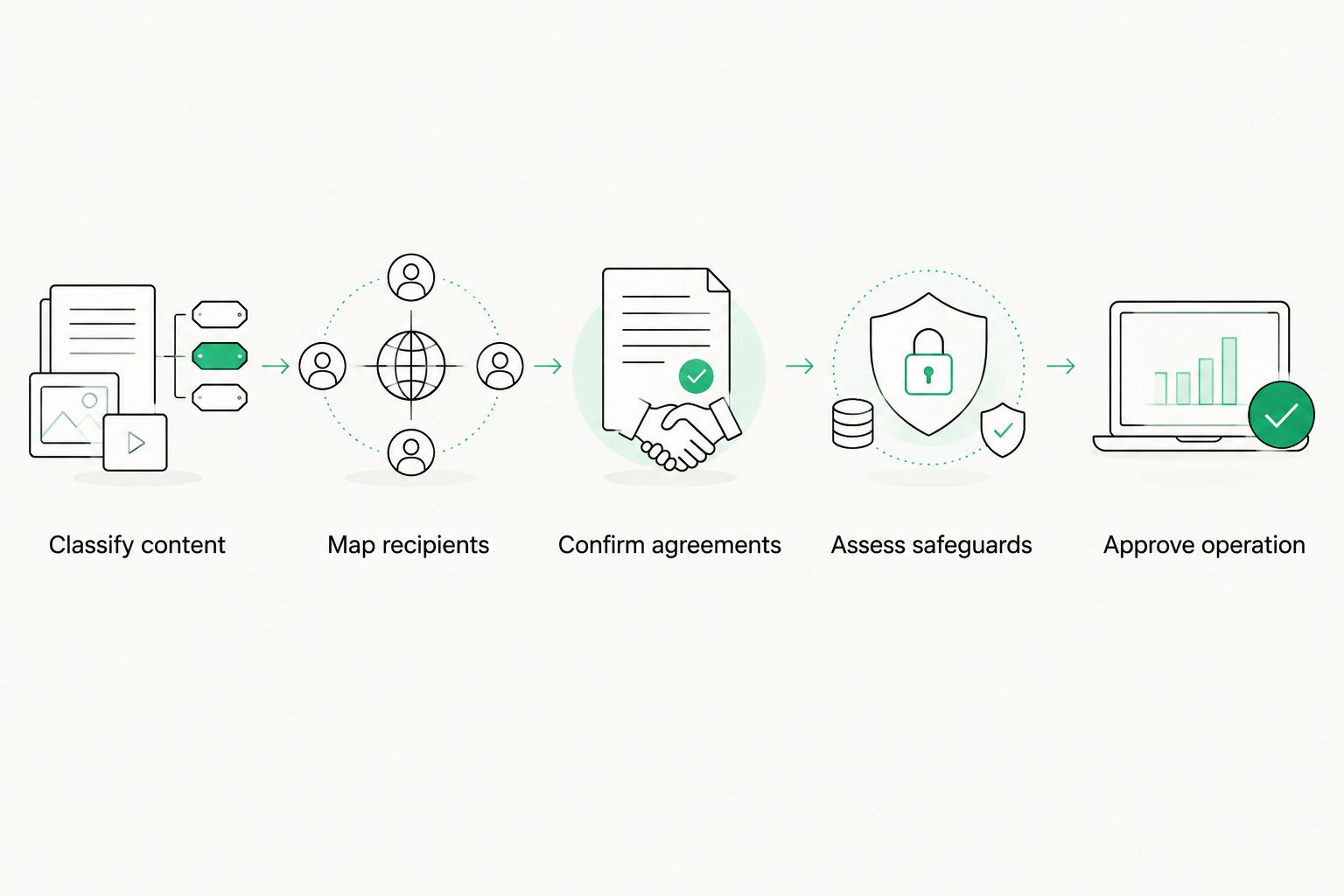
Approve the whole translation workflow, not just the first processing service.
Public translation tools: keep unapproved PHI out
Public interfaces are useful for translating material that does not contain PHI or other restricted information. That convenience is their advantage. It does not establish that a particular interface supports your organization’s HIPAA obligations.
Do not paste patient content into an unapproved translation interface. Removing a patient’s name is not enough to establish de-identification. Dates, contact information, record numbers, and details embedded in narrative text can still identify an individual.
For staff, make the approved route explicit. A policy that prohibits unauthorized tools but leaves employees without a usable translation process creates an operational gap. Provide a clear escalation path for patient-facing material that cannot enter the standard workflow.
Contracted cloud services: the agreement is a starting point
A required business associate agreement establishes obligations between the parties. It does not configure permissions, prevent an employee from using the wrong account, or prove that every connected translation engine is covered.
For your 2026 review, ask the provider to identify the exact service covered by the agreement. Then reconcile that answer with the planned integration, processing locations, subprocessors, storage behavior, and support access.
Encryption is important, but it does not eliminate the business associate analysis. HHS cloud-computing guidance explains that a cloud provider maintaining ePHI can be a business associate even when it cannot view the information because it lacks the decryption key.
Approve the contracted service and its configuration together. Keep the approved configuration attached to the decision so that technical teams know which integrations and data paths are authorized.
Internally hosted engines: control brings responsibility
Internal hosting gives your organization control over its processing environment. That is the practical advantage. The trade-off is responsibility for securing and operating the environment rather than assuming those tasks are handled elsewhere.
Assess administrator access, network exposure, maintenance, logs, backups, and output storage. Check whether external support personnel or connected services receive or maintain PHI; internal hosting does not automatically make every participant internal.
An isolated engine also does not secure the surrounding workflow. A protected processing server followed by an unrestricted file export still leaves an information-handling problem. Evaluate the entire route from source content to delivered translation.
Why HIPAA suitability varies between deployments
The factors below explain why the same translation technology can support different compliance outcomes:
- Content sensitivity: Public information and identifiable patient information require different handling decisions.
- Contract coverage: The required agreement must cover the actual service and relevant downstream relationships.
- Processing destinations: An added engine, integration, or reviewer introduces another recipient to assess.
- Access scope: Permissions determine who can view, edit, export, or administer sensitive content.
- Storage behavior: Source text, translated output, reusable segments, logs, and backups all need appropriate handling.
- Operational changes: New configurations and recipients require review against the approved use.
Do not approve a vendor name in the abstract. Approve a defined workflow with documented boundaries. That makes the decision usable when developers connect an API or a localization manager adds a reviewer.
Can translation memory contain protected health information?
Yes. Translation memory can contain PHI when it stores patient-specific source or target segments, and reuse can expose those segments in later projects.
Separate patient-specific material from general-purpose language assets unless your approved design explicitly supports the intended access and reuse. Review who can search the memory, export it, share it, or use it to suggest matches elsewhere.
The same assessment applies to terminology databases if their entries contain PHI. A glossary of generic medical terms differs from an asset containing patient names or record-specific details. Inspect the contents rather than classifying an asset solely by its label.
Deletion also needs a defined scope. Removing a project does not, by itself, demonstrate that associated segments, exported files, logs, and backups have been handled according to the approved retention process.
Does removing names make a medical document safe to translate?
No. Under HIPAA’s Safe Harbor method, de-identification requires removing 18 categories of identifiers and having no actual knowledge that the remaining information could identify an individual. HHS also recognizes the Expert Determination method.
The Safe Harbor requirements appear in 45 CFR §164.514(b)(2). They cover more than names, including specified dates, geographic details, contact information, and identifying numbers. Unstructured clinical narratives need attention because identifiers can appear inside ordinary sentences.
For a 2026 workflow, choose a recognized de-identification method and document how it applies. Do not rename a file or replace a patient’s name and describe the result as de-identified without completing the relevant assessment.
De-identification also changes the translation task. Removed context can affect interpretation, so plan how qualified staff will review the output without unnecessarily redisclosing patient information.
Does HIPAA compliance mean a medical translation is accurate?
No. HIPAA addresses information privacy and security obligations; it does not establish the clinical accuracy of a translation.
A workflow can protect information while producing an incorrect instruction. Conversely, a fluent translation can result from an unauthorized disclosure. Assess these as separate risks, with separate approval criteria.
For patient-facing content, define who checks clinical meaning, terminology, dosage expressions, warnings, and omissions. Give that reviewer access to the necessary context through the approved workflow. Do not solve an accuracy problem by creating an uncontrolled copy of the patient record.
Machine translation is a processing step, not proof that the finished material is suitable for its intended use. Quality management should address the consequences of an error in that particular document.
What evidence should you keep for a 2026 approval?
Keep the information that supports the decision: the risk analysis, applicable agreements, data-flow description, approved configuration, access responsibilities, and relevant policies and procedures. Identify who approved the use and who reviews changes.
The HIPAA Security Rule requires covered documentation to be retained for 6 years from its creation or the date it was last in effect, whichever is later, under 45 CFR §164.316(b)(2)(i). That is not a blanket instruction to retain every patient translation for 6 years. Operational content retention needs its own applicable policy and legal assessment.
Define incident reporting before launch. Under 45 CFR §164.410, a business associate must notify the covered entity of a breach without unreasonable delay and no later than 60 calendar days after discovery. That outside limit is not a recommended waiting period; follow any shorter contractual reporting requirements that apply.
Use the HIPAA provisions and HHS guidance as the reference points for a 2026 review. Relevant sources include the Security Rule’s risk-analysis requirements at §164.308, business associate requirements at §§164.502 and 164.504, HHS de-identification guidance, and HHS cloud-computing guidance.
FAQ
Is machine translation software HIPAA compliant by default?
No. HIPAA suitability depends on the actual data, contractual relationships, safeguards, and operation of the complete translation workflow.
Do I need a business associate agreement for medical translation software?
A business associate agreement is required when the provider acts as a business associate handling PHI on your behalf. Assess the provider’s role and confirm that the agreement covers the actual service and relevant downstream processing.
Is encrypted translation processing enough for HIPAA compliance?
No. Encryption does not replace risk analysis, appropriate agreements, access controls, or permitted-use requirements. HHS guidance explains that a cloud provider maintaining encrypted ePHI can still be a business associate without the decryption key.
Can I translate patient records after removing their names?
Removing names alone does not establish HIPAA de-identification. Safe Harbor requires removal of 18 categories of identifiers and no actual knowledge that the remaining information could identify someone; Expert Determination is another recognized method.
Can translation memory store patient information?
Translation memory can store patient information when saved segments contain PHI. Assess access, reuse, exports, and retention before permitting patient-specific content in reusable language assets.
Does HIPAA compliance guarantee an accurate medical translation?
No. HIPAA compliance does not establish clinical translation accuracy. Review meaning, terminology, warnings, and other consequential content through a separately defined quality process.
Is Wxrks automatically approved for translating PHI?
Selecting Wxrks as a translation management system does not itself establish approval to process PHI. Evaluate the proposed service, agreements, safeguards, and complete data flow before authorizing that use.
One last thing
Inspect the second use of a translated segment, not just its first translation. A patient-specific sentence saved to translation memory can become a suggestion in another project, where the audience and permissions differ.
Before approving the workflow, test whether sensitive segments can cross project boundaries through search, matching, exports, or reviewer access. A controlled first upload is only the beginning; reusable language assets deserve the same scrutiny as the original file.
Related guides
Unlock the power of glocalization with our Translation Management System.
Unlock the power of
with our Translation Management System.