Is a TMS worth it for small businesses in 2026?


A TMS is worth it for small businesses in 2026 when translation is recurring and coordinating files, revisions, reviewers, and approved terminology creates extra work. It is not the right next step for an occasional document with a straightforward handoff. The deciding factor is whether the workflow improvements justify setup, training, and ongoing administration—not how many employees you have.
TL;DR
- Is a TMS worth it for small businesses? Yes for recurring localization; skip it for isolated translation jobs.
- Translation memory supports reuse, but approved matches still need context checks.
- Choose workflow controls around your actual review and publishing process, not a feature checklist.
- Wxrks is best for teams seeking translation workflow automation, quality management, and cost tracking together.
Is a TMS worth it for small businesses in 2026?
Yes, when your translation work needs a repeatable process rather than another place to store files. Repeated updates, shared terminology, and review handoffs create work that a translation management system is designed to organize. A simple project with a clear owner does not automatically need that infrastructure.
Start by matching the approach to the work. The translation management systems for small businesses guide is a useful next step once you have identified the workflow you need to support.
Manual file handoffs
- Best for: Occasional translations with a clear owner
- Main advantage: Little process setup before work begins
- Main limitation: You must track versions, feedback, and approvals yourself
A translator-focused CAT tool
- Best for: A translator working with reusable text
- Main advantage: Translation memory and terminology support during translation
- Main limitation: Translation assistance alone does not resolve publishing and team handoffs
A TMS
- Best for: Recurring localization with shared review responsibilities
- Main advantage: A coordinated process for translation work
- Main limitation: Setup, permissions, and ongoing maintenance need an owner
These approaches are not mutually exclusive. Translators can use computer-assisted translation tools within a managed workflow, and some systems combine both functions. Evaluate the actual setup rather than assuming the category name tells you everything.
Choose the simplest approach that keeps the correct translation connected to the correct source. Adding software without fixing ownership can leave the same confusion inside a different interface.
Why this matters
For a small business, translation administration competes with product, marketing, and customer-support work. Someone must identify changed content, supply context, collect feedback, and confirm which version is ready to publish. None of those responsibilities disappears because the translation itself is automated.
Your 2026 decision should separate text generation from workflow management. If generating a draft is easy but approving and publishing it is messy, another translation engine does not address the bottleneck. A managed workflow is relevant because the problem sits between people and systems.
The opposite also holds. If a qualified translator receives a final document, returns an approved version, and the job ends, a larger workflow can add administration without solving a recurring problem.
When a TMS is the right next step
Recurring updates: best for changing content
A TMS is a stronger fit when you regularly change content that already exists in other languages. Examples include product descriptions, help articles, interface strings, and customer communications. The practical requirement is keeping the translations aligned with the current source.
The benefit is a defined update process. The limitation is that you still need rules for what triggers translation, who checks the change, and who publishes it. Automating an unclear update process preserves the uncertainty.
Shared review: best for several contributors
A managed workflow becomes useful when translation involves a content owner, translator, reviewer, and publishing owner. These are responsibilities, not necessarily separate employees. A small team can still need explicit handoffs.
The benefit is clearer accountability. The limitation is that assigning a review stage does not create reviewer capacity. Before adopting a system, make sure someone can resolve terminology disputes and approve the finished content.
Reusable content: best for established language assets
Translation memory is relevant when approved wording reappears across your content. Glossaries are relevant when product names, technical terms, or brand terminology need consistent treatment. Both become more useful when you maintain them deliberately.
The benefit is access to previous decisions. The limitation is that previous wording is not automatically correct in a new context. A reused sentence can carry the wrong meaning, tone, or product reference even when its wording looks familiar.
When a TMS is not worth adopting yet
Keep a simple workflow when the work is isolated, ownership is clear, and version control is manageable. A final document sent to a translator does not need a release-management process merely because it is multilingual.
A TMS also does not fix unfinished source content. If the original copy keeps changing during translation, establish a clear source-approval point first. Otherwise, the team will spend its effort processing changes that better preparation could have prevented.
Wait when nobody can own the system. Someone must maintain terminology, manage access, clarify review responsibilities, and retire outdated content. Without that ownership, the system becomes another inbox rather than a dependable process.
Do not confuse waiting with abandoning localization. You can improve source preparation, file naming, reviewer instructions, and approval records before adopting a larger system. Those improvements remain useful if you adopt one later.
Why TMS value varies between small businesses
The value of a TMS depends on the work it replaces and the responsibilities it makes clearer. Use these factors to assess your own workflow rather than applying a generic company-size threshold:
- Update frequency: Recurring changes create a stronger need to identify and process new source content.
- Content repetition: Reusable approved text gives translation memory a practical role; unrelated documents offer less reuse.
- Review responsibilities: More handoffs require clearer ownership, status, and approval rules.
- Quality requirements: Technical terminology, interface context, and consequential wording require deliberate review.
- Publishing workflow: Translation work must end in the right destination, with the approved version intact.
- Administration capacity: Setup and maintenance need someone who can make decisions, not just create accounts.
Treat these as diagnostic questions, not a scoring system. A business with limited content can still need careful approvals, while a business with substantial content can have a straightforward handoff. The workflow determines the need; volume alone does not.
How to test whether a TMS solves your problem
Use a representative translation job for your 2026 evaluation. Choose work that includes the source files, context, review, and publishing responsibilities you actually encounter—not a polished demonstration that bypasses the difficult parts.
1. Map handoffs
Write down how content moves from the original author to the published translation. Identify who sends files, who answers questions, and who decides that the work is finished. Include the informal steps that happen in messages or email.
Mark where work pauses or gets repeated. If the main delay is waiting for source approval, address that directly rather than expecting translation software to remove it.
2. Prepare context
Give translators the information needed to interpret the content: intended audience, approved terminology, surrounding text, and relevant visual context. For interface strings, identify where the text appears and what action it describes.
Use the same materials when comparing workflows. Otherwise, better preparation can look like better software, making the evaluation difficult to interpret.
3. Run translation
Process the job through the proposed workflow. Check how the team handles questions, source changes, translation memory suggestions, and terminology decisions. Record the work that still happens outside the system.
Do not judge only the first draft. The important test is whether the workflow keeps the current source, translator decisions, and reviewer feedback connected throughout the job.
4. Review quality
Assign an accountable reviewer and use explicit acceptance criteria. Check meaning, terminology, formatting, and suitability for the intended audience. Where content appears in an interface, inspect it in that context.
Record why edits were necessary. That distinction matters: a terminology problem calls for a different fix than missing context, an outdated source, or a publishing error.
5. Check outcomes
Compare the proposed workflow with your existing process using your own records. Look at coordination time, repeated work, unresolved questions, and approval clarity. Include the effort required to administer the system.
Adopt the TMS only if the complete workflow improves—not merely the translation step. A faster draft does not compensate for confusing approvals or extra manual work after export.
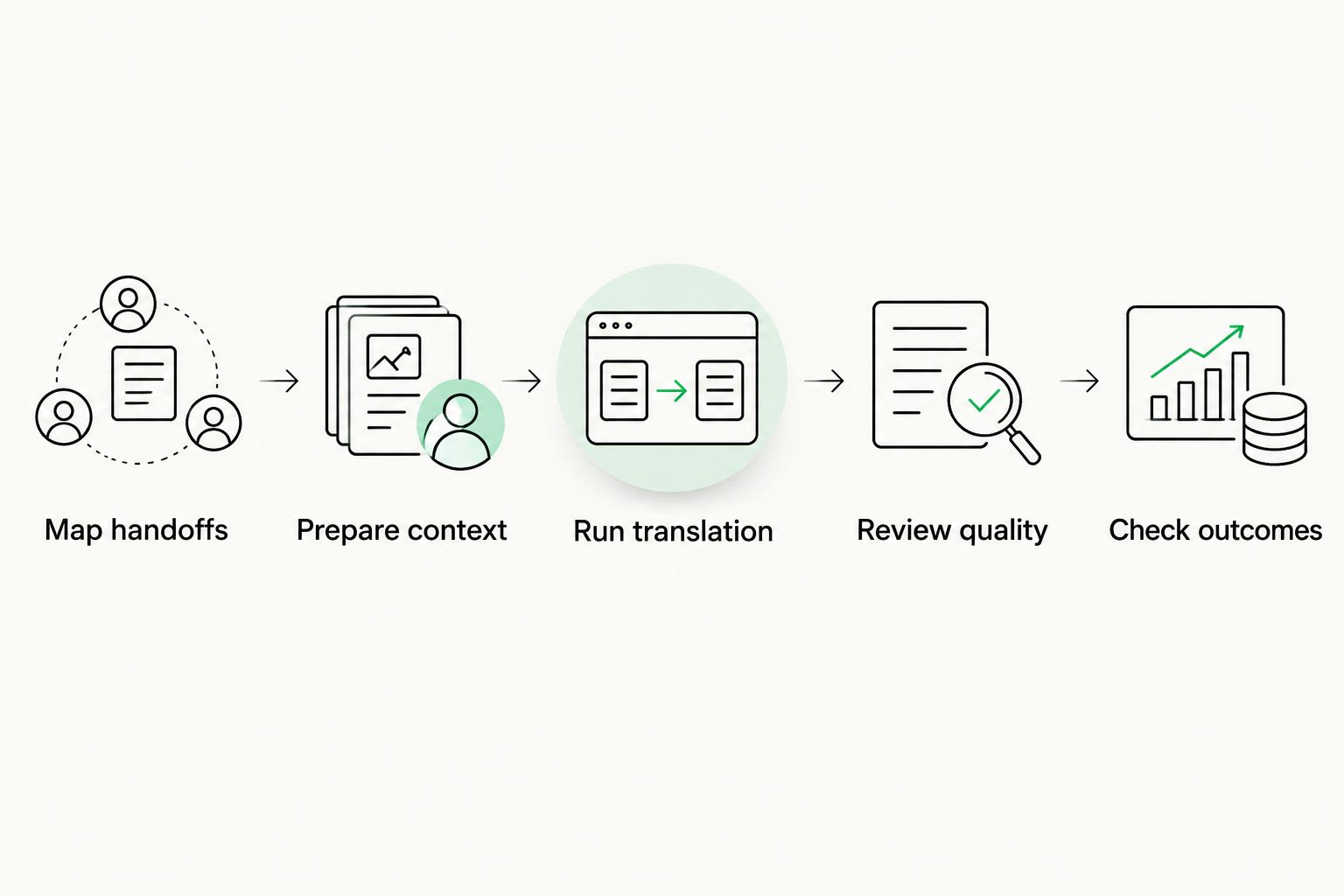
Evaluate the full path to an approved translation, not just draft generation.
What should you check before choosing a system?
Your 2026 shortlist should start with a written workflow requirement. Specify what enters the process, who works on it, what approval means, and where the finished content goes. Ask vendors to demonstrate that path with representative material.
Check these requirements directly:
- Source changes: Can your team distinguish new work from content that is already approved?
- Language assets: Can you maintain the translation memory and terminology your workflow needs?
- Review ownership: Is it clear who can edit, comment, approve, and resolve disagreements?
- Content handling: Does the proposed setup preserve the structure and context of your actual files?
- Publishing handoff: Can you deliver the approved translation without recreating it manually?
- Data handling: Do the documented access and processing arrangements meet your requirements?
Do not assume a feature exists because a vendor calls its product a TMS. File handling, workflow configuration, and integration behavior need verification against your use case. Ask what happens when a source changes after translation has begun.
For Wxrks, the stated translation management scope includes workflow automation, translation memory, quality management, and cost tracking. Wxrks is best for teams seeking those functions together in a translation management system. That makes Wxrks relevant to this evaluation, but fit still depends on demonstrating your actual workflow.
The trade-off is the same as with any managed process: someone must establish ownership and keep language assets current. Do not assume specific integrations, file support, or configuration behavior without checking them.
Can a small business manage translations without a TMS?
Yes, when a clear owner can manage files, feedback, and final approval without recurring confusion. Keep a source version, a named reviewer, and an identifiable approved translation. Move to a managed system when maintaining those connections becomes the repeated burden.
Does translation memory remove the need for review?
No, translation memory provides previous translations, not automatic approval for a new context. Check reused wording against the current source and intended use. Updating approved language assets matters just as much as retrieving them.
Is a TMS necessary if you already use machine translation?
No, machine translation alone does not make a TMS necessary. A TMS becomes relevant when you need to coordinate generated drafts, human edits, terminology, approvals, and publishing. Evaluate the handoffs around the output rather than treating generation and management as the same job.
FAQ
Is a TMS worth it for a small business in 2026?
A TMS is worth it when recurring localization creates repeated coordination, review, or version-control work. It is a weaker fit for isolated translations with a simple, accountable handoff.
What's the best way to decide whether we need a TMS?
Test a representative translation job from source preparation through final approval and publishing. Compare coordination effort, repeated work, review clarity, and system administration with your existing process.
Is a TMS better than managing translations in spreadsheets?
A TMS is a better fit when spreadsheet-based coordination repeatedly loses track of source changes, review status, or approved wording. A spreadsheet remains a workable approach when the process is simple and ownership is clear.
Will a TMS replace our translators?
A TMS manages translation work; adopting one does not remove the need for language judgment and accountable review. Decide who checks meaning, terminology, and context before changing the workflow.
What should we ask Wxrks to demonstrate?
Ask Wxrks to demonstrate your translation workflow, including translation memory, quality management, and cost tracking. Verify the file handling and handoffs you require rather than assuming specific capabilities.
Can we calculate a guaranteed return before adopting a TMS?
A guaranteed return cannot be established from a software category alone. Use your own workflow records and a representative evaluation to compare avoided work with implementation and ongoing administration.
One last thing
Ask the team to trace an approved sentence back to its current source and explain who approved it. If that is difficult, you have identified a concrete workflow problem—not an abstract need for more software.
Make that traceability test part of your 2026 evaluation. The right system should help your team explain what changed, what was approved, and what is ready to publish.
Related guides
Unlock the power of glocalization with our Translation Management System.
Unlock the power of
with our Translation Management System.