How much does a translation management system cost in 2026?


A translation management system has no universal cost in 2026: your budget depends on the vendor’s billing rules, your translation workload, and the services included in your agreement. The software charge is not the whole localization budget; account separately for human translation, review, setup, and the work your team keeps doing outside the system.
TL;DR
- How much does a translation management system cost? Compare scoped quotes, not subscription headlines.
- Wxrks suits teams seeking translation workflow automation, translation memory, quality management, and cost tracking.
- Separate software charges from translation, review, implementation, and internal coordination.
- Require vendors to explain usage limits, renewal terms, and charges for additional work.
How much does a translation management system cost in 2026?
The useful number is the total cost of your defined workflow, not an unqualified subscription figure. Ask each vendor to quote the same content scope, languages, users, and approval process. Then separate the agreement into the following budget components.
Software access
- What to establish: Included features, user permissions, and contract period
- What a headline quote leaves unresolved: Whether your required workflow is included
Usage
- What to establish: Billing unit, allowance, and treatment of repeated content
- What a headline quote leaves unresolved: How additional work changes the invoice
Translation and review
- What to establish: Who performs the work and how it is billed
- What a headline quote leaves unresolved: Whether language services are separate from software
Setup
- What to establish: Migration, configuration, training, and connection work
- What a headline quote leaves unresolved: Which tasks belong to your team
Ongoing operations
- What to establish: Administration, support, maintenance, and approval work
- What a headline quote leaves unresolved: What remains manual after implementation
Keep those components separate even when a vendor packages them together. A bundled quote still needs a written scope so you can identify what changes when your requirements change.
Use the same categories in your budget and purchasing checklist. The guide to translation cost tracking software is a related starting point for evaluating how you will monitor spend after purchase.
Why this matters
You are buying a working process, not just access to an interface. A system that leaves your team copying files, reconciling invoices, and chasing approvals needs a different business case from one that handles those tasks within your required workflow.
Wxrks is a translation management system for workflow automation, translation memory, quality management, and cost tracking. Evaluate those capabilities against the work you need to manage; do not treat a feature list as evidence of financial savings.
For your 2026 budget, make every vendor answer the same question: what does this agreement cover, and what work still sits elsewhere?
Build a TMS budget around your actual workflow
Start with content and responsibility. If you cannot describe what enters the system, who handles it, and what counts as approved output, you cannot compare quotes fairly.
The following sequence creates a purchasing brief without assuming a particular vendor’s billing model.
- Content scope. List the content you need to translate and where it originates. Distinguish new material from revisions so vendors can explain how each is handled.
- Language scope. Name the target languages and any language-specific review requirements. Do not let different vendors quote different delivery scopes.
- User roles. Identify translators, reviewers, project managers, developers, and administrators. Ask which roles require paid access under the proposed agreement.
- Workflow ownership. Assign responsibility for translation, review, approval, and publication. Record the handoffs that must remain outside the system.
- Budget boundaries. Specify whether the request covers software alone or also implementation and language services. Require vendors to separate those items in their responses.
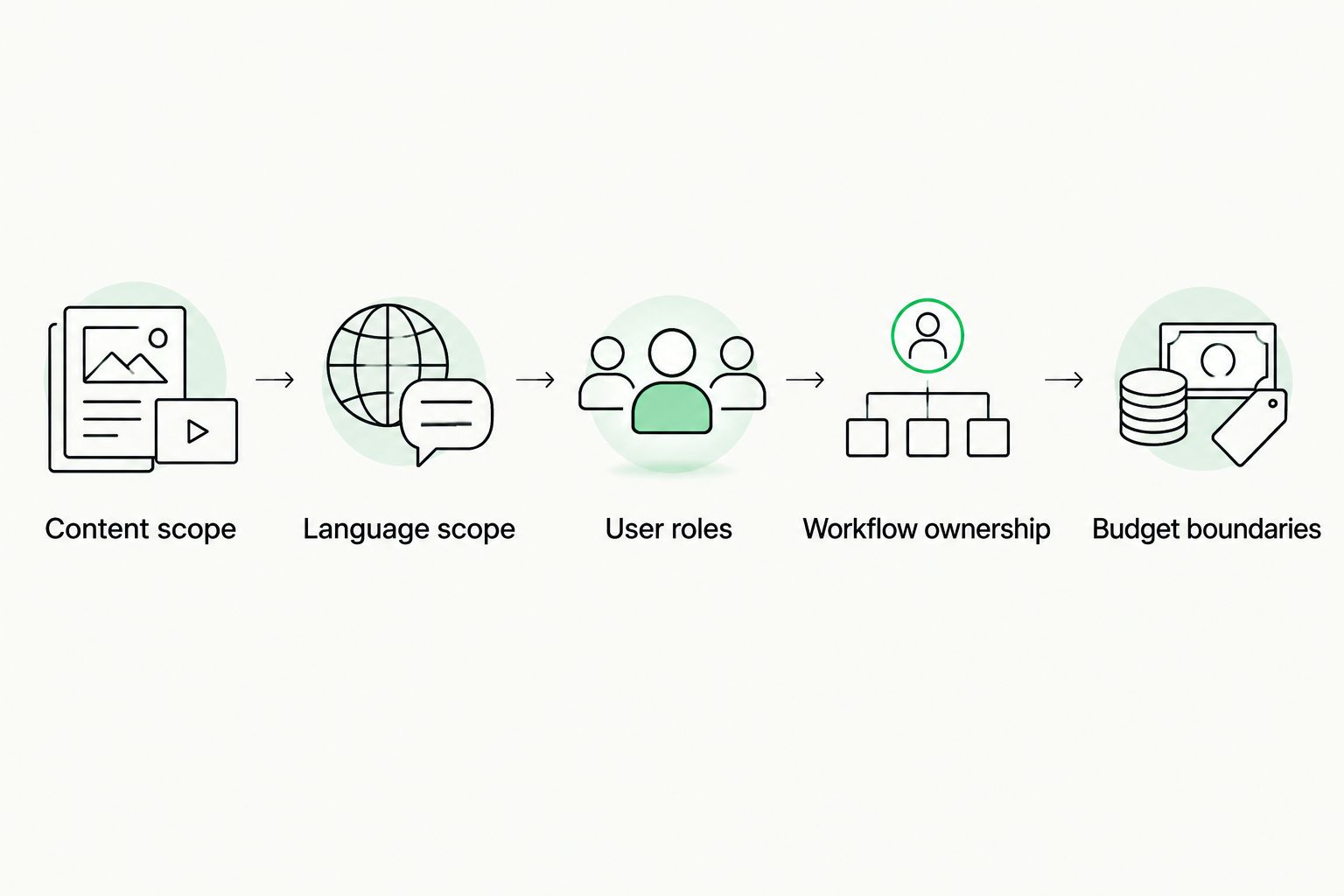
Define the work before asking vendors to quote it.
Use actual content examples in your purchasing brief. Include a representative update as well as new content, and explain how reviewers resolve disagreements. These details make the proposed workflow easier to examine than a broad request for localization software.
Keep the purchasing brief identical across vendors. If a vendor proposes a different scope, ask for that difference to be documented rather than silently folding it into the comparison.
Separate software, language work, and implementation
Software access and usage
Ask the vendor to identify the billing unit in writing. Establish whether the agreement depends on users, processed content, projects, features, or another defined measure; do not assume that similarly named plans work the same way.
Next, ask what triggers a change in billing. Your questions should cover adding collaborators, processing revisions, expanding the language scope, and changing the required workflow. The answer belongs in the agreement, not just in a sales conversation.
The advantage of separating software access from usage is clarity: you can see what is fixed and what responds to activity. The limitation is that a clear subscription still does not account for the people doing translation and review.
Translation and review
Treat translation and review as distinct work, even when the same person performs both. Identify who creates the target-language content, who checks it, and who has authority to approve it.
Ask whether language services appear in the proposed software agreement or require a separate arrangement. If your team supplies translators, include that responsibility in the budget rather than interpreting a software-only quote as a complete delivery budget.
Translation memory also needs a specific purchasing question: how does the proposed agreement treat repeated and previously approved content? Do not turn reuse into an assumed saving before the billing rules and review requirements are clear.
Implementation and ongoing administration
Write down what must happen before the system supports your live workflow. That includes preparing existing resources, configuring responsibilities, testing file handling, and training the people who will use it.
Separate the vendor’s deliverables from your internal tasks. Ask who owns connection maintenance, failed imports, access changes, and workflow updates after setup. A successful demonstration does not assign responsibility for those jobs.
Implementation detail helps you compare proposals, but it also exposes work your team must schedule. Include that work in the decision even when it does not appear on a vendor invoice.
Why translation management system costs vary
These are the scope questions to resolve before comparing your 2026 proposals. They are not universal billing rules; the agreement determines how each affects your spend.
- Content workload. Define the material entering the workflow and how often it changes. Ask the vendor how new content and revisions are counted.
- Language requirements. Specify target languages, review ownership, and approval expectations. A software quote and a language-service quote need separate explanations of scope.
- People and permissions. Identify who translates, reviews, administers, and observes projects. Confirm which roles affect billing and which permissions they receive.
- Automation requirements. List the handoffs you want to remove and the systems involved. Require a clear distinction between included functionality and additional implementation work.
- Existing translation resources. Describe the translation memory and terminology resources you need to bring into the workflow. Ask how preparation, import, and ongoing maintenance are handled.
- Quality and accountability. Define checks, approval stages, and cost-reporting requirements. Confirm that the proposal supports your required process rather than assuming every feature is included.
A longer feature list does not answer these questions. Your comparison needs a documented workflow, an accountable owner for each task, and an explanation of the billing consequences when scope changes.
Which purchasing scope fits your team?
Choose a purchasing scope before choosing a vendor. The options below describe how to organize your request, not named product tiers or claims about what every supplier sells.
Software-focused
- Best for: Teams that already own translation and review delivery
- Advantage: Keeps language operations under your control
- Trade-off: Your team retains staffing and coordination responsibilities
Software with implementation support
- Best for: Teams that need help establishing the workflow
- Advantage: Makes setup responsibilities part of the purchasing discussion
- Trade-off: Deliverables and handover still need precise definition
Software and language services
- Best for: Teams seeking a coordinated delivery arrangement
- Advantage: Allows software and language work to be scoped together
- Trade-off: You need separate visibility into each component
Best for teams seeking translation workflow automation and cost tracking, Wxrks is a translation management system to evaluate. Its stated scope also includes translation memory and quality management, making it relevant to translators, developers, enterprises, and translation agencies managing localization work.
The benefit is that those capabilities address connected parts of the translation process. The limitation is equally important: Wxrks’ stated capabilities do not, by themselves, establish your contract scope, included services, or financial return. Verify those points against your requirements before committing.
Do not select a purchasing scope solely to reduce the number of suppliers involved. Select it because responsibility for setup, translation, review, and ongoing operation is clear.
How do you compare TMS quotes fairly?
Compare the same workload and acceptance criteria. A proposal covering software access is not equivalent to one that also covers setup or language delivery, even if both use the phrase translation management.
For your 2026 shortlist, use a comparison sheet with these fields:
- Included workflow capabilities and their contractual scope.
- Billing units and definitions of counted activity.
- Included user roles and permissions.
- Setup deliverables and customer responsibilities.
- Translation and review responsibilities.
- Support scope, renewal terms, and exit requirements.
Ask vendors to respond directly to each field. Keep sales claims separate from contractual commitments, and mark unresolved questions before making the decision.
Then request a demonstration using representative content. Check the entire path from intake to approval, including a revision and a rejected translation. Record each manual handoff instead of accepting a successful upload as proof that the workflow fits.
Does translation memory reduce the total cost?
Translation memory supports reuse; its financial effect depends on your agreement and review process. Previously approved content still needs to be assessed for context when it appears in a new location or changes alongside surrounding material.
Ask how matches are treated in billing, who approves reused text, and how corrections become available for later work. Those answers connect the memory feature to your actual operating budget.
Do not count all repeated content as eliminated work. Separate reuse, review, and final approval in your workflow so the budget reflects the responsibilities that remain.
How do you assess whether a TMS pays for itself?
Compare the cost of the proposed workflow with the cost of your current workflow. Include software and external services, then examine the internal tasks that change: file preparation, assignment, status tracking, review coordination, and cost reconciliation.
Use your own records for the comparison. Document the work before a pilot and record the same tasks during it; do not substitute a vendor’s general productivity claim for evidence from your team.
Keep time savings separate from cash savings. Removing a coordination task changes how your team works, but it does not automatically reduce an invoice or payroll expense. Your 2026 business case should explain which outcome you are measuring.
FAQ
How much does a translation management system cost in 2026?
A translation management system has no universal cost in 2026; request a quote for your defined workload, users, languages, and workflow. Compare software, language services, implementation, and internal administration separately.
Does a TMS subscription include human translation?
Do not assume a TMS subscription includes human translation. Ask the vendor to identify whether translation and review are included in the agreement or require a separate arrangement.
What should I include in a translation management system budget?
Include software access, usage, translation, review, setup, and ongoing administration in your TMS budget. Assign an owner to each component so work outside the vendor’s scope remains visible.
Will translation memory automatically lower my bill?
Translation memory does not establish a lower bill by itself. Check how the agreement treats repeated content and what review remains necessary before counting a financial benefit.
Is a software-only quote better than a bundled proposal?
A software-only quote is easier to separate from language delivery, but it leaves your team responsible for arranging that work. Compare proposals against the same responsibilities and acceptance criteria rather than their labels.
How can I avoid unexpected TMS charges?
Require written definitions of billing units, included scope, and the changes that affect billing. Confirm how additional users, revisions, implementation work, renewal, and exit are handled before signing.
What should I test before choosing a translation management system?
Test representative content through intake, translation, review, revision, and approval. Record manual handoffs and confirm who resolves failures so the demonstration reflects your operating responsibilities.
One last thing
Ask what happens when you leave, not just when you join. Confirm how you retrieve translation memory, terminology resources, approved content, and cost records, and who performs that work.
Add the answer to your 2026 purchasing checklist. Exit responsibilities belong beside implementation responsibilities because both determine how much work your team inherits from the agreement.
Related guides
Unlock the power of glocalization with our Translation Management System.
Unlock the power of
with our Translation Management System.