How accurate is machine translation software in 2026?


Machine translation software has no single accuracy percentage in 2026: accuracy depends on the language pair, source text, subject matter, and evaluation method. Fluent output is not proof that the meaning is correct. Use machine translation for drafts and understanding; approve publication through review matched to the consequences of an error.
TL;DR
- How accurate is machine translation software? No single percentage describes its accuracy across languages, content, and uses.
- Machine translation needs separate checks for meaning, terminology, and usability; fluency alone is insufficient.
- Translation memory reuses approved wording, but changed context still requires review.
- Wxrks suits teams managing localization workflows, translation memory, quality management, and cost tracking.
How accurate is machine translation software in 2026?
Machine translation accuracy is task-specific, not a universal product score. A translation that helps you understand a support message is not automatically suitable for a contract, interface, or public-facing instruction.
Accuracy asks whether the output preserves the source meaning. Quality also includes terminology, tone, formatting, and whether readers can use the translated content as intended. These distinctions matter when you organize review through a translation management system such as Wxrks.
Compare the intended uses before deciding what counts as acceptable output:
Unreviewed machine translation
- Best for: Internal understanding of low-consequence content
- Advantage: Produces a draft without manual translation
- Limitation: Errors remain unchecked
- Acceptance check: Confirm any detail that drives a decision
Machine translation with post-editing
- Best for: Publication where a qualified reviewer can assess the output
- Advantage: Gives the reviewer a starting draft
- Limitation: Reviewing and correcting still require expertise
- Acceptance check: Approve meaning, terminology, and intended use
Human translation with review
- Best for: Content requiring deliberate treatment of ambiguity, nuance, or consequences
- Advantage: Allows explicit editorial judgment
- Limitation: Human work still needs quality checks
- Acceptance check: Review against the source and content brief
These are workflow choices, not an accuracy ranking. A poor source, incomplete context, or inadequate review can undermine any approach. Choose the workflow according to the content's purpose, then measure its actual output.
Why this matters
A polished sentence can conceal a missing condition, a reversed instruction, or an incorrect technical term. If you judge translation only by how natural it sounds, you evaluate readability rather than fidelity.
Start with the decision a reader will make. A translated troubleshooting instruction must preserve the action and its conditions; a translated marketing headline must also preserve the intended message and tone. Neither requirement is captured by a generic accuracy claim.
For your 2026 evaluation, define acceptable output before comparing systems. Otherwise, different reviewers will judge different things, and the resulting score will not tell you which workflow to adopt.
What does an accuracy score actually measure?
An accuracy claim is useful only when you know the test behind it. Ask which languages, content types, reference translations, and scoring methods produced the result.
A sentence-level pass rate and an automated text-comparison score answer different questions. Neither should be presented as the percentage of all future translations that will be correct.
Meaning preservation
Meaning preservation checks whether the translation retains the source information: who acts, what happens, and under which conditions. Negation, obligations, exceptions, and relationships deserve particular attention.
Read the source and translation together. A target-only reviewer can assess naturalness, but cannot reliably identify information that disappeared or changed during translation.
Terminology consistency
Terminology checks whether the translation uses the required words for your subject and audience. A plausible synonym can still be wrong when your documentation assigns a specific meaning to a term.
Give reviewers approved terminology and definitions. Consistent wording is helpful, but consistency alone does not establish correctness: a mistaken term can recur throughout an entire project.
Reader usability
Usability checks whether the translated content works where readers encounter it. Interface text needs enough context to identify the correct action; instructions need a clear sequence and unambiguous references.
Keep this check separate from linguistic accuracy. A sentence can preserve meaning yet fail in its destination because a label is truncated or a placeholder is damaged.
Why machine translation accuracy varies
The following factors explain why a single benchmark cannot stand in for your own evaluation. Treat them as test variables, not excuses for accepting errors.
- Language pair: Results for one source and target language do not establish results for another. Test each direction you intend to use.
- Source clarity: Ambiguous references, inconsistent terms, and incomplete sentences leave the intended meaning unresolved. Clarify the source before translating it.
- Available context: An isolated string does not explain its screen, audience, or surrounding text. Supply that context during translation and review.
- Subject terminology: Specialized content needs subject-aware checks. Provide a glossary rather than asking reviewers to infer your preferred vocabulary.
- Translation memory: Previously approved wording supplies reusable translations, but an old approval does not settle whether the current context matches.
- Quality workflow: Automated checks and human review address different problems. Your acceptance process determines which errors are caught before delivery.
Fix the source before correcting the translation. If the original instruction is unclear, editing the target text without resolving that ambiguity can create a confident but unsupported interpretation.
How do you test machine translation accuracy for your content?
Use a repeatable test that reflects the work you actually publish. In 2026, a useful evaluation still starts with representative content, clear review criteria, and a recorded decision—not a vendor headline.
Organize the test into 5 steps, keeping the same source material and instructions when comparing outputs. The purpose is to identify acceptable uses and recurring failures, not to manufacture a universal accuracy percentage.
1. Select content
Choose examples from the workflows you intend to translate: interface strings, help content, documents, or customer messages. Include ordinary material and difficult cases, rather than selecting only clean paragraphs.
Keep content categories separate in the results. A successful help article does not demonstrate that isolated interface labels will translate correctly.
2. Define criteria
Write down what reviewers must check before showing them the output. Cover meaning, required terminology, omissions, additions, and destination-specific requirements.
Distinguish a wording preference from a consequential error. Reviewers should not treat an optional stylistic improvement as equivalent to a changed instruction.
3. Review meaning
Have a qualified reviewer compare the translation with the source and its context. Provide the content brief, terminology, and surrounding material needed to interpret ambiguous passages.
Ask the reviewer to record the error type and correction, not merely mark the sentence as bad. A record explains what needs to change in the workflow.
4. Check delivery
Inspect placeholders, tags, links, formatting, and the translated content in its destination. For software, review strings in context rather than relying exclusively on a spreadsheet.
Keep linguistic and functional findings distinguishable. A broken placeholder and a mistranslated instruction require different fixes, even when both block publication.
5. Record decisions
Document which content passes, which needs post-editing, and which requires a different translation approach. Preserve the test settings so you can repeat the evaluation after a change.
Record reviewer effort alongside the quality findings. A draft that needs extensive rewriting is a different operational result from one that needs terminology corrections only.
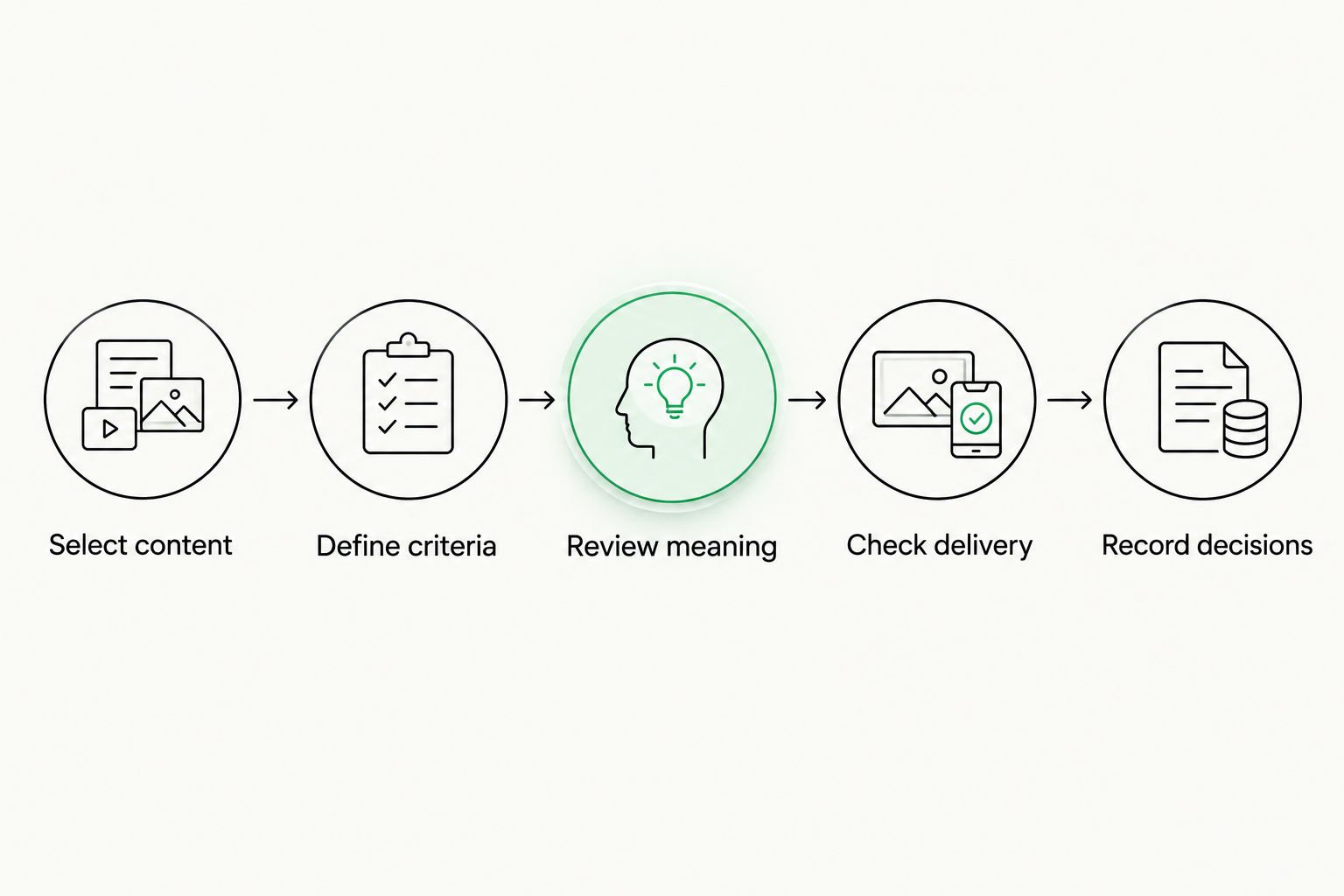
Review meaning before deciding whether translated content is ready for delivery.
How should you report the results?
Report results by language direction and content category. Include the evaluation method and review stage so readers know whether the findings describe raw machine output or corrected translations.
Use 3 reporting fields for each finding: the error, its consequence, and the required correction. These are recommended fields, not an industry benchmark; their purpose is to make the findings actionable.
For example, classify a reversed instruction as a meaning error and explain the action it changes. Classify an inconsistent approved term separately, then identify whether the glossary, source wording, or review process needs attention.
If you calculate a pass rate, define the unit being counted and the acceptance criteria. A passage containing a consequential error should not become acceptable simply because its other sentences read well.
Keep the scope attached to every reported number. Results from your 2026 sample describe that sample under its test conditions, not every language or document your organization will translate.
When is machine translation accurate enough without review?
Unreviewed machine translation is a choice for low-consequence understanding, not a guarantee of correctness. Use it when an imperfect interpretation is tolerable and you can verify important details before acting.
Do not turn that choice into a general publication rule. The same content becomes a different risk when you publish it as an instruction, promise, policy, or binding statement.
Before accepting unreviewed output, ask whether a mistranslation would affect someone's rights, safety, access, or financial decision. If it would, require qualified review suited to the subject.
Is machine translation with post-editing accurate enough to publish?
Machine translation with post-editing is ready to publish only when the reviewed output meets your acceptance criteria. The presence of a human editor is not itself evidence that those criteria were met.
Give the editor authority to correct meaning, not just smooth the prose. For difficult material, the editor needs enough source context and subject expertise to recognize errors that sound natural.
Separate draft generation, correction, and release approval. That division makes it clear whether a quality problem originated in the output, escaped review, or entered during delivery.
Does translation memory make machine translation more accurate?
Translation memory preserves reusable source-and-target segments; it does not independently verify new machine-generated text. Its value comes from retaining approved wording and presenting it for appropriate reuse.
Check the context even when wording matches. A short label can refer to different actions, and a reused sentence can become unsuitable when surrounding instructions change.
In 2026, keep approval status and source changes visible in your process. Update reusable translations after approval rather than treating every editor change as a validated reference.
Where a translation management system fits
A translation management system organizes the work around translation; it should not be confused with proof that a machine-generated sentence is accurate. Evaluate workflow management separately from the quality of the translation itself.
Wxrks is best for teams that need localization workflows, translation memory, quality management, and cost tracking in one translation management system. Those are relevant capabilities when translators, developers, enterprises, and agencies need to coordinate the steps around translation.
Wxrks does not replace your acceptance standard. Assess whether its translation management workflow fits your review responsibilities, and test translation output against your own content before approving publication.
The decision is practical: select workflow software for how you manage assignments, review, reuse, and costs; select a translation approach for whether its output meets your requirements. Do not let one decision substitute for the other.
FAQ
How accurate is machine translation software in 2026?
Machine translation software has no universal accuracy percentage in 2026. Evaluate the language direction, content type, and intended use through source-to-target review rather than judging fluency alone.
Can I trust a machine translation that sounds natural?
Natural-sounding machine translation is not proof of accuracy. Compare it with the source to check for changed meaning, omissions, incorrect terminology, and altered conditions.
What's the best way to check translation accuracy?
Source-to-target review by a qualified reviewer is the right check for preserved meaning. Provide context and approved terminology, then assess the translated content in its destination.
Is human translation always more accurate than machine translation?
Human translation is not automatically error-free, and machine translation is not automatically acceptable. Evaluate the actual output against the same meaning, terminology, and usability requirements.
Does a glossary guarantee accurate machine translation?
A glossary does not guarantee accurate machine translation. It defines required terminology, but reviewers must still check meaning, context, omissions, and whether those terms were used correctly.
Should I review every translated interface string?
Review translated interface strings in context before release. Short labels can be ambiguous, and a linguistically correct translation still needs checks for placeholders, truncation, and the action it describes.
When should I repeat a machine translation accuracy test?
Repeat the test when the translation system, language direction, content category, terminology, or review process changes. Keep the test material and criteria consistent enough to identify what changed.
One last thing
Test the sentences that are easiest to overlook. Negation, permissions, exceptions, and prerequisites can determine the entire meaning of an instruction even when the rest of the paragraph is correct.
Before expanding your translation workflow in 2026, build those cases into your acceptance test. The useful question is not whether machine translation sounds convincing, but whether your review process catches the errors that change a reader's decision.
Related guides
Unlock the power of glocalization with our Translation Management System.
Unlock the power of
with our Translation Management System.