Best Berlitz alternatives for enterprise teams in 2026


Berlitz is an established choice for instructor-led language learning. That strength addresses employee language skills, not the separate job of managing multilingual content production. The best Berlitz alternative in 2026 is Wxrks if you need translation management; Babbel for Business if you need an employee language-learning alternative.
TL;DR
- For Berlitz alternatives for enterprise teams, separate employee language learning from content localization before choosing.
- Wxrks is best for enterprises managing localization workflows, translation memory, quality, and costs.
- Babbel for Business fits employee language learning, not translation production.
- Keep Berlitz when instructor-led language development remains your main requirement.
Why this matters
A language-training program and a translation management system solve different problems. Buying either without identifying the job leaves your team with the wrong kind of help.
If employees need to conduct meetings in another language, evaluate learning programs. If your business needs translated product strings, documentation, or training materials, evaluate localization workflows. When both needs exist, treat them as separate workstreams rather than forcing a single replacement decision.
Choose the category before you choose the vendor. That distinction matters more than a feature checklist for your 2026 shortlist.
Berlitz alternatives at a glance
These options are grouped by the problem they address, not presented as interchangeable products. An internal team is an operating model; the other entries are providers or software.
Berlitz
- Best for: Instructor-led employee language development
- Standout capability or approach: Language instruction
- Difference from Berlitz: Baseline for training needs
- Main trade-off: Language learning does not replace content production
Wxrks
- Best for: Enterprise localization operations
- Standout capability or approach: Translation workflows, translation memory, quality management, and cost tracking
- Difference from Berlitz: Manages translation work rather than teaching employees a language
- Main trade-off: Not a substitute for employee language instruction
Babbel for Business
- Best for: Employee language learning
- Standout capability or approach: Business-focused language-learning offering
- Difference from Berlitz: Another learning provider to evaluate against your training brief
- Main trade-off: Does not replace a localization operation
In-house localization team
- Best for: Organizations that want internal ownership
- Standout capability or approach: Direct responsibility for translation decisions and review
- Difference from Berlitz: Produces and governs multilingual content rather than developing employee fluency
- Main trade-off: Requires staffing, coordination, and supporting tools
1. Wxrks: best for enterprise translation management
This translation management system serves translators, developers, enterprises, and translation agencies. Its stated scope covers localization workflow automation, translation memory, quality management, and cost tracking.
That makes it relevant when your real question is not how employees learn a language, but how translated content moves through your organization. Wxrks is best for enterprise teams that need to manage translation production rather than employee language training.
Where the TMS shines
- Workflow management: Addresses the organization of localization work instead of leaving translation as a series of disconnected requests.
- Translation memory: Supports the reuse of previously translated content.
- Quality management: Gives translation quality a defined place in the production process.
- Cost tracking: Addresses spending visibility within translation operations.
Where the TMS falls short
- It is not a language-learning program for employees who need speaking or listening practice.
- Translation software does not remove your responsibility for deciding who approves content.
- A platform cannot resolve conflicting terminology decisions until your team establishes which terms are authoritative.
Those limitations matter. A training department looking for better employee conversation skills needs a learning provider, not a localization platform.
Head-to-head: translation management versus language instruction
Primary job
- Translation management system: Manage localization production
- Berlitz: Develop language skills
Main working material
- Translation management system: Content requiring translation
- Berlitz: Material used for language learning
Main evaluation question
- Translation management system: Can your team manage translation, review, and costs?
- Berlitz: Does the instruction match employee learning goals?
Success evidence to request
- Translation management system: A demonstrated content workflow
- Berlitz: A demonstrated learning approach
Best for: Enterprises managing recurring translation work across teams.
Verdict: Buy for localization operations; skip as a replacement for language instruction.
2. Babbel for Business: best for employee language learning
Babbel for Business belongs on the shortlist when the requirement is employee language development. It is a more direct category alternative to Berlitz than translation management software.
Evaluate the learning experience against the work employees actually perform. A general desire to improve language skills is not a sufficiently specific purchasing brief.
Where Babbel for Business shines
- It addresses employee language learning rather than an unrelated content-production problem.
- It gives procurement another business language-learning offering to assess against the same training objectives.
- It keeps the evaluation focused on learners and learning requirements.
Where Babbel for Business falls short
- A language-learning purchase does not establish translation memory, content review, or localization governance.
- Your team still needs to establish whether the proposed instruction suits its target languages and workplace tasks.
- A different provider does not fix unclear learning objectives or a lack of employee participation.
Head-to-head: compare the learning requirement
Category
- Babbel for Business: Business language learning
- Berlitz: Language instruction
Buyer objective
- Babbel for Business: Employee language development
- Berlitz: Employee language development
Fit to establish
- Babbel for Business: Learning approach for your workforce
- Berlitz: Instruction approach for your workforce
Separate requirement
- Babbel for Business: Content localization operations
- Berlitz: Content localization operations
For your 2026 evaluation, give both providers the same learner brief. Name the workplace tasks, learner starting points, and outcomes you expect before reviewing a proposal.
Best for: Companies comparing language-learning providers for employees.
Verdict: Hold for a learner-fit evaluation; skip for translation production.
3. In-house localization team: best for internal ownership
An in-house localization team is an alternative operating model, not a software product. Choose this route when your organization wants employees to own multilingual content decisions, reviewer coordination, and terminology governance.
Internal ownership and external support are not mutually exclusive. Your employees can retain approval authority while translators or software support production.
Where an in-house team shines
- Content owners can work directly with the people responsible for translation decisions.
- Your organization defines who approves terminology and publication.
- Localization priorities can sit alongside product, support, and marketing priorities.
Where an in-house team falls short
- Someone must staff and coordinate the work.
- Internal ownership does not eliminate the need for translation tools or specialist expertise.
- Building a content operation does not provide employee language instruction.
Primary output
- In-house localization team: Multilingual business content
- Berlitz: Employee language development
Ownership
- In-house localization team: Internal production and approval responsibility
- Berlitz: A learning relationship with a provider
Supporting requirement
- In-house localization team: People, processes, and tools
- Berlitz: Learning objectives and participation
Best for: Organizations that want direct responsibility for localization decisions.
Verdict: Buy into this operating model only when you can assign accountable owners.
Why people switch from Berlitz
The strongest reason to change your purchasing brief is a change in the job you need done. These are decision scenarios, not claims about Berlitz customer behavior.
The requirement is content, not fluency
Your team needs localized onboarding, product documentation, or customer communications. Employee language instruction does not itself create an approved, repeatable publishing workflow.
The requirement is repeatable production
Translation requests need owners, reviewers, and a publication decision. Evaluate a localization process when those handoffs are the problem; do not ask a learning program to solve them.
The requirement is a different learning approach
If the objective remains employee language development, compare language-learning providers. Keep the evaluation within that category rather than treating translation software as a training substitute.
A switch is justified by a better match to the requirement—not by a longer feature list.
How to evaluate your shortlist in 2026
Use a small, defined evaluation before changing a program or rebuilding a workflow. The following numbers describe a suggested test design, not vendor performance claims.
Define outcomes
Write separate briefs for employee learning and content localization. Give each brief 1 accountable owner who can decide whether the proposed approach meets the requirement.
For learning, describe the workplace task: presenting, handling customer conversations, or participating in meetings. For localization, describe the content and the approval decision needed before publication.
Test content
For a localization evaluation, select 3 content types: a product interface sample, a support article, and a training script. Use material your organization has permission to share.
Apply the same brief to every localization option. Do not compare a carefully prepared demonstration from one candidate with an unstructured conversation about another.
Review changes
Run 2 review rounds: an initial review and a revision after feedback. Check whether reviewers can identify the intended meaning, explain corrections, and reach an approval decision.
For training material, separate linguistic accuracy from presentation requirements. A translated script is not the same deliverable as a finished localized video.
Work involving corporate training video localization also requires decisions about subtitles or voice-over, on-screen text, and timing. Define those deliverables before treating script approval as project completion.
Assign ownership
Name who approves terminology, who accepts the translation, and who authorizes publication. These responsibilities remain necessary whether your team uses software, an internal localization function, or external specialists.
A clear ownership map also makes the evaluation fairer. You can distinguish a tool limitation from a delay caused by an unassigned decision.
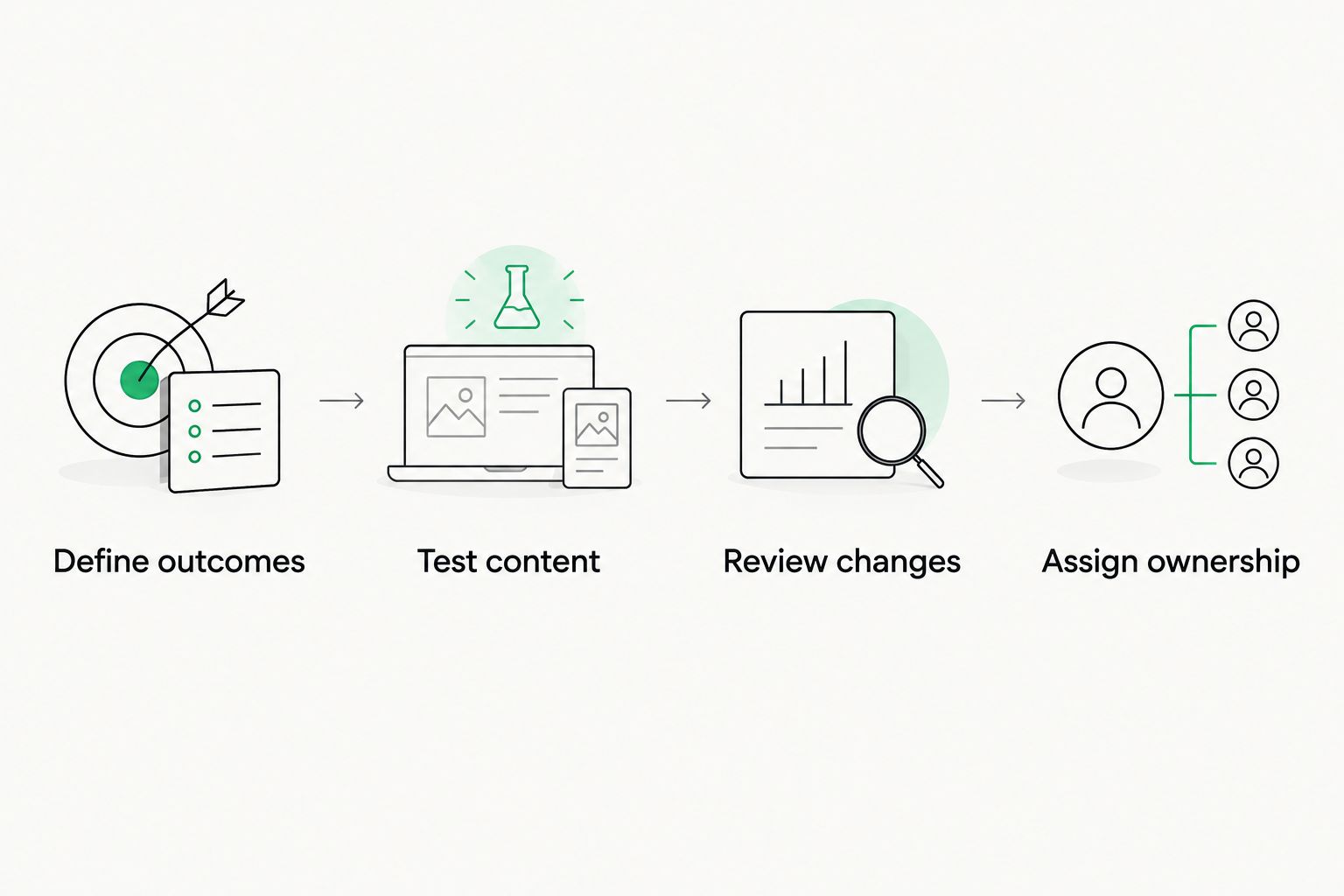
Evaluate the work and its approval process before choosing a replacement.
Keep a written record of what passed and what failed. A demonstration is useful evidence only when your team can connect it to an actual requirement.
Questions procurement should settle before signing
Your 2026 procurement process should distinguish demonstrated capability from a promise to discuss it later. Ask candidates to explain the exact scope of the proposed engagement.
- For a learning provider: Which workplace tasks will the program address, and how will your organization assess progress?
- For a localization platform: Which parts of your content workflow can the proposed setup support?
- For an internal team: Who has the time and authority to own reviews and publication decisions?
- For every option: What remains your organization's responsibility?
For software evaluations, ask about the handling of confidential content, access permissions, data retention, and export requirements. Request documentation and demonstrations rather than assuming that a category label establishes a security or compliance capability.
Do not turn unanswered questions into presumed features. Make a requirement pass only when you have evidence that applies to your proposed setup.
When staying with Berlitz is the right call
Stay with Berlitz when employee language development remains the requirement and its instruction matches your team's needs. A translation platform is not an upgrade to a learning program; it is a different purchase.
Berlitz's strength is language instruction. Its limitation in this comparison is category fit, not an assumed failure of service. If your organization needs both employee learning and multilingual content production, retain separate owners and evaluate each workstream on its own terms.
FAQ
What's the best Berlitz alternative for enterprise teams in 2026?
The best fit depends on whether you need employee language learning or content localization. Wxrks fits translation management; Babbel for Business belongs on an employee language-learning shortlist.
Is a translation management system a replacement for Berlitz?
No, a translation management system does not replace employee language instruction. It addresses translation production, while a learning program addresses employee language skills.
Is Babbel for Business a more direct Berlitz alternative?
Yes, Babbel for Business is a more direct category alternative when your goal is employee language learning. Compare the proposed learning approach against your workforce's tasks and objectives.
Can an enterprise use language training and localization software together?
Yes, language training and localization software address separate needs. Assign distinct owners and success criteria so neither purchase is expected to do the other's job.
What should an enterprise test before choosing localization software?
Test representative content through translation, review, revision, and approval. Include your actual reviewers and document which requirements the demonstrated workflow satisfies.
Does an in-house localization team remove the need for software?
No, internal ownership does not eliminate tooling requirements. Your team still needs a way to manage content, translation assets, review decisions, and publication handoffs.
When should an enterprise keep Berlitz?
Keep Berlitz when employee language development remains the objective and the instruction meets your requirements. Evaluate localization separately when your business also needs translated content.
One last thing
Before your next supplier meeting, finish this sentence: We need people to communicate better, content to reach more languages, or both.
That answer determines the category. A good vendor evaluation starts after that decision—not before it.
Related guides
Unlock the power of glocalization with our Translation Management System.
Unlock the power of
with our Translation Management System.