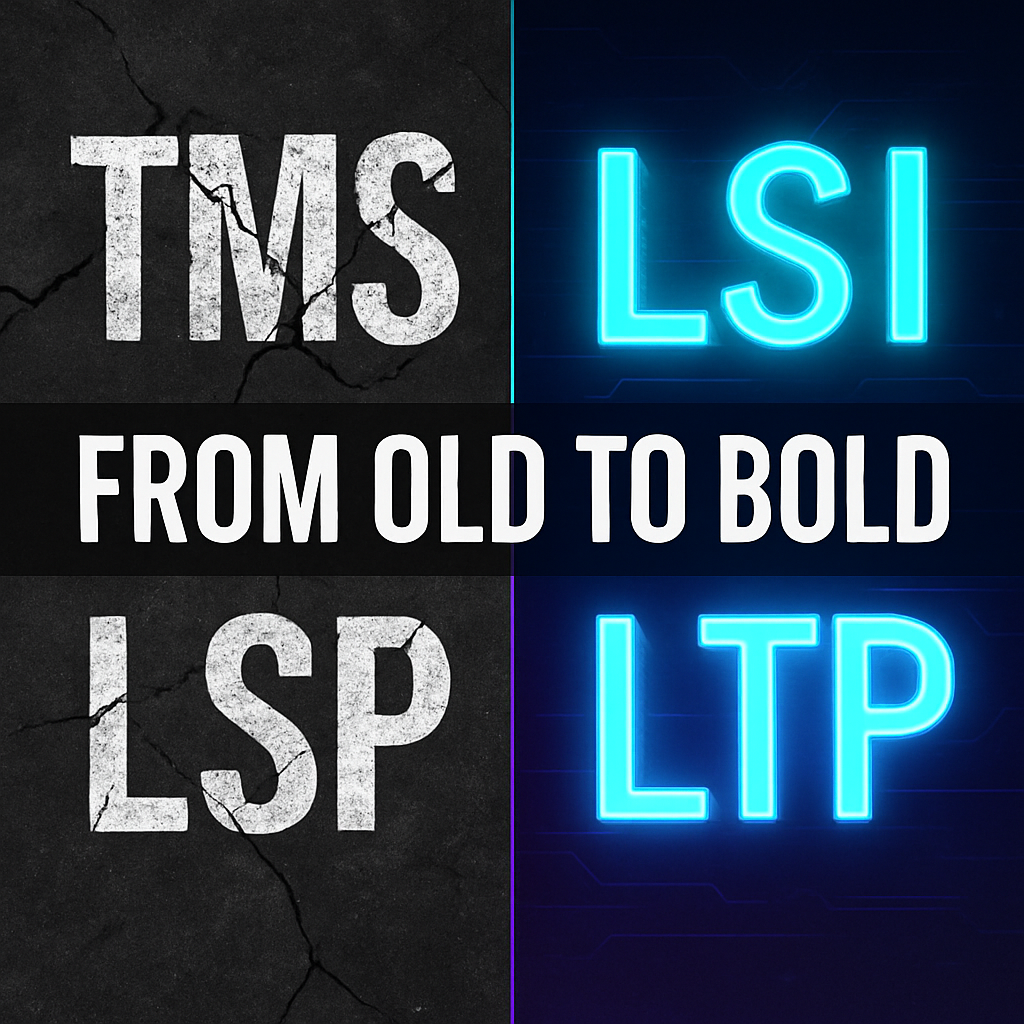


Some companies now tell their localization teams they want "no TMS." Some executives go further and ask why they need a content management system at all, much less a translation management system (TMS), the software that holds a company's translations, terminology, and workflows.
On October 13, Centific's The Signal Room Podcast opened a new series, the Signal Room Sessions, with that question. Host Vincent Swan sat down with Istvan Lengyel, founder of BeLazy, Jeff Kent of Centific, and our CEO, Gabriel Fairman. Between them they bring more than 60 years of work on translation systems. You can watch the full episode on YouTube.
Here is what Gabriel argued, in his words. Quotes are lightly edited for clarity.

Customers Want AI and Predictability at Once
Jeff opened with a signal from his own work. The industry is getting comfortable with imperfection, because AI gives probable answers instead of the same answer every time. Gabriel said he feels that comfort himself. "I'm more focused on concepts and ideas and the gist of things and getting things done."
His customers feel the opposite. "I see our customers more worried than ever about the accuracy and predictability of these things," he said. They want AI, and they want results they can count on, so they hold on harder to structure they already trust, like segments and strict file parsing.
That is the tension every translation team lives with now, and it is why wxrks keeps the structure under the AI. Context Sensitivity brings your memory and glossary into every suggestion before a person reviews it, and Free Flow lets a linguist work on the whole text instead of one segment at a time, on the same record.
AI Is a Tool, and People Stay in Charge
Gabriel studied the philosophy of language, with a major he named "the death and rebirth of human agency," and his signal for the week came from there. Most sentences about AI, he said, describe it as its own entity, as if nobody created it, deployed it, or controls it.
"When people say AI slop, it's not AI slop, it's human slop using AI as a tool to produce that slop," he said. "I don't see AI as an agent, I see AI as a tool."

For him the wording matters because it changes how software gets built and how people relate to it. "The more in control we can feel, the better in the long run." We wrote more about that idea in AI agents are not autonomous, and that changes everything.
Localization Is Slow to Change, and That Raises the Risk
Vincent suggested the industry has always adapted well, from translation memory to machine translation. Gabriel disagreed. "I think we're terrible at that," he said. "We're good at saying that we do."
His proof is the systems most teams still run. They were built for an early wave of globalization, when the job was taking software and manuals into many languages. Real change tends to get shut down, he said, because "it's very hard to change the wheels of a moving car." When change does come, it usually comes from the top, or from outside the industry.
That is the new risk. More executives question the role of software in general, so a team that cannot show what its system does for the business is easier to replace.
The TMS Becomes the Source of Truth for AI
For the main topic, Gabriel set the labels aside and described the parts. Behind the screen, a TMS is a large structured database. "The best use cases that I've been able to handle with AI," he said, "are when you have structured databases working with non-structured databases side by side."
In that picture, whatever we call a TMS is "a structured database that works as a source of truth" for the AI engines around it, and he thinks it matters more now. "The productivity genie is out of the bottle, and everybody can do more. Doing more also means that we have to have better records of what it is we're doing, because otherwise things fall apart really quickly."
So when a customer asks for no TMS, he hears a different request. "People are not finding the right words to describe what it is that they actually want," he said. It might be something simpler, more streamlined, or less expensive. "But if you're just working with a ton of agentic pipelines, it becomes nearly impossible to manage at scale."
That is how we build wxrks, the operating system for translation. One record holds your translations, terms, and decisions. The editor, the Sous-Chef agents, and Smells, the check that flags meaning problems for review, all work from it.

Gabriel's Quick-Fire Answers
Will the standalone TMS be gone in five years? "I disagree. It becomes maybe less visible, but it still has a place."
Is the TMS a decision layer or a workflow engine? Both, and more. "It's ultimately both a system of record and a place where augmented relationships take place between humans and machines."
Will quality estimation replace human review? Quality estimation is an AI score that predicts how good a translation is before anyone reads it. Gabriel expects it to be "the initial gate for everything," but not to replace human judgment, at least in the near future. "You will see both, working together." Our own research on 27 million translated sentences points the same way, since people still read the suggestions they keep.
Will open-source TMSs take enterprise share from proprietary vendors? He disagreed.
Gabriel closed with advice for anyone in localization. "Experience is more important than ever. There's just way too much information, way too many words flying around." Try the tools yourself, he said, and talk to people who know the work, like the Centific team, who help clients find the right words for what they need.
Listen to the full conversation on The Signal Room Podcast, and if you want a translation management system built as a source of truth for AI, see wxrks for enterprise.
Unlock the power of glocalization with our Translation Management System.
Unlock the power of
with our Translation Management System.