

Getting rejected by a major localization company feels like a defining moment. For many translators, it can feel like a door closing before things even begin.
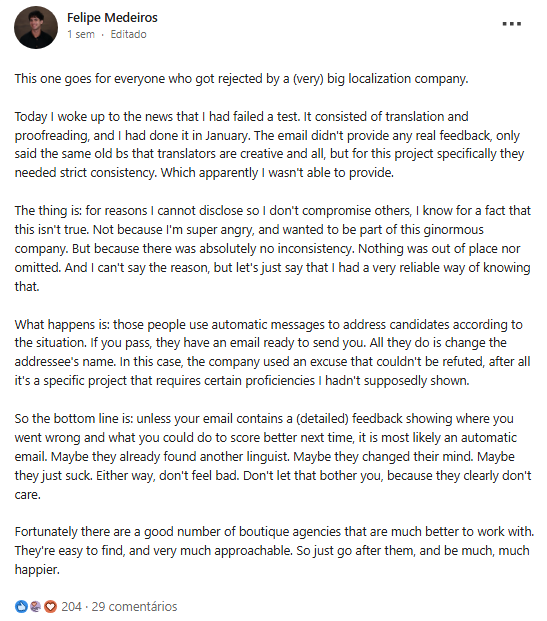
This LinkedIn post captures that frustration perfectly. A translator goes through tests, waits for feedback, and receives… a generic response. No clarity, no real explanation, just a vague note about “not meeting consistency requirements.”
- No actionable feedback
- No clear mistake identified
- No real opportunity to improve
And that’s where the real issue starts.
The illusion of “failing” vs. the reality of the system
It’s easy to internalize rejection as a lack of skill. But in many cases, especially with large localization companies, the process is far less personal than it seems. These companies operate at scale. That means:
- Standardized tests
- Automated or semi-automated feedback
- High volumes of candidates
The result? Decisions that don’t always reflect your actual capabilities.
In the post, the translator even suggests something many suspect but rarely say out loud: sometimes, the feedback isn’t entirely honest, it’s just convenient. And whether that’s always true or not, one thing is clear: relying on these processes as your only path into the industry is risky.
Big companies vs. real opportunities
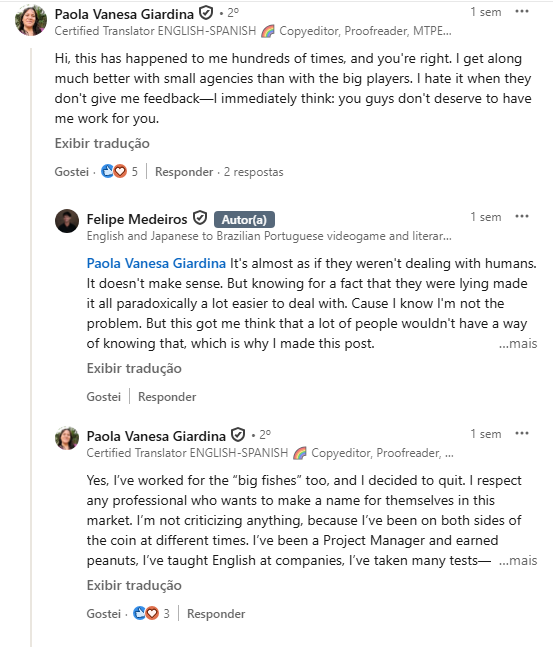
One of the most valuable insights comes from the comment in the second screenshot. The idea is simple, but often overlooked: smaller agencies, and even direct clients, can offer a better experience than large players.
- More human communication
- Real feedback and collaboration
- Greater flexibility in how you work
While big companies offer prestige, they also come with layers of process that can distance you from real growth. Smaller agencies, on the other hand, tend to value relationships over scale. And for translators trying to build a career, that difference matters more than brand names.
The real problem: lack of visibility, not lack of skill
What this situation really highlights is a deeper issue in the translation industry: visibility. It’s not always about being good, it’s about being seen as reliable. When companies don’t know you, they rely on:
- Standardized tests
- Surface-level evaluations
- Generic criteria
That means your actual strengths, your research ability, your adaptability, your process, don’t always come through. So instead of asking “Am I good enough?”, a better question might be: “How do I make my work more visible and trustworthy?”
Consistency: the skill everyone talks about, but few structure
The rejection in the post mentions “lack of consistency.” This is one of the most common, and most misunderstood, criteria in localization. Consistency is not just about being careful. It’s about having a system.
- Using the same terminology across projects
- Maintaining tone and style throughout
- Applying decisions consistently over time
Without structure, even skilled translators can appear inconsistent, especially under test conditions. And this is where many professionals hit a wall: they rely on their ability, but not on a repeatable process.
What experienced translators do differently
If you look at translators who succeed long-term, especially in competitive environments, a pattern emerges. They don’t just translate, they build workflows.
- They keep personal glossaries
- They reuse validated translations
- They track decisions across projects
In other words, they reduce variability. Because in a field where clients can’t always evaluate your thinking, consistency becomes your strongest signal of quality.
Practical ways to move forward after rejection
Instead of treating rejection as a final verdict, it can be reframed as a signal to adjust your approach.
Here are some directions that actually make a difference:
- Shift your focus away from big companies (at least initially)
Build experience with smaller agencies or direct clients where your work is more visible - Choose a niche where precision matters
Legal, medical, and technical fields reward consistency and structured thinking - Document your decisions
Start building glossaries and references, even for personal projects - Improve your process, not just your output
Think about how you work, not just what you deliver
These steps don’t guarantee immediate success, but they build something much more valuable: reliability.
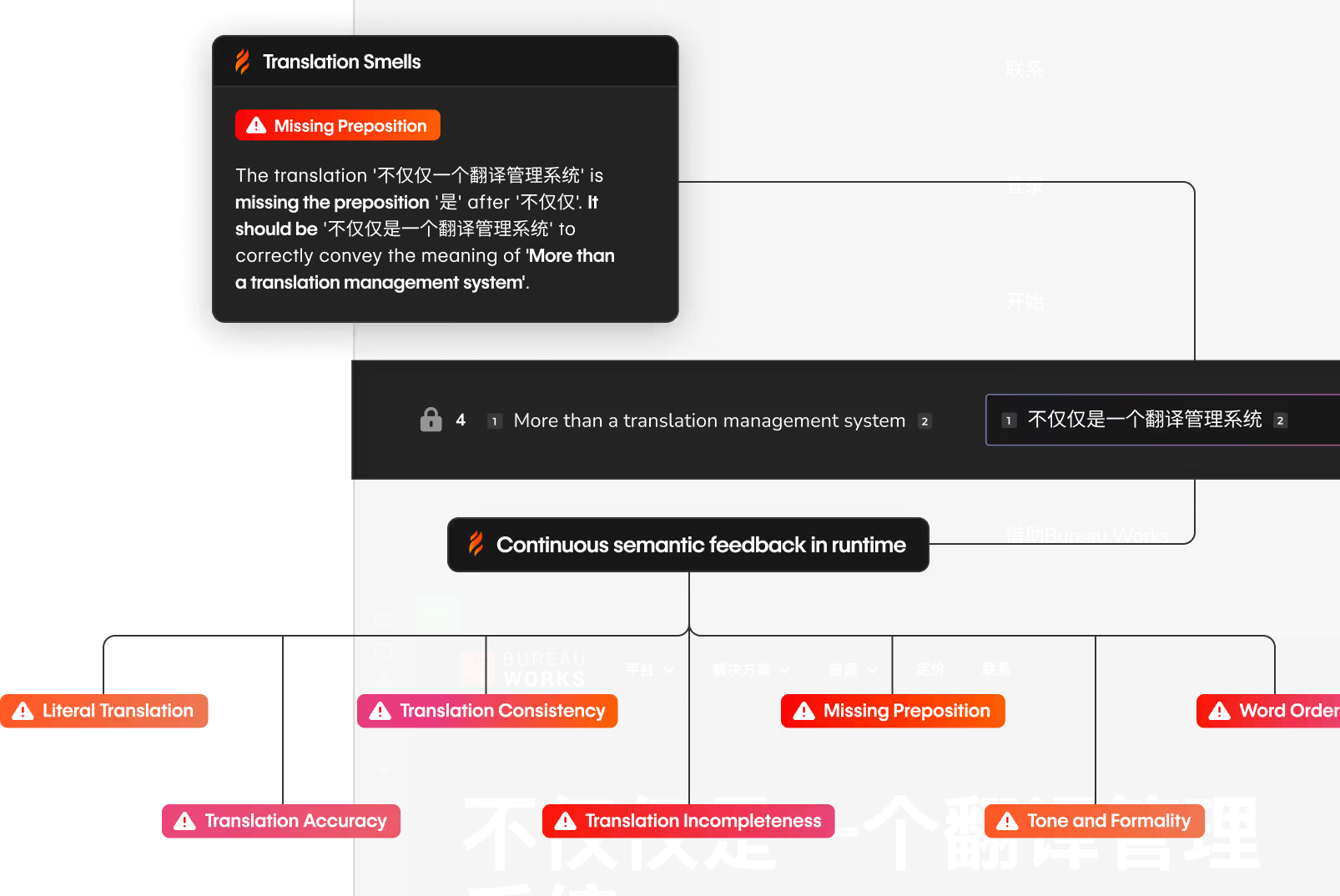
Why tools are becoming part of the equation
At some point, managing all of this manually becomes unsustainable. As projects grow, so does the need for structure. This is where translation management systems (TMS) come in, not as a luxury, but as a practical necessity.
They help translators:
- Maintain consistent terminology across projects
- Store and reuse previous work efficiently
- Reduce the risk of errors in complex assignments
Instead of relying on memory or scattered notes, everything becomes organized and accessible.
This is exactly the kind of challenge wxrks is built to support.
For translators navigating rejections, inconsistencies, and growing complexity, wxrks provides a way to bring structure into the process.
- Centralized glossaries help maintain consistency
- Translation memory reduces repetitive work
- A unified workflow keeps everything aligned
It doesn’t replace your skills, but it makes them more visible, more reliable, and easier to scale.
Rejection is not the end, it’s a filter
Getting rejected by a big localization company can feel like a setback. But in many cases, it’s just a reflection of how the system works, not your actual potential. The real opportunity lies in how you respond.
- Do you keep chasing the same path?
- Or do you build a system that makes your value undeniable?
Because in today’s translation industry, the difference is not just talent, it’s structure.
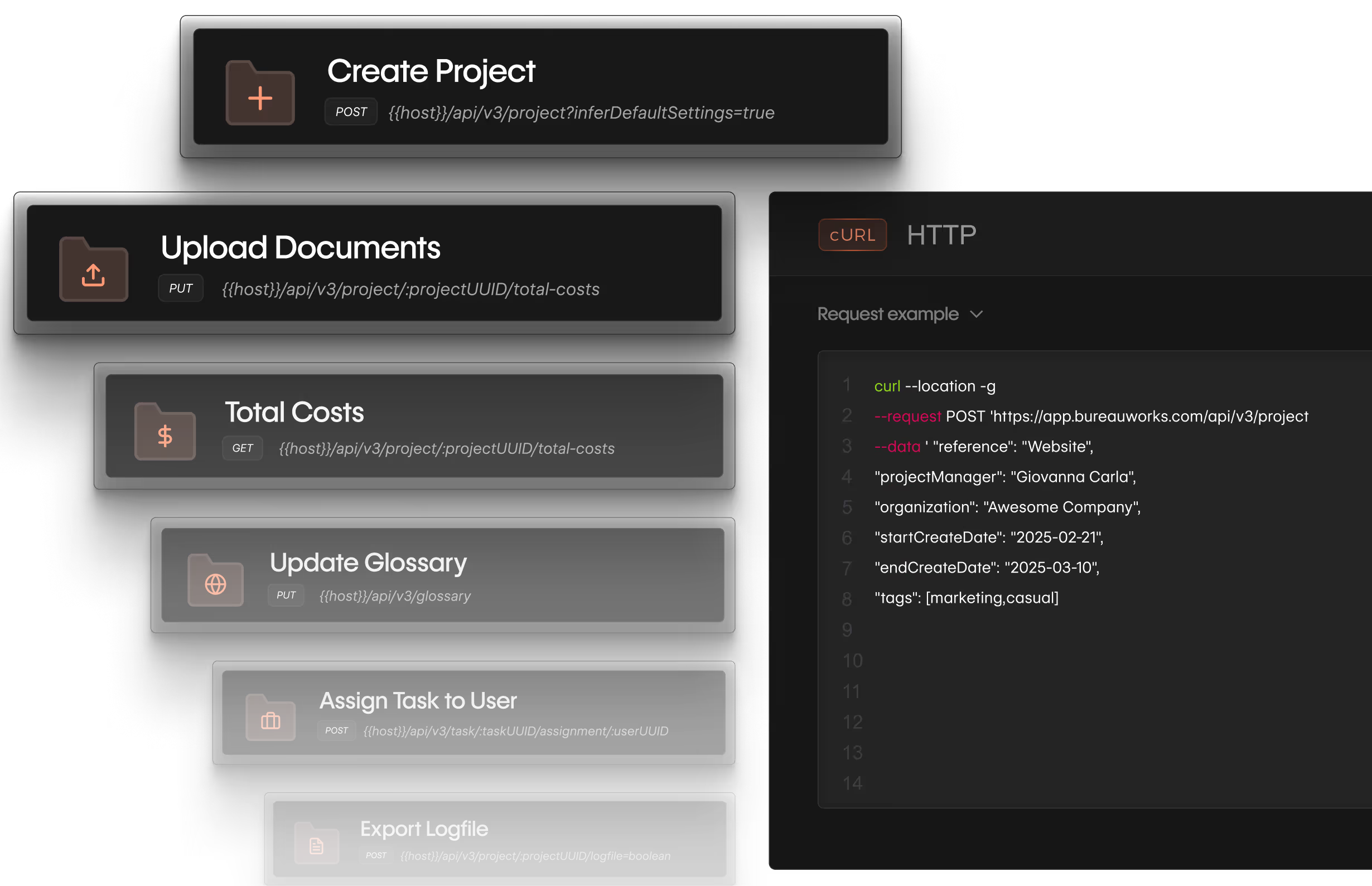
Ready to take control of your translation process?
If you want to move beyond uncertainty and start building a more consistent, reliable workflow, it might be time to rethink how you work.
Sign up for wxrks and discover how a translation management system can help you stay organized, improve consistency, and turn your skills into real, scalable opportunities.
Unlock the power of glocalization with our Translation Management System.
Unlock the power of
with our Translation Management System.