

Localization ROI Is Not Broken. You’re Measuring the Wrong Thing.


There’s a recurring argument in the localization industry: “Localization doesn’t have a clear ROI.” At first glance, it sounds reasonable.
After all, how do you isolate the impact of translation from:
- marketing campaigns
- product quality
- pricing strategy
- distribution channels
Fair point. But here’s the problem: This question assumes localization is a cost center. It’s not.
The Real Issue: ROI Is Being Measured Too Late
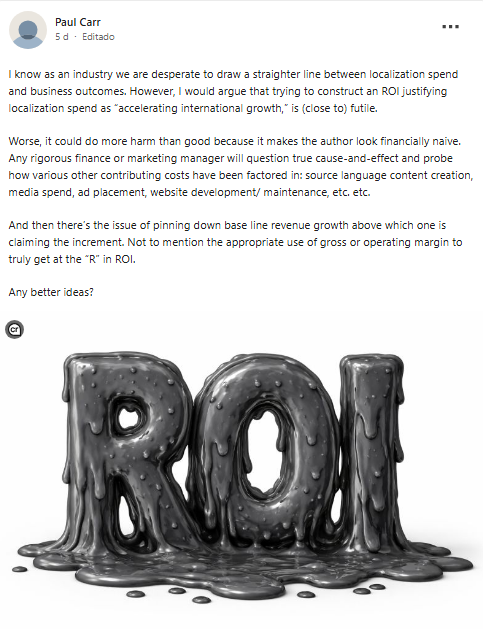
The LinkedIn post raises a valid concern: It’s hard to draw a straight line between localization spend and business outcomes. That’s true if localization happens at the end of the process. When localization is treated as: “Translate this after everything is ready”
Then yes:
- ROI becomes blurry
- impact becomes diluted
- attribution becomes impossible
Because localization is no longer a strategy. It’s a patch.
Localization Is Not a Line Item. It’s a Multiplier.
Let’s shift the perspective. Localization doesn’t create value in isolation. It amplifies everything else.
Think about it:
- A great marketing campaign → multiplied across markets
- A strong product → accessible to more users
- A high-performing app → discoverable in local languages
Without localization, your growth is capped. With localization, your growth becomes scalable. That’s not a cost. That’s infrastructure.
Where ROI Actually Comes From
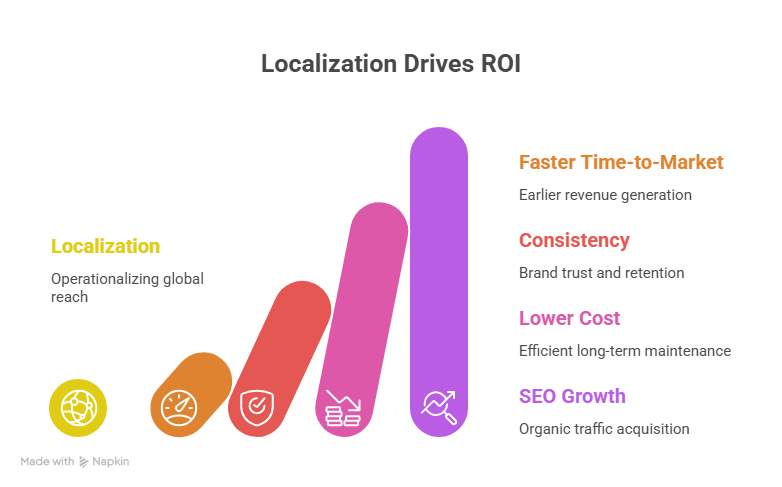
ROI in localization doesn’t come from translation alone. It emerges from how well localization is embedded into operations, how efficiently it scales, and how consistently it supports growth across markets.
When treated as a structured system rather than a one-off task, localization becomes a measurable driver of business performance.
1. Faster Time-to-Market = Earlier Revenue
Speed is one of the most underestimated drivers of ROI in localization. When companies rely on manual processes or fragmented workflows, launching content in multiple languages becomes slow and sequential. This delay directly impacts revenue, especially in fast-moving industries like gaming, SaaS, and e-commerce, where timing is often the difference between capturing demand and missing it.
A structured TMS changes this dynamic by enabling parallel workflows, automation, and continuous localization. Instead of waiting for content to be finalized before translation begins, teams can localize incrementally as content evolves. This reduces bottlenecks and allows companies to launch in multiple markets simultaneously.
The result is not just operational efficiency, but earlier market entry, faster user acquisition, and a shorter path to revenue generation. In this context, ROI becomes tangible through time saved and opportunities captured sooner.
2. Consistency = Brand Trust
The biggest problem when we hit the automatic button using AI is the lack of consistency, because AI is not programmed to give the same reply always. So every time it's going to reply something different, when some term are important for the business.
By centralizing glossaries, translation memory, and style guides within a system like wxrks, companies ensure that every piece of content aligns with their brand identity, regardless of language or market. Over time, this consistency builds familiarity and trust with users, making interactions smoother and more predictable.
The ROI here is not immediate in a single transaction, but cumulative, reflected in higher retention, improved user confidence, and stronger brand perception across regions.
3. Maintenance Is Where Money Is Lost (or Saved)
One of the biggest misconceptions in localization is that costs are concentrated at launch. In reality, the majority of expenses and inefficiencies come from ongoing maintenance.
Products evolve, content changes, and updates are constant. Without a structured system, teams often end up retranslating content, duplicating effort, and introducing inconsistencies with every iteration.
Translation memory allows previously translated content to be reused, while change tracking ensures that only new or modified segments are processed. This dramatically reduces redundant work and keeps all language versions aligned over time. More importantly, it transforms localization from a reactive process into a controlled, predictable system.
The ROI becomes clear in reduced operational costs, fewer errors, and a significant decrease in rework as the product scales.
4. SEO and Discoverability
SEO is maybe one of the most impacted areas after the ChatGPT boom. But SEO never was only about Google ranking it was about being found, about organizig your content in a way your visitors can find you and solve their pains. And translators are experts in doing this research.
The cultural background of localization and translators teams are essential to give keyword ideas, refine a content generated by LLM. Localization also can refine the SEO keywords adding to a glossary that will be used during the LLM translation, improving the translation workflow with term relevants in every country. And make sure the context match is right for example.
When localization is done strategically integrating multilingual SEO practices it allows companies to rank in local search engines, adapt messaging to regional intent, and increase visibility in ways that directly impact traffic and acquisition. Without this layer, even the best products remain invisible in key markets.
With it, companies can reduce dependency on paid acquisition and build sustainable organic growth channels. The ROI here is measurable through increased traffic, improved search rankings, and lower customer acquisition costs over time.

The Hidden ROI: Risk Reduction
This is the part most people ignore. Bad localization doesn’t just fail. It damages.
- wrong tone → brand misalignment
- mistranslations → legal issues
- cultural mistakes → market rejection
A structured system minimizes this. With controlled workflows, glossaries, and review layers: Risk decreases, predictability increases. That’s ROI. Even if it doesn’t show up in a spreadsheet immediately.
Why the “No ROI” Argument Persists
Because many companies still:
- localize too late
- use fragmented tools
- rely on manual processes
- treat translation as a task, not a system
In that context, the critic is right. ROI is hard to prove. But not because localization doesn’t work. Because the implementation is broken.
The Shift: From Translation to Language Operations
The companies that see ROI don’t “do translation.” They build language operations.
They:
- integrate localization into product cycles
- automate workflows
- manage terminology centrally
- scale content systematically
This is where platforms like wxrks come in. Not as translation tools. But as operational infrastructure.

A Better Way to Think About ROI
Instead of asking: “What ROI does localization generate?” Ask: “What revenue are we losing by not scaling language properly?”
That’s the real question. Because in global markets: not being localized = not existing. Localization ROI is not invisible. It’s just misunderstood. It doesn’t live in isolated metrics.
It lives in:
- speed
- scale
- consistency
- efficiency
- market access
And most importantly: in everything that becomes possible once language stops being a barrier. If you want to move beyond fragmented translation efforts and start building real language operations:
wxrks gives you the infrastructure to scale content globally with speed, consistency, and control. From glossary management to automated workflows and real-time updates, you can turn localization into a measurable growth driver, not just a cost.
Start using wxrks and transform localization into a system that delivers real ROI.
Unlock the power of glocalization with our Translation Management System.
Unlock the power of
with our Translation Management System.