

For decades, translation memories were one of the most valuable assets in localization.
They helped companies reduce costs, reuse approved translations, and keep large multilingual programs under control. If a sentence had already been translated before, why pay for it again from scratch?
That logic shaped the way translation teams worked for years.
- Translate once
- Store the result
- Reuse it later
- Save money over time
And for a long time, this made perfect sense. But now, with generative AI changing how content is translated, one question becomes unavoidable:
Do translation memories still matter?
The answer is yes, but not in the same way they used to.
The old role of translation memories
Traditionally, translation memories worked like large databases of past translations.
A sentence in the source language would be stored alongside its translated version. Then, when similar content appeared in the future, the system could suggest that previous translation again.
This created huge savings, especially for companies translating:
- Product manuals
- Help centers
- Technical documentation
- Software updates
- Legal or compliance content
If a company translated a 400-page manual one year, and then updated that same manual the next year, translation memory made it possible to reuse large parts of the previous work.
This was not just convenient. It became a financial argument.
Localization teams could show stakeholders that they were translating more content while reducing the cost per word. Translation memory became a way to justify investment, headcount, and long-term localization strategy.
The problem: translation memories get messy
The issue is that translation memories are not always clean. It must make sure the context match.
Over time, they collect everything: good translations, outdated translations, corrected translations, inconsistent translations, and sometimes even mistakes.
A translator may confirm one version. A reviewer may edit it later. Someone in-market may then change the final text directly in the CMS without updating the memory.
Suddenly, the “source of truth” is no longer fully true.
- The live content says one thing
- The translation memory says another
- The team does not always know which one is right
This becomes even more complicated when communication evolves.
A sentence translated ten years ago may be technically correct, but no longer aligned with how a brand speaks today. Tone changes. Inclusivity standards change. Product positioning changes. Audiences change.
And if the translation memory keeps feeding old language into new content, the brand may end up sounding outdated without realizing it.
AI changes the value of old translation assets
In the past, bigger translation memories were usually seen as better. More data meant more matches. More matches meant more savings. More savings meant a stronger localization program.
But AI changes this logic. Generative AI does not only look for exact or fuzzy matches. It can work with meaning, context, tone, and relationships between ideas.
That makes translation memory more powerful, but also more dangerous if the data is poor. Because when old translations become part of the context that guides AI, they stop being just “stored strings.” They become knowledge.
And bad knowledge creates bad suggestions.
- Outdated tone can influence new translations
- Inconsistent terminology can confuse the system
- Old brand language can contaminate fresh content
This is where the phrase “less is more” becomes important. In the age of AI, a smaller and cleaner translation memory can be more useful than a massive and polluted one.
.png)
From cost savings to content curation
The real shift is this: translation memories are no longer only about saving money. They are about guiding quality.
A curated translation memory can help AI understand how a brand communicates, which terms matter, which tone to follow, and how specific audiences should be addressed.
But for that to work, companies need to stop treating translation memories as giant storage rooms. They need to start treating them as strategic language assets.
That means organizing them by:
- Content type
- Audience
- Tone of voice
- Market
- Product line
- Level of formality
A legal document, a marketing campaign, and a customer support article should not all rely on the same translation memory in the same way. They have different goals, different risks, and different expectations.
Why old monolithic translation memories no longer work
Many companies still have massive translation memories built over years, sometimes decades. These assets may contain millions of segments, but size alone does not make them useful. Actually, the bigger they are, the harder they become to manage.
You may not know:
- Which segments are still accurate
- Which ones reflect the current brand voice
- Which ones were corrected outside the system
- Which ones belong to outdated products or campaigns
In a traditional workflow, humans often had several rounds to catch these issues: translator, reviewer, quality manager, in-country reviewer. But today, companies increasingly expect faster localization cycles. Sometimes they want content available almost instantly.
That creates pressure. If there are fewer human review layers, then the underlying linguistic data needs to be much cleaner from the beginning.
.png)
The new role of translation memories
Translation memories are not dead. But their role has changed. They are no longer just reuse engines. They are context engines. Their value is not only in saying, “We translated this sentence before.”
Their value is in helping answer:
- How do we usually talk about this topic?
- What tone should we use for this audience?
- Which terminology should stay consistent?
- What past translations still represent our current voice?
This makes translation memory cleanup and segmentation much more important. Instead of one huge memory for everything, companies need smaller, sharper, better-curated memories that support specific use cases.
For example:
- A formal memory for legal documents
- A warm and conversational memory for marketing
- A precise memory for technical documentation
- A localized memory for a specific regional audience
That is where translation memory becomes genuinely useful in an AI-driven workflow.
AI does not remove the need for structure
One of the biggest mistakes companies can make is assuming that AI removes the need for translation management. It does the opposite. The more AI becomes part of localization, the more important structured data becomes.
AI needs direction. It needs context. It needs clean terminology, updated style guides, and curated translation memories that reflect how the company actually wants to communicate.
Without that structure, teams may get faster output, but not necessarily better output. And speed without control can create a new kind of localization problem.
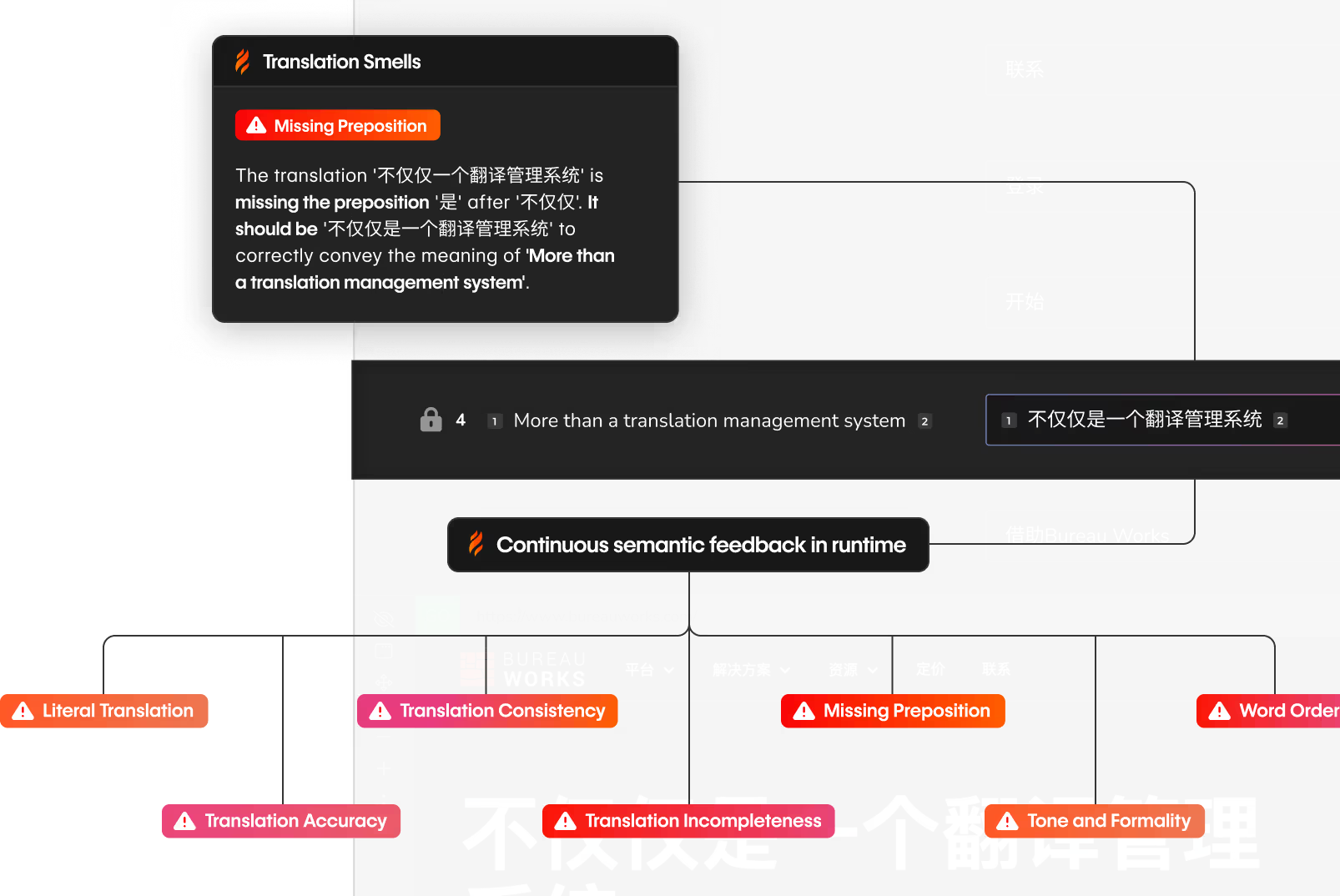
Where wxrks fits into this new reality
This is exactly the kind of challenge wxrks is built to solve.
As a translation management system, wxrks helps teams move beyond messy, disconnected localization workflows and work with language assets in a more structured way.
Instead of treating translation memories as static archives, teams can use wxrks to support consistency, context, and better decision making across projects.
That matters even more in the age of AI.
Because the future of localization is not just about translating faster. It is about using the right context, the right terminology, and the right linguistic assets to communicate better.
Ready to make your translation memories actually useful again?
If your team is working with old translation memories, inconsistent terminology, or AI driven localization workflows, it may be time to rethink how your language assets are managed.
Sign up for wxrks and discover how a translation management system can help your team organize, curate, and scale localization with more consistency and control.
Unlock the power of glocalization with our Translation Management System.
Unlock the power of
with our Translation Management System.