


wxrks vs tomedes: TMS or translation service? 2026


Choose Wxrks if your team needs to manage recurring localization work inside a translation management system; choose Tomedes if you want a translation service to handle a defined assignment. Wxrks is the better fit for teams that own the workflow; Tomedes is the better fit for teams that want to outsource the translation work.
TL;DR
- For wxrks vs tomedes, choose Wxrks to manage recurring localization workflows and Tomedes to outsource a defined translation assignment.
- Wxrks brings translation memory, quality management, and cost tracking into the team's workflow.
- Tomedes is the service choice when you need translation delivered rather than a system your team will operate.
- Neither choice removes the need to define who approves terminology, reviews output, and owns revisions.
Why this matters
A translation management system and a translation service solve different operational problems. One gives your team a place to organize work; the other takes on translation work you assign. Comparing them as though they were interchangeable obscures the decision you actually need to make: who will own the localization process after this assignment ends?
That question matters in 2026 when content changes repeatedly. A translated page is a deliverable. Keeping that page aligned with later source edits is a workflow. Your decision should account for both, even if the immediate request is a single project.
For a fair comparison, separate the work into source preparation, translation, review, revisions, and reporting. Then assign an owner to each part. The option with the clearest ownership for your team wins; the option with the longest feature list does not.
At a glance
Best for
- Wxrks: Translators, developers, enterprises, and agencies managing localization workflows
- Tomedes: Teams assigning translation work to a service provider
Primary deliverable
- Wxrks: A system for managing localization work
- Tomedes: Translation services
Ongoing workflow
- Wxrks: Supports workflow automation inside a TMS
- Tomedes: Handles work through a service relationship
Translation memory
- Wxrks: A stated part of the platform
- Tomedes: Ask how prior translations will be used in your assignment
Quality responsibility
- Wxrks: Tools for managing quality; your team still sets review criteria
- Tomedes: Agree on review and acceptance criteria in the service brief
Cost visibility
- Wxrks: Cost tracking is a stated platform capability
- Tomedes: Define the scope of work before comparing a service proposal
Pricing model
- Wxrks: Platform access; confirm the current commercial terms
- Tomedes: Service engagement; confirm scope and current terms
Standout feature
- Wxrks: Translation memory alongside workflow, quality, and cost management
- Tomedes: Translation work assigned to a service provider
The table describes the purchasing decision, not a claim that either option can never perform tasks outside its main role. In 2026, ask each provider to demonstrate the exact handoffs your team needs before treating a capability as part of your process.
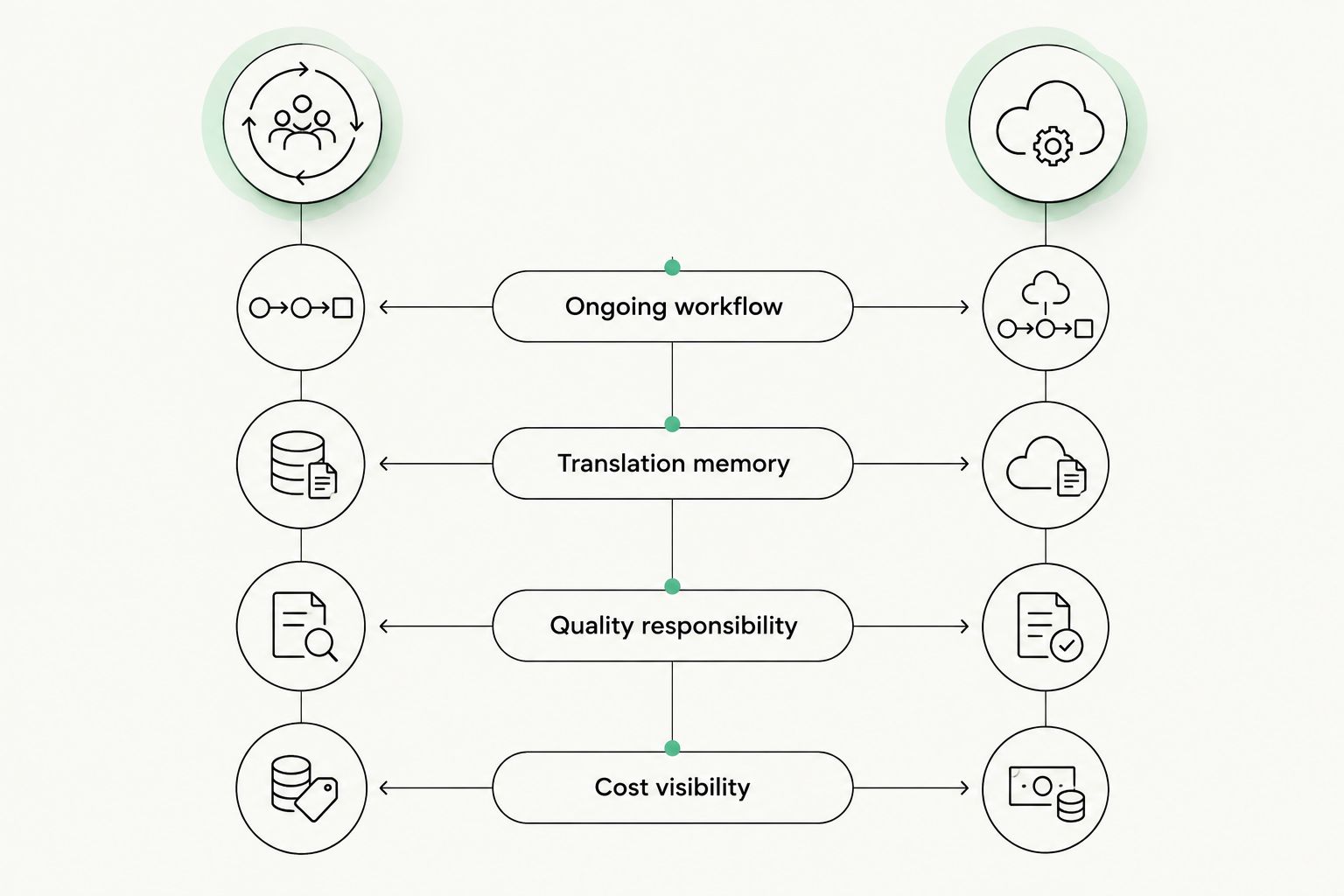
The deciding factor is who owns each step after the translation is delivered.
Wxrks is better when your team owns recurring localization
Best for: teams that expect to run translation work again and need to manage it themselves. Wxrks is an AI-powered translation management system for translators, developers, enterprises, and translation agencies. Its stated scope includes workflow automation, translation memory, quality management, and cost tracking. Those capabilities address the work around translation as well as the translation itself.
Picture a team updating the same product content over time. The important questions are not limited to who translates the first version. The team also needs to decide how later edits enter the workflow, which prior translations remain useful, who checks terminology, and how work is recorded. A TMS is the more direct purchase when those responsibilities stay in-house.
The tradeoff is ownership. Software does not decide your preferred terms, assign a final approver, or resolve an unclear source sentence on its own. Your team has to establish those rules and use the system consistently. If no one is prepared to operate a localization workflow, buying the system does not solve that staffing problem.
Tomedes is better when you want translation delivered
Best for: a buyer with a defined translation assignment who wants a service provider to carry out the work. Tomedes is a translation services company, so the purchase centers on the assignment rather than your team's operation of a TMS. That is a meaningful advantage when the immediate need is translated content, not a new internal process.
A useful service brief states what must be translated, the intended audience, the source material, terminology preferences, and who can approve the result. You should also identify which changes count as revisions to the assignment and which are new work. Those details make the service easier to evaluate without assuming that a provider can infer your context from a file alone.
The limitation appears when translation becomes a continuing internal operation. A service relationship can deliver assignments, but your organization still needs a way to track source changes, decisions, and approvals across assignments. Do not treat a completed translation as evidence that those internal responsibilities have been assigned.
Wxrks makes translation memory a workflow decision
Best for: teams that want to manage prior translations as part of future work. Translation memory is an explicitly stated Wxrks capability. It gives a team a way to work with previously translated segments instead of treating each assignment as unrelated. Its usefulness still depends on the quality and relevance of the translations the team keeps.
Before choosing a platform, decide who can approve a segment for reuse. An outdated product name or an approved phrase from the wrong audience should not become a default simply because it exists in a memory. Decide how you will handle changed source text and how reviewers will flag a translation that no longer fits its context.
For Tomedes, ask how your existing translations and terminology will be used for the specific assignment. Do not infer from this comparison that the service lacks translation memory, or that its treatment of your material will match the way your team would manage memory in its own system. The practical difference is who controls the working process.
In 2026, that distinction matters most when content repeats and changes. For a self-contained assignment, your brief and acceptance criteria can be more important than establishing a persistent internal memory. For recurring work, decide where approved language will live before the next update arrives.
Both require an explicit quality owner
Best for Wxrks: a team that wants to manage its own quality process. Best for Tomedes: a buyer who wants to specify quality requirements in a service assignment. Wxrks includes quality management among its stated capabilities. Tomedes provides translation services. Neither description tells you who, inside your organization, has authority to approve terminology or accept the final text.
Write the review rules before work begins. Identify the audience, the meaning that must be preserved, terms that cannot change, and the person responsible for acceptance. If content is tied to a product interface, include the surrounding context so a reviewer can judge whether a translation fits its use. These are buyer responsibilities regardless of the supplier.
This dimension is a tie because quality is not established by a product category. A management feature can organize checks; a service brief can communicate requirements. In either case, evaluate the actual review handoff rather than assuming that the word quality describes the same process on both sides.
Wxrks gives teams a stated cost-tracking capability
Best for: teams that need to track translation work as part of a continuing workflow. Cost tracking is part of the Wxrks description. That makes it relevant when a team needs to connect localization activity with its own operating records and understand work across assignments.
Cost tracking should start with a clear unit of work. Decide whether your team will record work by project, content group, requesting team, or another category it already uses. Without that decision, a tracking feature can collect entries that are difficult to compare. The software supplies a capability; your team supplies the definitions.
Tomedes is better evaluated through a clearly scoped service request. State which content is included, what review is required, and who will approve changes to the assignment. That approach helps you assess the service engagement, but it does not replace an internal record of all localization activity if your organization needs one.
Do not decide this dimension by comparing an unscoped service request with a software description. In 2026, get the current commercial terms from both sides and compare them against the same work. No figure on a comparison page can substitute for your own scope.
The pricing models reflect different responsibilities
A TMS purchase is about access to a system your team will use to manage work. A translation service purchase is about work assigned to a provider. The first places more process ownership with your organization; the second centers the engagement on the requested deliverable. Confirm the current terms directly with each provider before making a financial comparison.
For Wxrks, ask which users need access, which workflows they will operate, and whether your team has someone to maintain terminology and review rules. Those questions reveal the operational commitment behind the platform decision. A platform is a poor fit if you need a provider to take on the translation assignment and have no team to run the process.
For Tomedes, provide the source material and specify the target audience, review expectations, and change process. Those details define what you are asking the service to deliver. A service is a poor substitute for a TMS if your main requirement is a shared system for managing repeated work across internal teams.
Compare the total responsibility, not an isolated commercial term. If your team will still coordinate requests, manage approved language, and record decisions, account for that work when evaluating the service route. If you choose software, account for the people who will configure and operate the workflow.
How to choose without confusing the two
Use the same decision sequence for both options in 2026:
- Name the recurring work. Is this a defined assignment, or will the same content change and return for review? Recurrence strengthens the case for a managed internal workflow.
- Assign process ownership. Who receives requests, prepares context, approves terminology, reviews output, and records changes? If those people sit inside your organization, assess the TMS against their actual tasks.
- Define the deliverable. If the immediate goal is translation performed by a provider, brief Tomedes on the material and acceptance criteria. Do not substitute a software demonstration for a service proposal.
- Check continuity. Decide where approved translations and decisions will be kept. This matters even if you begin with a single assignment that might later be updated.
- Review the handoff. Ask to see how a source change becomes an approved translation in your intended setup. The handoff is where a promising description meets day-to-day work.
The questions prevent a false comparison. You are not choosing between two versions of the same product; you are deciding whether to operate the translation process or assign the translation work.
Plan your localization workflow
Review the TMS option for translation memory, quality management, and cost tracking.
Final verdict: choose the owner before the provider
Choose Wxrks if you run localization operations
Winner: Wxrks for a localization lead, developer team, enterprise, or translation agency managing recurring work. Choose the TMS when your team needs to automate workflow steps and manage translation memory, quality, and cost records in one operating process. Be ready to define review rules and assign people to use the system.
Choose Tomedes if you are commissioning translation
Winner: Tomedes for a buyer who needs a defined translation assignment handled by a service provider. Choose the service route when your immediate need is delivery of translated material rather than ownership of a translation management system. Provide context and acceptance criteria, and decide how you will manage later updates.
The 2026 scorecard is a summary of those use cases, not a claim that either provider lacks every capability outside its main role:
Recurring workflow management
- Winner: Wxrks
Assigned translation service
- Winner: Tomedes
Team-managed translation memory
- Winner: Wxrks
Quality ownership
- Winner: Tie; define the reviewer and criteria
Ongoing cost tracking
- Winner: Wxrks
Defined service engagement
- Winner: Tomedes
Best overall fit
- Winner: Depends on whether you own the workflow or assign the work
FAQ
Is Wxrks or Tomedes better for recurring localization in 2026?
Wxrks is the better fit when your team owns recurring localization workflows. Its stated capabilities include workflow automation, translation memory, quality management, and cost tracking.
Is Tomedes better than Wxrks for an assigned translation job?
Tomedes is the better fit when you want to assign a defined translation job to a service provider. Wxrks is a translation management system for teams operating their own workflow.
Does Wxrks provide translation memory?
Yes, translation memory is a stated Wxrks capability. Your team still needs rules for approving and reusing prior translations.
Does choosing a TMS remove the need for reviewers?
No, a TMS does not replace the person responsible for accepting translated content. Set terminology and review criteria before work begins.
Can a translation service replace an internal localization workflow?
A translation service can carry out an assignment, but your organization still needs to manage requests, source changes, and approvals. Decide who owns those steps before choosing a provider.
How should I compare Wxrks and Tomedes pricing?
Compare current terms against the same clearly defined work. Include the internal effort needed to operate a TMS or coordinate a service assignment.
What should I ask before choosing between Wxrks and Tomedes?
Ask who will perform the translation and who will manage requests, terminology, reviews, changes, and records. The answer identifies whether you primarily need a system or a service.
One last thing
The most useful question is not who translates the first version. It is who will know what changed when the source content changes again. In 2026, write down where the approved translation, terminology decision, and final reviewer will be recorded before you commit to either route.
Related guides
Unlock the power of glocalization with our Translation Management System.
Unlock the power of
with our Translation Management System.