You tell your account manager what you need. He agrees. Then it goes into a chain. A product lead hears a shorter version. A manager writes a ticket. A developer reads the ticket. What ships, months later, is a fair guess at what you said.
Everyone who has asked a vendor for something knows this trip. It is not bad faith. It is handoffs. Each one keeps a little less of what you meant, and the thing that made you ask, the part of your week you were tired of, does not survive the second hop.
This is the story of one feature that skipped most of the chain. The new Home in wxrks, the first screen after you log in, went from the person who hears you every day to the code with fewer hands in between than anything we have shipped. Here is how, and what it changes for you.
What you told us
In onboardings, trainings, and support calls, the same thing came up for years. You log in, and then you go looking for what needs you. The old Home was a feed. You scrolled it to find out what mattered.
The person who heard it most often is Hugo Vieira. He has been at wxrks for 12 years, and he sits in onboardings and trainings with our customer success team. He knows which project managers open the platform first thing to see what is late, and which account admins want the money waiting in quotes before anything else.
The usual way
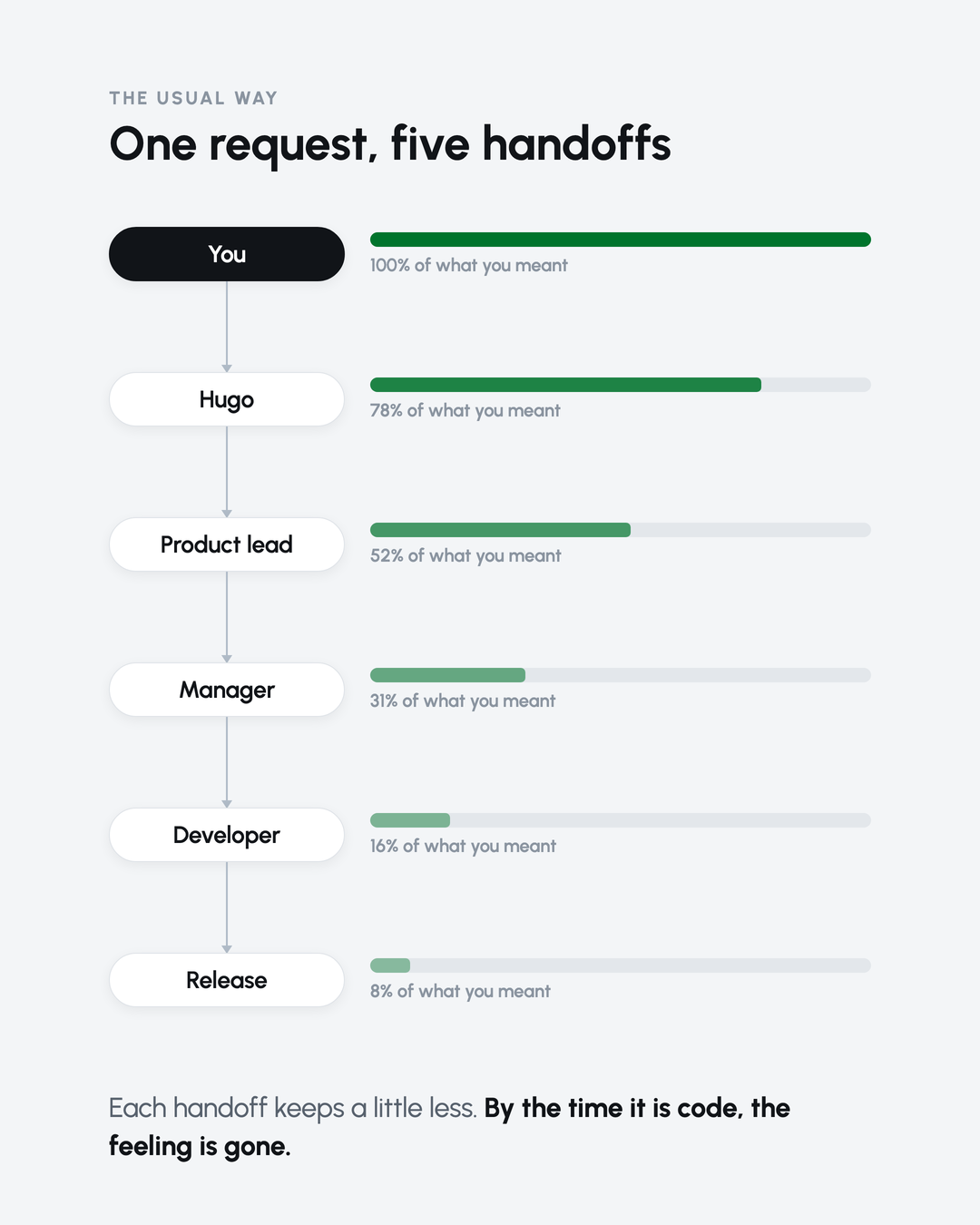
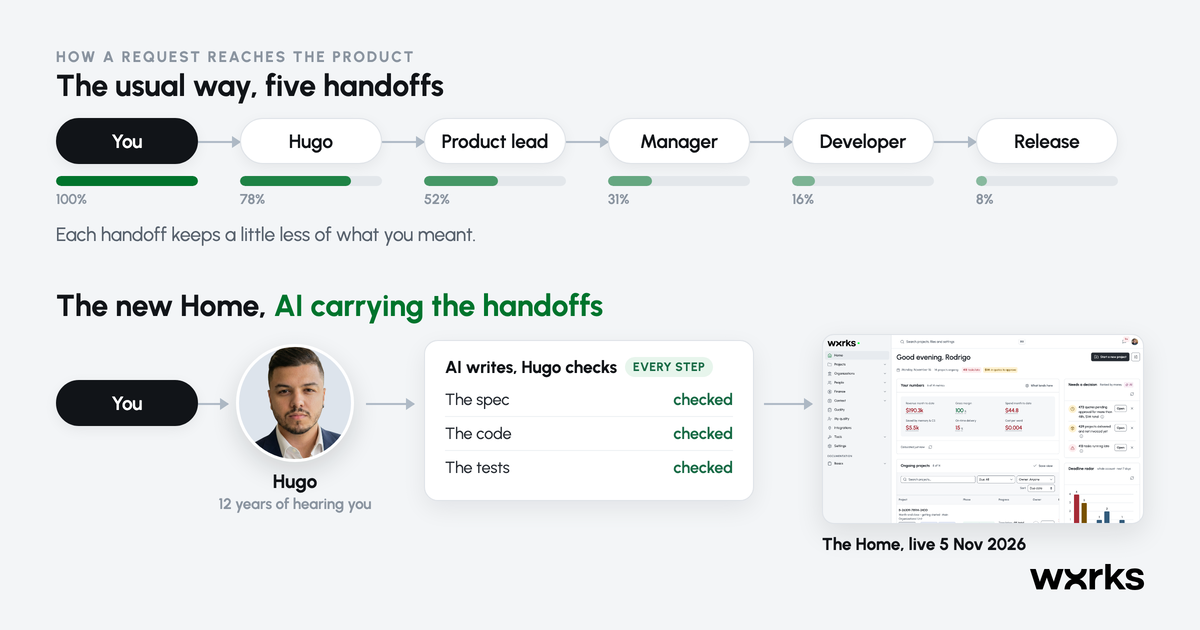
In most software companies, that knowledge travels. The account manager tells product. Product writes a brief. A designer draws it. Engineering estimates it, builds it, and hands it to QA. Six people, five handoffs, and a few months. Each person is good at their job. None of them sat in the call.
The chain existed because coordination was the work. That is changing fast. Fortune reported in June that 41% of employees say their company cut management layers in the past year, with AI taking over the coordination between people (Fortune, June 2026). Elena Verna, who runs growth at Lovable, describes her company's way of working as "No headcount asks. No project briefs. No handoffs." (Elena Verna). That is the pattern the Home followed.
How the Home was made

Hugo designed the Home from what he had heard, and built it with AI. His own description of the method, from a feature estimate in October, is one developer's time plus Claude sessions until the local checks pass. The AI writes the spec, the code, and the tests. Hugo checks each one against what you said.
The record is in our own repository. The Home went into review on 27 October as seven pull requests, about 55,000 lines in all, and was merged the next day. QA found thirteen things on the 29th, and Hugo fixed them by the 31st. The release reached our staging environment on 2 November, and every client was on it on 5 November.
The Home itself is the test of the method. It opens with what needs you, ranked. Needs a decision lists what is waiting on you by the money at stake. Task triage gathers the tasks with no linguist and preselects the lightest-loaded one who fits. Messages drafts the note to the person who can act on a late project, and you send it. Those are the three things people asked for most, and each is on the first screen.
What stays human
AI did not decide what the Home should be. It did not sit in the onboarding, and it did not hear how people described their mornings. Hugo did. The AI carried the handoffs, the brief, the tickets, and the first draft of everything, so the one person who had the feeling could keep it all the way to the code. The people in between were checkers, not messengers.
This is the rule we hold for translation too. The machine carries the volume, the memory, and the first draft. The person keeps the meaning and the judgment. Gabriel said on SlatorPod that each human edit now counts for more. The same is true of each human check on a feature.
What it means for you
Two things. The first is that what you ask for reaches the product with less lost on the way. Say it to Hugo, or in your next Home review with Giovanna, and it does not need a committee to become real.
The second is bigger. The chain inside your own company, from a request to a translated page, loses meaning at every handoff too. The fix is the same. Fewer hands between the person who knows and the result, with AI carrying what used to need a meeting. Two weeks ago we wrote that a rule you set once reaches every project after it. The Home is what that looks like from our side.
Tell us what is missing
Open your Home. If something you need is not on it, say so in Messages, at the top of the page. It reaches the people who build it, and now there is less between your words and the next version.
Unlock the power of glocalization with our Translation Management System.
Unlock the power of
with our Translation Management System.