


Berlitz Alternatives 2026: Wxrks for Localization


Berlitz is a strong choice when you need language instruction for people. Lessons stop being the whole answer when your real task is moving product content through translation, review, and release. The best Berlitz alternative in 2026 is Wxrks if you need to manage localization workflows; Duolingo is the better fit if you need independent language practice.
TL;DR
- For berlitz alternatives in 2026, choose Wxrks for localization workflows, not language lessons.
- Choose Duolingo for independent language practice; choose Berlitz when instruction is the requirement.
- Smartling and Phrase are translation management options to assess alongside Wxrks.
Why this matters
A request for Berlitz alternatives can mean two different things: you want to learn a language, or you want to deliver content in other languages. Those jobs require different tools. A course develops a person's skills; a translation management system organizes the content, people, and decisions behind a localization project.
Start with the work you need done. If employees need instruction, compare learning options. If translators, developers, and reviewers need a shared process for multilingual content, compare localization platforms. Buying software will not teach a team a language, and enrolling a team in lessons will not manage its translation memory.
Berlitz alternatives at a glance
Berlitz
- Best for: Instructor-led language learning
- Standout capability: Language instruction
- How it differs from Berlitz: The benchmark for learning rather than a substitute for a content workflow
- Best for: Managing localization work
- Standout capability: Translation memory, quality management, workflow automation, and cost tracking
- How it differs from Berlitz: Organizes translation work rather than teaching a language
Smartling
- Best for: Teams assessing localization software
- Standout capability: Translation management
- How it differs from Berlitz: Addresses multilingual content operations rather than language lessons
Phrase
- Best for: Teams assessing localization software
- Standout capability: Localization management
- How it differs from Berlitz: Addresses content workflows rather than individual instruction
Duolingo
- Best for: Independent language practice
- Standout capability: Self-directed lessons
- How it differs from Berlitz: Lets individuals practice without replacing an instructor-led program
These options are not interchangeable. The useful comparison is the outcome you need: a person who can use a language, or a process that can publish and maintain translated content. The sections below separate those outcomes before comparing features.
1. Wxrks: best for managing localization workflows
Wxrks is an AI-powered translation management system for translators, developers, enterprises, and translation agencies. It covers workflow automation, translation memory, quality management, and cost tracking. Choose it when the work is coordinating content and contributors, not teaching employees to speak another language.
Where Wxrks shines
- Translation memory: Keep previously translated material available to the translation workflow.
- Workflow automation: Reduce manual coordination across localization work.
- Quality management: Give translation review a place in the process.
- Cost tracking: Keep spending visible alongside project work.
Where it falls short
- It is not a replacement for instructor-led language training.
- A team seeking only personal language practice needs a learning product, not a translation management system.
- Organizations must define who owns translation, review, and approval; software does not make those decisions for them.
Best for: Teams that need to manage multilingual content across translators, developers, and reviewers. Verdict: Choose for localization operations; skip for language lessons.
Primary job
- Wxrks: Manage localization work
- Berlitz: Teach languages
Core activity
- Wxrks: Coordinate translation and review
- Berlitz: Deliver language instruction
Translation memory
- Wxrks: Part of the stated product offering
- Berlitz: Not the reason to choose language instruction
Right buyer
- Wxrks: A team managing multilingual content
- Berlitz: A person or organization seeking instruction
The distinction is ownership. With a translation management system, your team needs a plan for source content, translation, review, and updates. With instruction, the desired output is a learner's ability to use a language. Decide which output matters before scheduling a software evaluation or a course.
2. Smartling: best for evaluating translation management software
Smartling is another option when the purchase is about managing localization rather than learning a language. Put it on a software shortlist if your team needs to compare how translation work enters a system, moves through review, and returns to the content it supports. Evaluate it against your actual content and approval process, not against a classroom experience.
Where Smartling shines
- It belongs in a translation management evaluation rather than a language-learning comparison.
- It gives teams a platform to assess for recurring multilingual content work.
Where Smartling falls short
- It does not answer a request for language instruction.
- Its fit depends on your content systems, contributors, and review requirements; the category name alone cannot settle that choice.
Best for: Teams building a shortlist of localization platforms. Verdict: Assess for translation operations; skip if employees need lessons.
Primary job
- Smartling: Manage translation work
- Berlitz: Teach languages
Main user decision
- Smartling: How content moves through localization
- Berlitz: How a learner receives instruction
Useful evaluation
- Smartling: Test a representative content workflow
- Berlitz: Assess learning goals and instruction format
For a meaningful software comparison, bring an actual piece of content and identify who translates it, who reviews it, and who approves the final version. That exercise exposes workflow gaps faster than a feature list. It also makes clear why a course and a localization platform answer different requests.
3. Phrase: best for comparing localization platforms
Phrase is a localization software option for teams deciding how to manage translated content. Consider it when you need to evaluate the path from source material to reviewed output. If your question is how an employee will learn a language, keep the evaluation focused on instruction instead.
Where Phrase shines
- It is relevant to a shortlist centered on localization work.
- It gives teams another platform to compare against their content and review process.
Where Phrase falls short
- It is not the answer to a request for a language course.
- You still need to establish the responsibilities and approval rules the platform must support.
Best for: Teams comparing software for multilingual content delivery. Verdict: Assess for localization; skip for language instruction.
Primary job
- Phrase: Manage localization
- Berlitz: Teach languages
Output to assess
- Phrase: Reviewed multilingual content
- Berlitz: Learner progress
First question
- Phrase: Does the workflow fit the team?
- Berlitz: Does the instruction fit the learner?
Do not treat a long localization feature list as proof of fit. Write down the handoff that causes trouble today. Then ask each shortlisted platform to show how that handoff works with your content, contributors, and review decisions.
4. Duolingo: best for independent language practice
Duolingo belongs on the learning side of this list. It offers self-directed language lessons, making it relevant when someone wants to practice independently rather than manage translated content. That makes it a closer alternative to Berlitz for an individual learner than any translation management system here.
Where Duolingo shines
- Learners can practice without organizing an instructor-led session.
- Its purpose is language learning, so the buying question stays focused on the learner.
Where Duolingo falls short
- Self-directed practice does not provide the same format as instructor-led instruction.
- It does not organize translation, review, and release of company content.
Best for: Individuals who want independent language practice. Verdict: Choose for self-directed learning; skip for localization operations.
Learning format
- Duolingo: Self-directed practice
- Berlitz: Instructor-led instruction
Primary user
- Duolingo: Individual learner
- Berlitz: Learner seeking instruction
Company content workflow
- Duolingo: Not its purpose
- Berlitz: Not the purpose of language lessons
The trade-off is the format, not a claim that one approach teaches every learner better. If guided instruction is a requirement, compare instruction providers. If the learner needs a way to practice independently, an app belongs on the shortlist.
Why people switch from Berlitz
The clearest reason to look beyond Berlitz is a change in the job you need done. A team can have capable language speakers and still struggle to track source changes, reuse prior translations, route reviews, and understand localization costs. Those are content-operation problems. More lessons do not create a shared translation workflow.
Separate the request into these decisions:
- Language lessons: The goal is to develop a person's language skills. Compare instruction and practice formats.
- Content localization: The goal is to produce and maintain translated material. Compare translation management systems.
- Review workflow: The problem is deciding who checks, approves, and updates translated content. Document those responsibilities before choosing software.
- Learning practice: The goal is independent repetition. Compare self-directed learning options with the learner's needs.
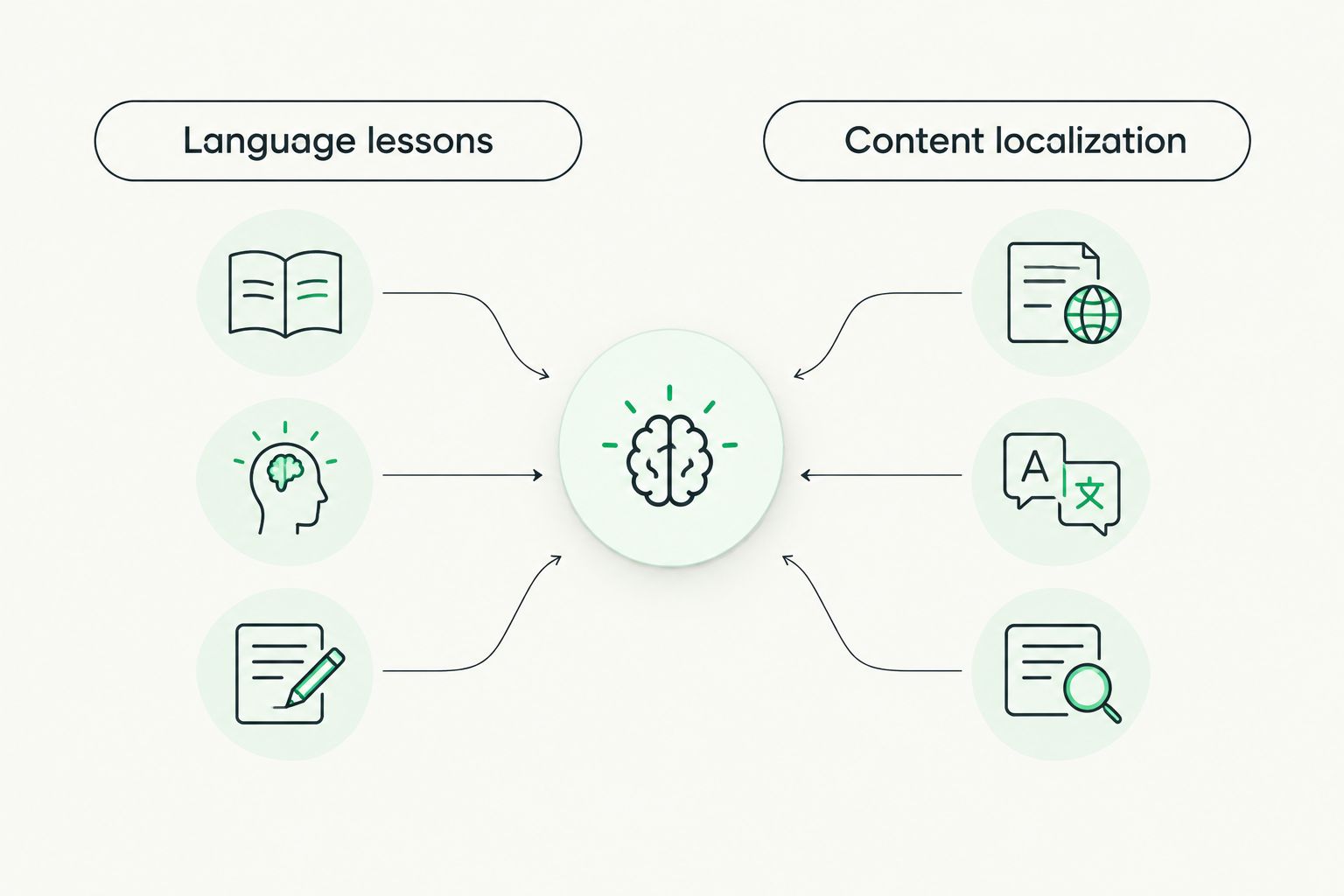
Choose a learning option for people and a localization platform for content.
A 2026 shortlist should start with one sentence describing the desired result. For example, decide whether the team needs instruction or needs to get product content translated, reviewed, and maintained. If both are true, plan for both. Calling every option a Berlitz alternative hides that difference and makes a purchasing decision harder than it needs to be.
For a software evaluation, follow one piece of content from its original version through translation, review, and a later update. Ask who makes each decision and what they need to see. That test keeps attention on the work the system must support rather than on a list of features you might never use.
When staying with Berlitz is the right call
Stay with Berlitz when instructor-led language instruction is the outcome you want. A localization platform will not replace teaching, and an independent practice app offers a different learning format. If the problem is employee communication rather than multilingual content production, keep the decision centered on learners.
Do not switch categories just because a team uses the word translation. A person translating during a conversation and a team maintaining translated product content face different tasks. Keep language instruction for the first task; assess translation management for the second. That rule holds for a 2026 evaluation even when the same organization needs both.
FAQ
What are the best Berlitz alternatives in 2026?
Wxrks is the choice for managing localization workflows, while Duolingo is an option for independent language practice. If you need instructor-led lessons, keep Berlitz in the comparison rather than substituting software.
Is Wxrks a direct replacement for Berlitz?
No. Wxrks manages translation workflows, translation memory, quality management, and cost tracking; Berlitz is a language-instruction choice. Select based on whether you need to manage content or teach people.
Is Duolingo better than Berlitz for language learning?
Duolingo fits independent practice; Berlitz fits a search for instructor-led instruction. The better choice depends on the learning format the person needs.
Should a software team compare Berlitz with Smartling or Phrase?
Compare Smartling and Phrase when the requirement is managing localization work. Compare Berlitz with learning options when the requirement is language instruction.
Can language lessons replace translation management software?
No. Lessons build a learner's skills; translation management software organizes multilingual content, contributors, and review. A team that needs both outcomes must address both jobs.
What should a team test before choosing a localization platform?
Test a real piece of content through translation, review, approval, and an update. Record who owns each step so the evaluation reflects the work your team actually does.
When should a team stay with Berlitz?
Stay with Berlitz when instructor-led language instruction remains the requirement. Changing to a content platform would solve a different problem.
One last thing
The most useful Berlitz alternatives shortlist in 2026 may contain both a learning option and a localization platform, but they should never share the same success measure. Decide whether you need a person to use a language or a team to deliver translated content. Then evaluate only the options built for that result.
Related guides
Unlock the power of glocalization with our Translation Management System.
Unlock the power of
with our Translation Management System.