

Translation is priced per word. So the first number in any website localization project is the word count of the whole site. Most teams don't have that number. The estimate they use instead is a guess wearing the costume of a plan.
So we built the tool that produces the real one. Point the wxrks Word Counter at a domain and it crawls the site, then reports the total, the count per page, and the count per folder. It's free.
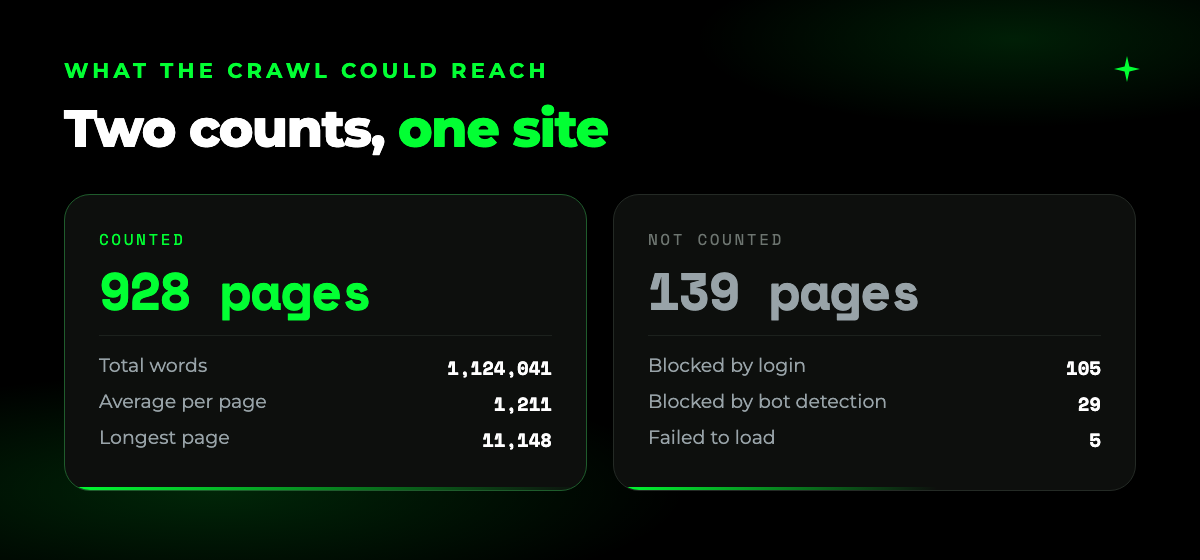
We ran it on wxrks.com first. 1,124,041 words across 928 pages.

Page counts lie. Word counts don't.
The usual estimate starts with pages. Someone opens the sitemap, sees roughly 900 URLs, multiplies by an assumed 500 words a page, and writes 450,000 into the budget doc.
Our real number was more than double that, because our real average is 1,211 words a page. Words are not spread evenly across a site, and no assumed average survives contact with a real one.
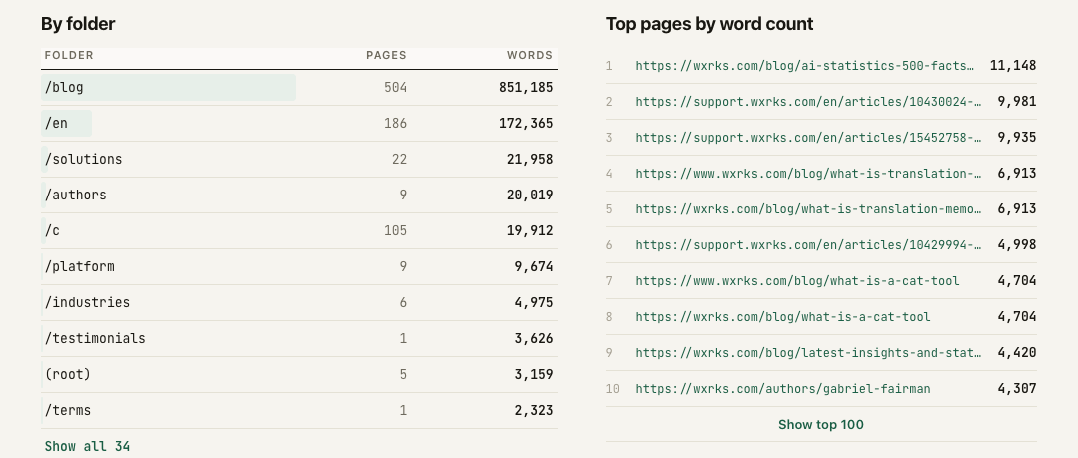
On wxrks.com the blog holds 504 of the 928 pages, a little over half. It holds 851,185 of the words, more than three quarters. Our longest page runs 11,148 words. Our shortest runs 15.
A page count cannot see that spread. A word count is the spread.
Every error you make gets multiplied by your language count
wxrks.com publishes in ten languages besides English. Run the real total through that and the site is 11,240,410 words of translation, not 1,124,041.
Now put the guess through the same multiplier. Being 20% light on a million-word site is 225,000 words you didn't budget for. Across ten languages it's 2.25 million.
That is the part scoping conversations get wrong. The base number is not one line in a spreadsheet. It's the multiplicand for every language, every update cycle, and every quote you sign off on.
The pages a crawler can't reach are still part of the bill
The report on our own site flagged 105 pages blocked behind a login, 29 blocked by the site's own bot detection, and 5 that failed to load. That's 139 pages, roughly 13% of everything the crawl found.
Those pages still have words in them. A help center behind a login still needs translating. So the counter shows you what it couldn't reach instead of quietly rounding your site down to the part that was easy to read.
Bot detection blocks our crawler for the same reason it blocks any other automated visitor, including the ones search engines send. It's not a bug in the count. It's a boundary on the count, and you should be able to see where it sits.
The folder view is where the actual decision is
The total tells you the size of the problem. The per-folder breakdown tells you what to do about it.
Our /blog folder is 851,185 words. Our /platform, /solutions and /industries folders together come to 36,607 words across 37 pages, about 3% of the site.
Those 37 pages are the ones that explain what we sell. Ten languages of them costs 366,070 words. Ten languages of the blog archive costs 8.5 million.
Nobody sensible translates the second one first. But you cannot make that call from a total, and you certainly can't make it from a page count. You make it from a table that shows which folders hold the weight, which is why the true complexity of a multi-language site shows up as a shape, not a sum.
Then subtract the words you already paid for
A raw count is the ceiling, not the invoice. If you've translated any of this before, part of that total is already sitting in your translation memory and should never be billed to you twice.
Boilerplate, navigation, product names, legal footers, the same value proposition restated across nine website localization pages. Repetition is normal, and on a large site it's a lot of the count.
So run the number, then hand it to a platform that can tell you how much of it is new. The gap between the crawl total and the billable total is the argument for having a TM at all.
What to do with the number
Get the count before the kickoff meeting, not during it. Walk in with the total, the folder table, and a note on what the crawl couldn't see, and the scoping conversation stops being a negotiation between two guesses. The report has a share link, so whoever signs the budget can read the whole thing instead of a screenshot of it.
Then be careful what you do with it. Word count is how the industry prices work, but it's a measure of volume, not of value, and selling words is not the same as delivering outcomes. Use the number to plan honestly. Don't let it become the plan.
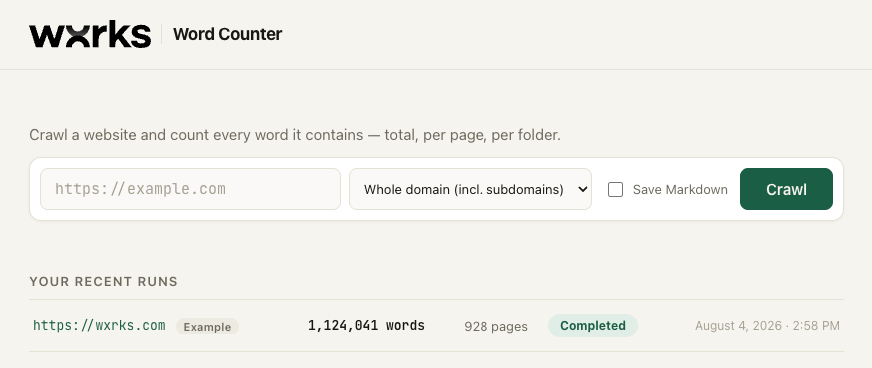
Sign in with Google, paste your domain, and see what your site actually weighs.
Unlock the power of glocalization with our Translation Management System.
Unlock the power of
with our Translation Management System.