


Translation keyword search volume benchmarks by language 2026


Translation search volume by language is not one number. It is a ratio between how often people in a market search for translation, and how many competitors already answer them in that language. This page gives you the core keyword in ten languages, the method to pull real volume for each, and the scoring worksheet to rank markets before you localize with Wxrks.
TL;DR
- No public source publishes one clean translation search volume by language figure for 2026; volume depends on the tool, country and keyword form.
- Ten languages each have a distinct core translation keyword, and the head term is noisy in Russian and English.
- Rank languages by volume per competing page, not raw volume, then localize the top two or three first.
- Wxrks is best for teams that want to act on the ranking with translation memory, glossaries and cost tracking in one system.
Why this matters
Picking the wrong first language costs more than a bad keyword. Translation, review and maintenance repeat for every page, so a weak market multiplies the spend.
Most benchmark posts in this space paste a volume table from one tool and call it the answer. That table breaks the moment you change country targeting or keyword variant. A better benchmark is the method, plus the keyword forms that actually differ by language.
The short answer
The average translation search volume by language does not exist as a single published figure for 2026. Volumes vary by country, device, keyword form and the tool reporting them. What holds across tools is the structure: each language has its own head term, its own tool-versus-service intent split, and its own competition level.
This page holds no volume numbers it cannot source. Pull your own from Google Keyword Planner or a third-party tool using the table below, then apply the worksheet.
Core translation keyword by language
Seed your research with these terms. Each row is the base word for translation in that language, plus the measurement trap that distorts its volume.
English
- Core keyword: translation
- Measurement trap: Tool-intent queries (translate, online translator) crowd the head term
Spanish
- Core keyword: traducción
- Measurement trap: Many users type traduccion without the accent; pull both forms
French
- Core keyword: traduction
- Measurement trap: Traducteur often means the tool or the person, a different intent
German
- Core keyword: Übersetzung
- Measurement trap: Ü is often typed as ue; Übersetzer means the person
Portuguese
- Core keyword: tradução
- Measurement trap: Brazil and Portugal behave as separate markets; pull each by country
Japanese
- Core keyword: 翻訳
- Measurement trap: No spaces between words, so seed phrases and tool exports differ
Korean
- Core keyword: 번역
- Measurement trap: 번역기 (translator tool) is a separate, tool-driven query family
Russian
- Core keyword: перевод
- Measurement trap: Also means money transfer, so raw volume overstates translation demand
Arabic
- Core keyword: ترجمة
- Measurement trap: Right-to-left script; check that your tool export keeps encoding intact
Chinese
- Core keyword: 翻译
- Measurement trap: Simplified and traditional (翻譯) are different keyword sets
Only the rows where the keyword form is established are listed. Add a language only after you confirm its term in a native-speaker review.
Where the head term misleads
Russian and English lead on noise. Перевод carries a non-translation meaning, and English translation queries skew toward free online tools rather than services or software. Both overstate the market a localization buyer can reach.
Spanish, French and German are the cleanest in structure. Each has a clear service term and a separate person or tool term, so you can split intent without much cleanup.
Japanese, Korean and Chinese need script-aware handling. The same concept splits across keyword sets, and a single seed pull will undercount.
These are structural observations about keyword forms, not volume rankings. Treat any page that ranks languages by volume without naming country, tool and date as unverified.
Methodology and its limit
The keyword forms above are standard terms for translation in each language. They are meant as seeds, not as measured volumes. Search volume figures from any tool are monthly averages scoped to a location and language setting, and they differ between tools.
The limit: volume says what people type, not what they will pay for. A language with high raw volume and mostly free-tool intent can be a worse first market than a smaller one with service and software queries.
How to measure translation search volume by language
Run the same five steps for every language so the numbers compare.
- Seed terms. Start from the core keyword in the table, plus its person and tool variants.
- Pull volume. Export monthly volume per country, not per language, since one language spans several markets.
- Strip brand queries. Remove searches for named tools such as free online translators, which inflate the head term.
- Compare ratios. Divide volume by the number of strong competing pages for the same query.
- Pick languages. Choose the top two or three by ratio and localize those first.
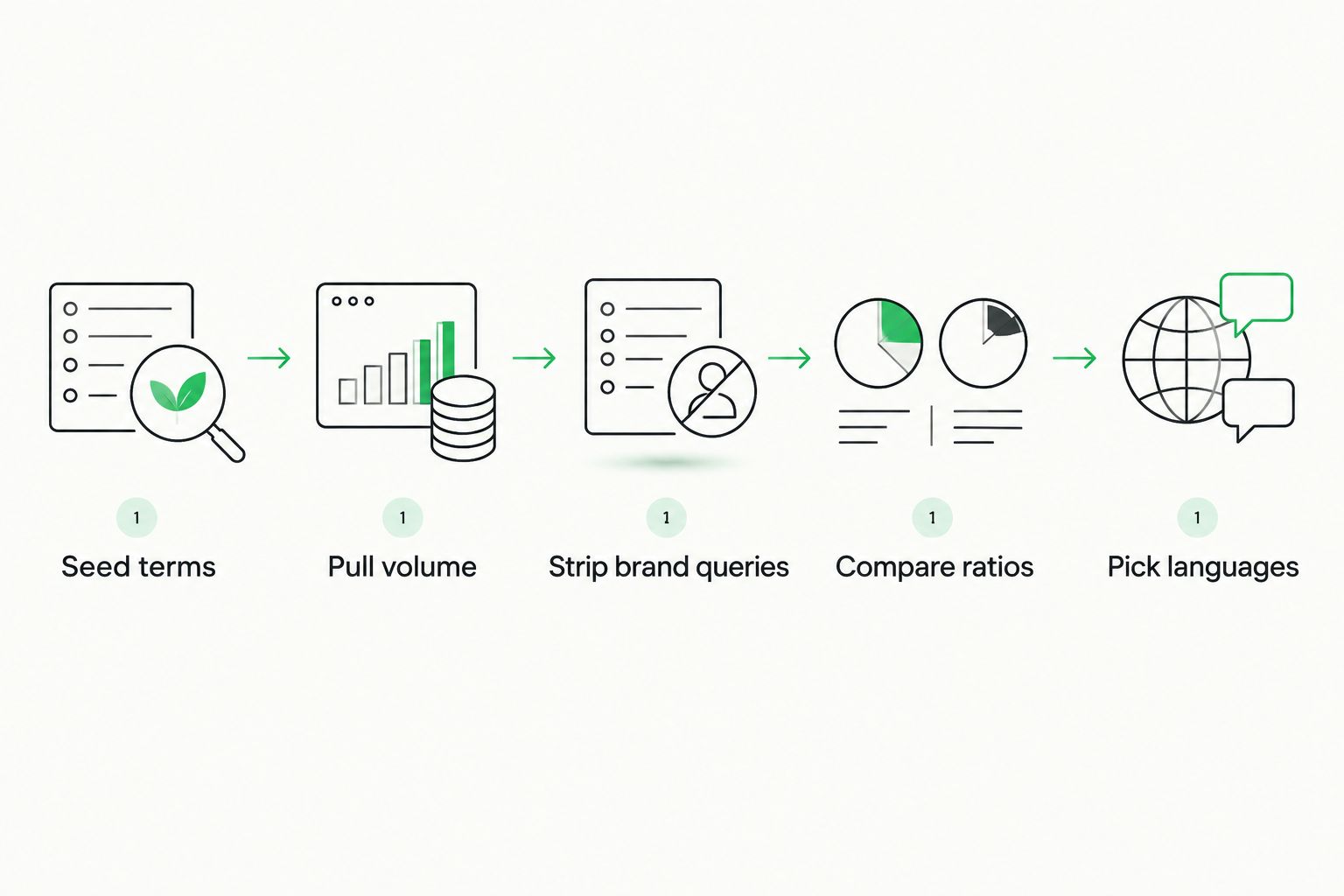
Rank by volume per competing page, not by raw volume.
Country-level pulls matter most for Portuguese, Spanish and Arabic, where one language covers many distinct markets. A Spanish pull for Spain tells you little about Mexico.
Scoring worksheet
Fill one row per language-country pair, using your own exports.
Monthly volume for the core keyword
- Source: Keyword Planner or a third-party tool
- How to use it: Your base demand figure
Service-intent share
- Source: Manual review of the top queries
- How to use it: Drop tool and person queries
Strong competing pages
- Source: First results page for the core keyword
- How to use it: Fewer means easier entry
Your existing impressions
- Source: Google Search Console, last 28 days
- How to use it: Shows demand you already earn
Volume per competing page
- Source: Calculated
- How to use it: The ranking score
Search Console is the benchmark that is yours. If you already earn impressions in a language you never targeted, that language moves up the list before any third-party number does.
How to use these benchmarks
- Start with ratio, not volume. A language with modest volume and weak competition beats a crowded head term.
- Localize two or three languages, not ten. Each language adds review and upkeep cost that compounds with every update.
- Lock terminology before you scale. Keyword forms such as traducción and traduction need glossary entries so every page uses the term you chose to rank for.
- Re-pull every quarter in 2026. Tool volumes shift, and a market that was weak in January can open by midyear.
Once you have your top languages, the work becomes operational: reusing approved translations, tracking cost per language and keeping quality consistent. A translation management system handles that. See the best translation management systems for how the options compare, or the guide to translation cost tracking software if budget per language is your first constraint.
Verdict: Wxrks is best for teams that have ranked their languages and now need translation memory, glossaries and cost tracking running together. It is not a keyword research tool, so pull the volumes elsewhere first.
Localize your top languages
Automate translation memory, glossaries and quality checks.
FAQ
What is the translation search volume by language in 2026?
No single published figure covers it. Volume depends on the tool, country and keyword form, so pull your own per country and compare ratios rather than raw numbers.
Which language has the highest translation search volume?
It depends on the tool and country scope, and raw volume is distorted by free-tool queries. English and Russian head terms are the noisiest, so rank by service-intent volume instead.
What is the best keyword for translation in Spanish?
Traducción is the core term. Pull traduccion without the accent too, since many users type it that way and tools count them separately.
Should I research by language or by country?
By country. One language spans several markets, so a Spanish or Portuguese pull for one country says little about another.
Does Chinese need one keyword set or two?
Two. Simplified 翻译 and traditional 翻譯 are different keyword sets, and each serves different markets.
Is search volume enough to choose a localization language?
No. Volume shows what people type, not what they buy. Weigh service intent and competing pages, and check your own Search Console impressions.
How often should I refresh translation keyword research?
Every quarter in 2026. Tool volumes change, and a market that looked weak earlier in the year can open later.
One last thing
Check your own Search Console country report before you buy any keyword data. If a language already sends you impressions without a localized page, you have a ranked demand signal that no benchmark table can match.
Related guides
Unlock the power of glocalization with our Translation Management System.
Unlock the power of
with our Translation Management System.